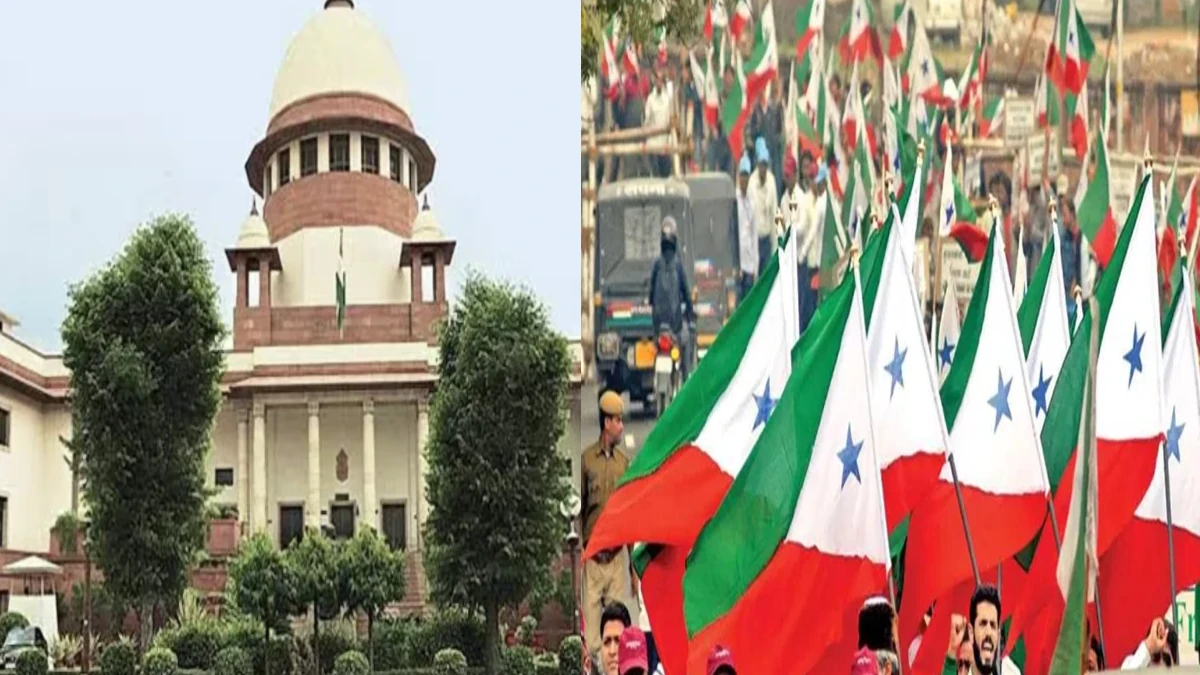
The Supreme Court has set aside a Bombay High Court judgment granting default bail to two accused in a case involving alleged unlawful activities of the Popular Front of India (PFI), holding that the High Court had wrongly treated the investigation as complete when analysis of electronic evidence was still pending.
A Bench of Justices Prashant Kumar Mishra and Shree Chandrashekhar delivered the judgment on September 21 in State of Maharashtra v. Momin Moiuddin Gulam Hasan alias Moin Mistri. It upheld the additional 15 days granted to Maharashtra’s Anti-Terrorism Squad (ATS) for filing the chargesheet and directed Momin to surrender within 30 days, while leaving him free to seek regular bail. The other respondent, Asif Aminul Hussain Khan Adhikari, died during the pendency of the appeal.
The case arose from an FIR registered by the Mumbai ATS in September 2022. According to the prosecution, PFI members, including the respondents, were spreading hostility towards Hindus and planning activities against India’s sovereignty. The prosecution alleged a conspiracy involving foreign assistance to establish an Islamic State in India.
The judgment records that investigators found a document titled “India-2047-Towards Rule of Islam in India” on a co-accused’s mobile phone. Fifteen mobile handsets, eight laptops and other electronic devices were seized for forensic examination. These form part of the prosecution’s case; the Supreme Court’s decision concerns the legality of the investigation period and default bail, rather than a determination of guilt.
Following the respondents’ arrest on September 22, 2022, the Special Judge initially extended the investigation period by 30 days. A further 15-day extension was granted on January 18, 2023. The chargesheet was filed on February 2, within that extended period.
The accused challenged the second extension. Their contention was that the investigation had already concluded and additional time was being sought merely to obtain government sanction for prosecution. Accepting this position, the Bombay High Court held that the extension was invalid and that the accused had consequently acquired a right to default bail.
The Supreme Court found that this approach overlooked the work that remained to be done. The ATS had sought time to analyse material retrieved through the forensic laboratory, examine its connection with the alleged activities and assess financial transactions. Receipt of forensic material did not, by itself, mean that the investigation was over.
The Bench held that analysing the retrieved data was itself part of the investigation. The investigating agency had to explain how the material recovered from electronic devices, and the movement of money through bank accounts, connected the accused with the alleged offences. The High Court’s discussion of sanction, the Supreme Court found, had diverted attention from these stated grounds for seeking more time.
The Court also acknowledged that default bail is a facet of the fundamental right to personal liberty under Article 21. Under the UAPA, however, the court may extend the investigation period upon satisfaction with the Public Prosecutor’s report explaining its progress and the specific reasons for continued detention.
In this case, the Supreme Court held the extension lawful, reversed the High Court’s July 15, 2024 judgment and dismissed the default-bail application. Momin’s right to apply for regular bail remains open.