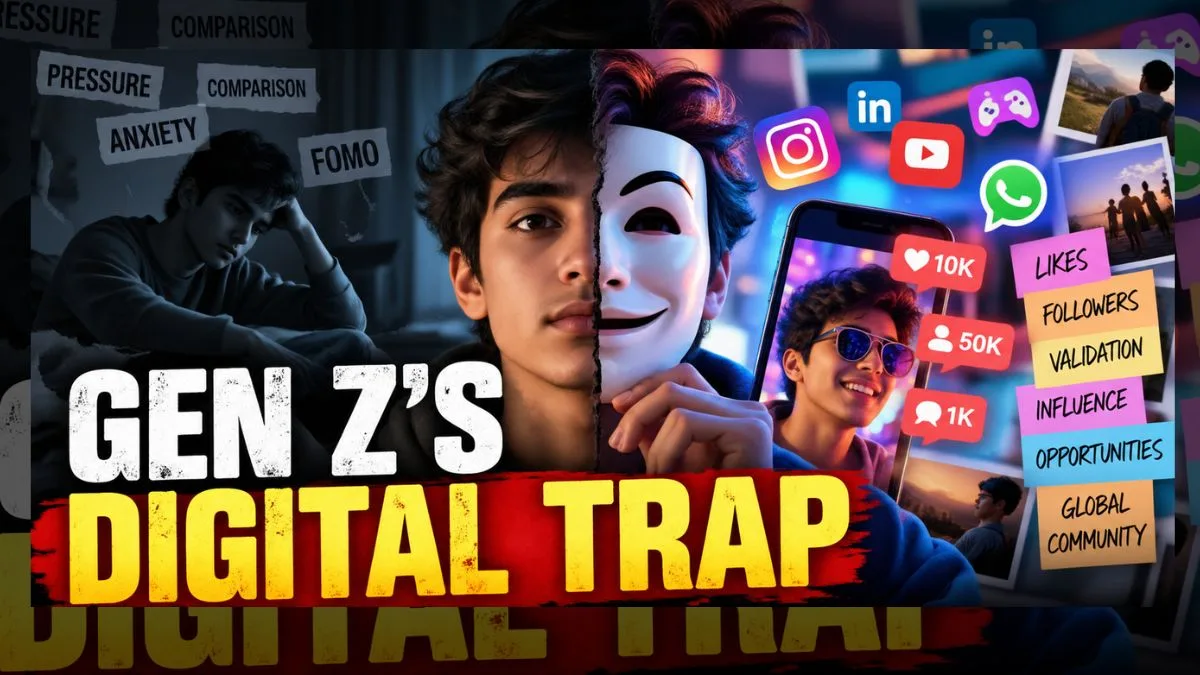
For Gen Z, the digital world is not a separate world—it is woven into everyday life. Social media, online communities, gaming platforms and digital networks have become spaces where young people express themselves, build relationships, discover opportunities and form opinions. In many ways, the digital identity of a young person has become an extension of the identity they carry in the physical world.
A photograph on Instagram, a professional profile on LinkedIn, a gaming username, a comment on YouTube or even a WhatsApp status can communicate something about who a person is—or who they want others to believe they are. Just give a thought to the points to what Gen-Z are after-
1. The Self We Present
Young people often carefully select what they share online. Achievements, celebrations, travels and attractive photographs naturally receive more attention than failures and struggles. A student may proudly display a successful project while leaving out the many unsuccessful attempts behind it. Gradually, the curated online self can become quite different from the person’s complete reality.
2. Many Identities, One Person
Gen Z often moves comfortably between different digital spaces. LinkedIn may reveal the professional self, Instagram the creative or social self, and a gaming platform the playful self. These are not necessarily false identities; rather, they are different windows into the same person.
3. The Permanent Digital Footprint
The internet has a long memory. A careless comment, photograph or video posted at seventeen may resurface years later before a college, employer or professional community. The simple wisdom “Think before you post” therefore becomes increasingly important.
4. The Search for Validation
Likes, views, shares and followers provide immediate feedback. A viral post can create excitement and confidence, while an ignored post may create disappointment. Yet popularity is not the same as worth. A person’s value cannot be measured by an algorithm.
5. Influencers and Aspirations
Influencers can shape what young people admire, purchase and aspire to become. A student exposed to coding content may discover programming; another may find inspiration in fitness, art or entrepreneurship. The influence can be constructive, provided young people learn to question, verify and think independently.
6. Communities Without Borders
The digital world also creates remarkable opportunities for belonging. Someone interested in Sanskrit, robotics, classical music or environmental conservation can find like-minded people across geographical boundaries. Technology can therefore connect individuals who might otherwise never meet.
7. From Expression to Activism
Social media gives Gen Z a powerful voice. Young people can spread awareness, organise campaigns, raise funds and bring attention to social causes. A simple online initiative to reduce plastic use, for example, can inspire action in the physical community.
8. The Danger of the Digital Crowd
The same connectivity can also create misinformation, herd behaviour, trolling and online outrage. A person may share a sensational claim simply because everyone else is sharing it. When emotion travels faster than verification, disagreement can quickly become condemnation. This is one of the environments in which cancel culture can emerge.
9. The Question of Authenticity
The real challenge is not whether Gen Z should have a digital identity—they inevitably will. The deeper question is: Does that identity reflect responsibility, authenticity and values?
The digital world can either become a mirror that reflects our best qualities or a mask that hides them.
Gen Z’s digital identity carries both opportunity and responsibility. Technology can provide self-expression, community and knowledge, but it also demands critical thinking, privacy, empathy and restraint.
Use technology to express yourself, not to lose yourself.