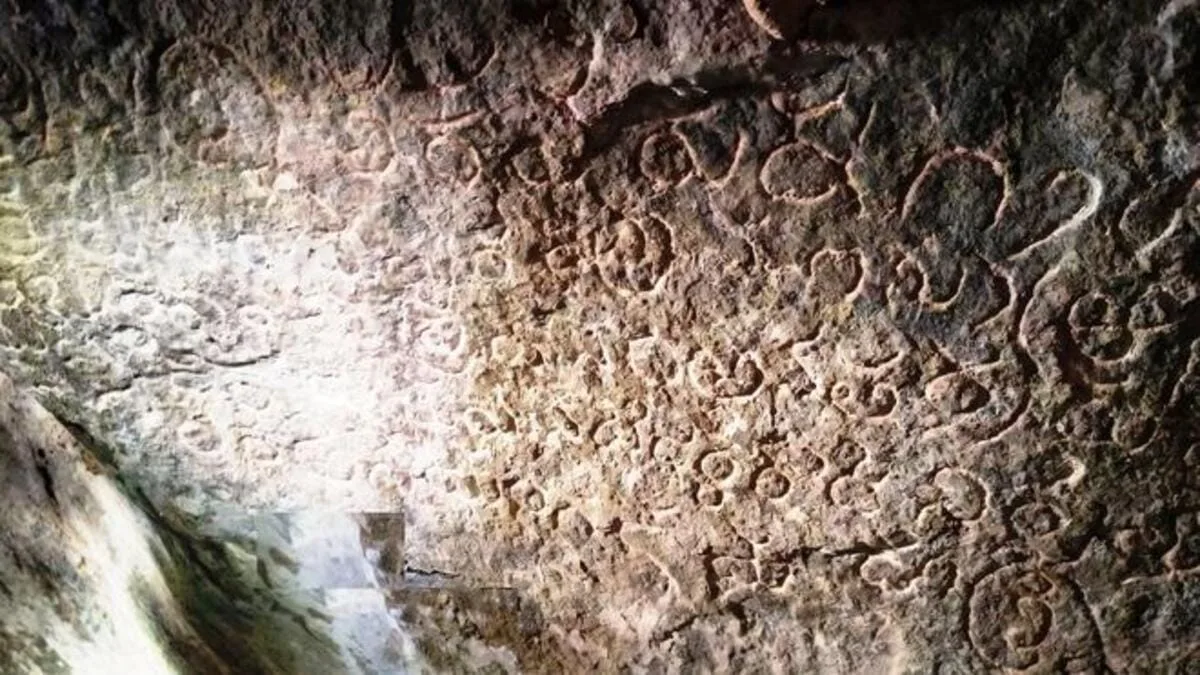
SRI SATHYA SAI: An ancient stone inscription discovered at the Sri Naga Lingeshwara Swamy Mandir atop Penukonda hill in Andhra Pradesh’s Sri Sathya Sai district has shed light on a 662-year-old chapter of Vijayanagara history. The inscription reveals that the shrine was commissioned by Anantharasu Chikka Odeyar, who served as Prime Minister during the reign of Vijayanagara Emperor Bukka Raya I.
Penukonda, which served as the second capital of the Vijayanagara Empire, is home to several historic structures, including the hilltop shrine where the inscription was discovered. Historian MyNaa Swamy said the epigraph dates back to the reign of Bukka Raya I, who ruled from 1356 to 1377 CE.
Speaking to the media on September 21, 2026, Swamy said members of the Vishwa Hindu Parishad’s Penukonda chapter discovered the dilapidated shrine while ascending the hill through its rugged northern and western approaches. During their search, they noticed an inscription carved into a large boulder within the temple premises and subsequently sent photographs to historians for decipherment.
Written in an ancient Kannada-Telugu script, the inscription begins with the phrase “Svasti Sri Saka Varusha 1285” and concludes with “Mangala Maha Sri”. According to Swamy, the epigraph records that Anantharasu, who served as Prime Minister under Bukka Raya I, consecrated the Shiva Linga on Sunday, July 16, 1363 CE. The date corresponds to Saka 1285, Shravana Shuddha Panchami, which coincided with Naga Panchami.
The inscription also refers to a sacred water body constructed alongside the shrine, locally known as Nagula Bavi, or the “Well of Serpents”. Further evidence supporting the reference was found in an intricate sculpture at the site depicting eight Naga Kanyas worshipping Bhagwan Shiva.
The discovery provides fresh evidence about the religious and architectural activity in Penukonda during the early Vijayanagara period. Historian MyNaa Swamy and his team have urged the Andhra Pradesh State Endowments Department to undertake preservation and restoration measures to protect the historic shrine and its associated heritage structures.