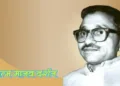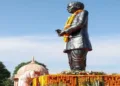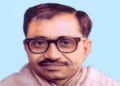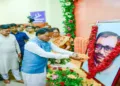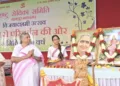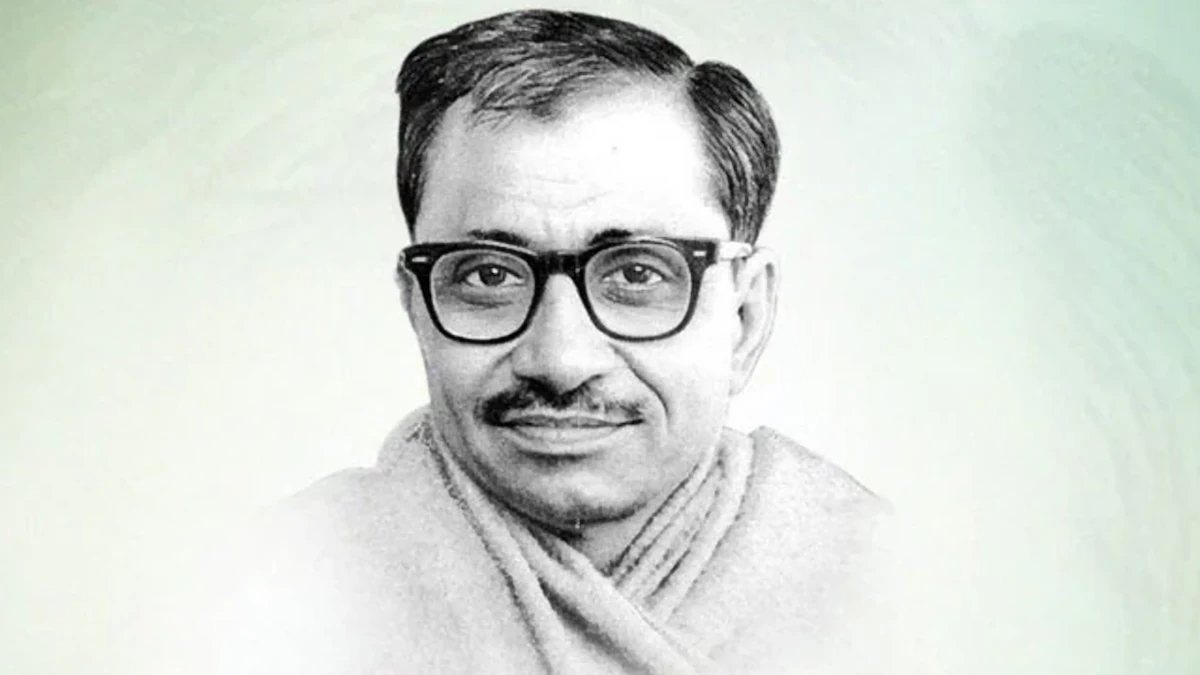
Every year on 25 September, India observes Antyodaya Diwas. The date marks the birth anniversary of Pandit Deendayal Upadhyay, and more importantly, it renews a quiet but radical idea he placed at the centre of public life: that a nation’s true progress is measured by the well-being of the person standing at the very end of the line.
In 2015-16, while researching a documentary on this remarkable thinker, I had the privilege of speaking with people who had either known him closely or studied him deeply. Their recollections, offered with affection and clarity, still illuminate why Upadhyay remains singular in India’s political landscape.
The late Shri V.K. Malhotra, veteran Jana Sangh and BJP leader admitted pride in the fact that he had worked under Upadhyay’s close tutelage for nearly sixteen years. Malhotraji spoke of a man of extraordinary simplicity and nearness. “The closer one went to him, the greater the respect and affection grew,” he recalled. Living in a modest room near Ajmeri Gate that doubled as the party office, Upadhyay treated every karyakarta as a near relation.
When Malhotra, as Chief Executive Councillor of Delhi, once opposed a measure that would raise food prices for the urban poor, Upadhyay gently corrected him: “You are not merely representing Delhi; you are the sole representative of the Jana Sangh there. Think of the entire country, including the farmer.” That sense of balance, neither urban nor rural exclusivity, defined him.
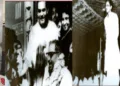
Among the closest relationships of those years was the one he shared with Atal Bihari Vajpayee. After Vajpayee entered Parliament, Upadhyay often stayed at his residence. The two complementary figures, one the organisational and ideological backbone of the Jana Sangh, the other its eloquent parliamentary voice, worked in quiet harmony.
Upadhyay’s rigorous clarity of thought and Vajpayee’s gift of communication formed a rare partnership that strengthened the young party. When Upadhyay’s body was brought to Delhi after the tragedy at Mughalsarai, it was to Vajpayee’s house on Ferozshah Road that it was taken. From there the long, emotional funeral procession began its slow journey to Nigambodh Ghat. The image of that shared grief remains etched in the memory of those who witnessed it.
Professor Rakesh Sinha, the academician and former nominated Rajya Sabha member who teaches at Motilal Nehru College, Delhi University, describes Upadhyay as the tallest figure of the Jana Sangh precisely because he gave the movement both an organisational spine and a philosophical foundation.
“He changed the dimensions of political life,” Sinha notes. While others sought power, Upadhyay insisted that politics must be rooted in values. When five Jana Sangh MLAs in Rajasthan opposed the abolition of zamindari, he expelled them. Numbers mattered less than principle. His Integral Humanism rejected both the one-dimensional maximisation of capitalism and the coercive collectivism of communism. Man, he taught, is an integrated whole, body, mind, intellect and soul, situated within society, nature and the divine. Policies must therefore begin with the last person, the one whose feet are cracked and who has known neither education nor ease. This is Antyodaya.
In 1951–52, when the Bharatiya Jana Sangh was born, Deendayal became its organisational spine. Dr Syama Prasad Mookerjee is said to have remarked that if he had three more Deendayals, he could change the map of the country. For fifteen years Deendayal served as general secretary, living in a modest room near Ajmeri Gate in Delhi that doubled as party office.
Presidents came and went; the work remained his. He built the party not through caste arithmetic or patronage but through patient organisation and an idea that refused both capitalist concentration of wealth and communist concentration of power. Kalyani Shankar, the senior political commentator and former Political Editor of the Hindustan Times, remembers him as the quintessential pracharak, simple living, high thinking.
She highlights the Jaunpur by-election, where Upadhyay, a Brahmin candidate in a seat the party considered winnable, refused to mobilise votes on caste lines. “If anyone seeks votes in the name of my caste, I will withdraw,” he declared.
He lost the election and celebrated the defeat of the method rather than mourn the personal setback. “The ideology has won,” he told workers. That refusal to compromise remains one of the purest expressions of his politics.
M.J. Akbar, the veteran journalist and author, places Upadhyay in a generation for whom idealism and politics were inseparable. A gold medallist who could have entered the administrative services, Upadhyay chose a life of deliberate austerity. His greatest contribution, Akbar argues, was in the realm of ideas. Integral Humanism provided the intellectual foundation for a polity that places the human being, not caste, creed or class, at the centre. Akbar sees its imprint in contemporary schemes that seek to financially empower the smallest entrepreneur and bring the unbanked into the formal system. These are modern expressions of the same impulse: to reach the person at the end of the line.
Dr Mahesh Chandra Sharma, the scholar who has edited the multi-volume complete works of Deendayal Upadhyay and served as Chairman of the Research and Development Foundation for Integral Humanism, explains the philosophy with precision.
Western thought, he notes, split the individual from society. Upadhyay restored their unity. Man is neither pure individual nor pure collective; he is the integrated whole of vyashti, samashti, srishti and parmeshti. Any policy that ignores this completeness remains incomplete. Antyodaya is not charity; it is the starting point of genuine development that ultimately leads to Sarvodaya.
Subramanian Swamy, the economist and long-time political figure, recalls the practical genius of the man. Upadhyay’s ability to find common ground enabled the improbable coalitions of 1967 that shook the Congress monopoly in several states. His simplicity disarmed even ideological opponents.
“He was not a traditional Indian politician,” Subramanian Swamy told me. “He did not deal in caste arithmetic. He was a scholar with perspective.”
It was at the historic Calicut session of the Bharatiya Jana Sangh in 1967 that Upadhyay, newly elected president, delivered an address that stunned political opponents and expanded the party’s horizons. He called upon the RSS and Jana Sangh to take the lead in the trade-union movement, declaring that the fight for equality was not the monopoly of any single ideology.
He spoke of an inclusive Indian nationalism in which Muslims and Christians were Mohammadi Hindus and Christi Hindus, full participants in the civilisational legacy of the land. The speech projected a larger constituency for the Jana Sangh, one capable of drawing support beyond traditional bases and challenging the established order. Many who heard it believed that, had he lived longer, it would have transformed the party’s trajectory.
Barely three months later, on 11 February 1968, Upadhyay’s body was found near the railway tracks at Mughalsarai. He was only fifty-one. The circumstances remain contested. Nearly forty-six years later, in September 2014, his family publicly appealed to Prime Minister Narendra Modi for a thorough probe. His niece Madhu Sharma, president of the Deendayal Smriti Manch, said the family had never overcome the grief.
“Both his younger brothers and sister want the reality behind the murder of Panditji to come out,” she stated. She recalled that after the death, family members faced threats and were forced to withdraw earlier efforts.
“In Modi, we see a man who has the courage to let the country know who killed my uncle.” The earlier Chandrachud Commission had left questions unanswered. The family’s request remains a quiet, persistent reminder that some truths still await full light. What emerges from the conversations and the historical record is a portrait of rare coherence. Upadhyay was organisational genius and original thinker in one. He built a party from almost nothing yet never sought personal office until the very end.
He lived the values he preached, washing his own clothes, travelling light with books as his heaviest luggage, remaining accessible to the humblest worker. When he died, the spontaneous outpouring of grief across political lines revealed how deeply he had touched people. On this Antyodaya Diwas, his message remains urgent. In an age still tempted by the extremes of unbridled markets and coercive state control, Integral Humanism offers a third way rooted in India’s civilisational wisdom.
Progress is not complete until it reaches the last person. Institutions and schemes may carry his name; the deeper task is to carry his spirit, of simplicity, integrity, and unwavering focus on the poorest. They do not make politicians like that anymore. Yet the idea he left behind continues to ask the quiet, demanding question of every generation: What have we done for the one at the end of the line?