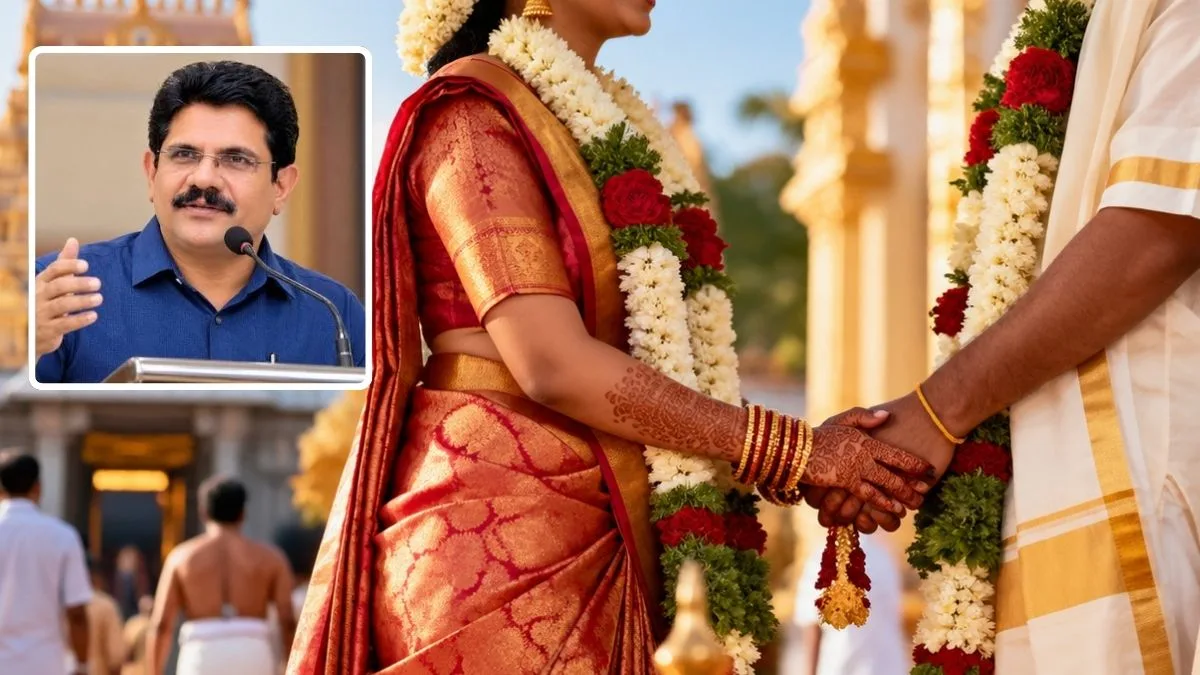
KOCHI: The Vishva Hindu Parishad’s Kerala unit is pushing a set of social reforms aimed at encouraging marriages across caste boundaries, by reducing dependence on horoscope matching and making temple practices more accessible to younger devotees. The organisation says that the measures are intended to address difficulties faced by young Hindus in finding suitable partners, along with emerging demographic concerns within the community in Kerala.
The decisions were taken at a state-level meeting of the VHP in Kochi on September 21, Monday, with the organisation identifying caste restrictions and horoscope compatibility as two factors that can narrow the pool of prospective brides and grooms and thereby delay marriages. VHP Kerala State General Secretary Advocate Anil Vilayil said that the problem was particularly pronounced among smaller Hindu communities, where prospective partners are often sought within increasingly narrow caste and sub-caste groups.
“Youths in microscopic Hindu communities find it difficult to get a suitable partner from their own communities. Hence, we have decided to promote marriages that break caste barriers”, Vilayil said. The organisation is also now preparing to launch an online matrimonial platform that will allow Hindu youths to seek partners without caste being used as a primary filter. Horoscope compatibility or jathaka porutham, will also not be treated as a determining factor.
VHP Plans caste-neutral matrimonial platform
According to Vilayil, Kerala’s Hindu society includes several communities that are further divided into smaller sub-groups. He cited the Viswakarma community, which includes traditional divisions such as Thattan, Kollan, Asari and Moosari, as one example of how the pool of prospective partners can become restricted when marriages are sought strictly within caste or sub-caste boundaries. While larger communities such as Nairs and Ezhavas have relatively sizeable populations, the VHP argues that young people from smaller communities can face greater difficulties in finding suitable matches. The organisation says its assessment is based partly on feedback received through its grassroots network.
Vilayil said that the VHP has units in more than 200 of Kerala’s 220 Prakhand areas, with around 1,500 local committees operating below them. Horoscope matching is another practice that the organisation wants to move away from as a deciding factor in marriage. Vilayil said families sometimes abandon otherwise suitable proposals after astrologers identify a dosham or insufficient compatibility between horoscopes. The VHP, however, has clarified that it is not seeking to oppose astrology or astrologers. Its position is that horoscope compatibility should not prevent two otherwise compatible adults from marrying.
The proposed matrimonial platform is expected to focus instead on factors such as education, occupation, income and broadly comparable socio-economic backgrounds. The organisation has said that removing caste as a filter should not mean ignoring other aspects of compatibility. The service is also expected to be offered free of charge, distinguishing it from commercial matrimonial platforms. The VHP links the initiative to concerns over Kerala’s demographic trends. According to state government data cited by the organisation, 344,766 births were registered in Kerala in 2024, of which 135,753 were to Hindu mothers, accounting for around 39 per cent of registered births. The 2021 Census recorded Hindus as constituting about 54 per cent of Kerala’s population. Vilayil attributed the declining birth rate among Hindus, in part, to delayed marriages and argued that reducing barriers to marriage could contribute to more timely marriages.
VHP is pointing to birth and death figures as a warning sign
Underneath VHP’s push for more marriages sits a deeper worry inside the group about what they see as a falling Hindu population in Kerala. Vilayil referred to official vital-statistics numbers from the state’s Department of Economics and Statistics. He said the organisation is troubled that the number of registered deaths among Hindus has now climbed higher than the number of births, while the trend among Muslims looks quite different. The VHP’s thinking is that if marriage becomes simpler and some of the usual obstacles are cleared away, more people will eventually get married—and that, in turn, should lead to more births over time.
They’re launching a “caste-less” matrimonial app. Their most practical step is a new matchmaking app that drops caste and horoscope as the main filters. Vilayil was careful to explain that “caste-less” doesn’t mean ignoring every other kind of compatibility. The platform will instead put much more weight on things like education, income, job, and roughly similar socio-economic backgrounds. He gave an example: if you simply match people from completely different educational and economic worlds just to get rid of caste, you can still end up with serious compatibility problems. So the VHP wants to shift the whole focus of matchmaking away from caste and horoscopes and toward social, educational and economic fit. They also plan to keep the service free, setting it apart from the usual commercial matrimonial sites.
Temple Reforms to Make Worship More Accessible to Younger Devotees
The organisation’s reform agenda extends beyond matchmaking and marriage. The VHP has also decided to campaign against the practice in several Kerala temples that requires male devotees to remove their shirts before entering the sanctum or temple premises. Vilayil said that the practice could discourage younger devotees, particularly those who may wish to visit temples during their daily routines or while travelling to and from work.
“Wearing an upper garment should not be a barrier to temple entry”, he said, adding that the VHP believes reforms are necessary to bring younger generations closer to temples. The organisation said men would henceforth be allowed to enter the more than 200 temples under its control while wearing upper garments. Vilayil also pointed to temples such as the Pavakkulam Mahadeva Temple in Kochi, where men can worship without removing their shirts. The VHP is also seeking the support of the Thantri Samajam and other traditional temple authorities for the broader adoption of the practice.
Vilayil referred to a 2023 meeting of Hindu clerics in Thrissur that had recommended reconsidering the requirement. Alongside the marriage and temple reforms, the VHP plans to expand its Kudumba Prabodhan initiative, including premarital counselling for couples and efforts to discourage extravagant spending on weddings. Ashok Singhal Ji Kudumba Prabodhan Kendra is scheduled to be inaugurated in Ernakulam on October 2, according to Vilayil.