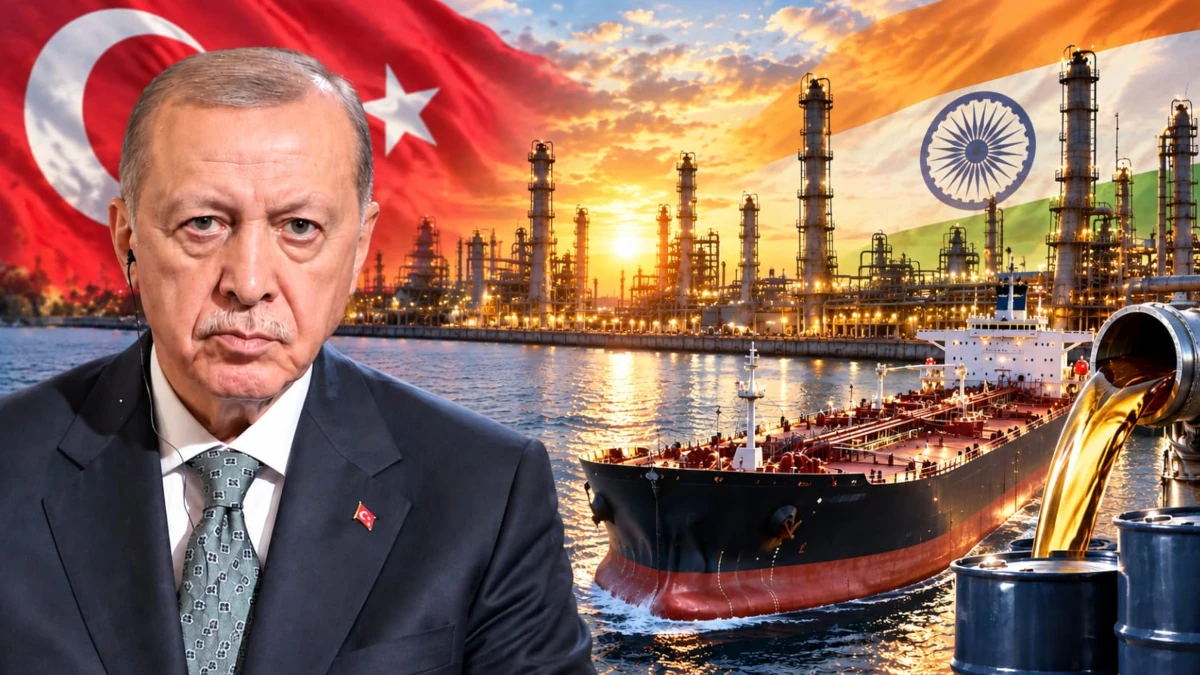
NEW DELHI: Turkey, a key US ally and NATO member, has sharply increased its purchases of diesel from India, with Indian shipments reaching a record level in August 2026 as Russian supplies to the Turkish market fell dramatically.
The surge comes at a politically sensitive moment for New Delhi, with US President Donald Trump stepping up pressure on countries maintaining energy ties with Russia and signing new legislation that gives Washington expanded powers to impose unilateral tariffs on countries purchasing Russian-origin oil and gas.
According to commodities data firm Kpler, Turkey imported more than 120,000 barrels per day (bpd) of Indian diesel in August, while imports from the United States reached about 90,000 bpd. Both were the highest monthly levels in Kpler’s records dating back to 2017. By contrast, Turkish imports of Russian diesel fell to around 80,000 bpd in August, from more than 200,000 bpd during earlier months of 2026.
The figures underline a significant change in Turkey’s fuel-supply pattern. Russia supplied about 85 per cent of Turkey’s diesel imports in 2025, equivalent to roughly 281,000 bpd, according to Turkey’s Energy Market Regulatory Authority. But Russian diesel exports were restricted after Ukrainian attacks disrupted Russian refineries and domestic fuel supplies. Russia’s share of Turkey’s diesel imports consequently fell to about 20 per cent in August.
Trump’s Russia tariff threat puts India’s refined-fuel trade in focus
The shift in Turkey’s diesel sourcing comes just days after President Donald Trump signed the Lindsey O. Graham Sanctioning Russia and Iran Act of 2026 into US law on September 18. The legislation expands the US president’s authority to impose unilateral sanctions and tariffs, potentially reaching 100 per cent, on goods from countries that continue purchasing Russian-origin crude oil or natural gas.
The timing is significant because India has remained a major buyer of Russian crude while simultaneously expanding exports of refined petroleum products. Kpler data showed Indian Russian-crude imports reaching around 2.73 million bpd in June 2026, among the strongest monthly levels recorded. Reuters has also reported that India’s refined-product exports have risen sharply as global supply disruptions create demand for diesel and other petroleum products.
India’s position is linked to its enormous refining capacity. Indian refiners import crude from multiple international sources, process it domestically and export finished products such as diesel and petrol according to global demand, pricing, freight costs and supply availability. Therefore, the diesel sold by India to Turkey is a refined petroleum product traded in the international market rather than a direct shipment of Russian crude.
The expansion of India’s refined-product exports has become particularly visible in 2026. According to Crisil Intelligence, India’s petroleum exports grew 46 per cent year-on-year between April and August 2026, helping drive overall merchandise-export growth of 18.8 per cent.
Russia’s diesel decline pushes Turkey towards Indian refiners
The immediate reason for Turkey’s search for alternative diesel supplies is the disruption to Russian and West Asian fuel flows. Russian diesel exports were restricted following attacks on refineries, while war-related damage to West Asian refineries and disruption to shipping through the Strait of Hormuz have further tightened the global refined-fuel market. Reuters reported that Turkey’s Russian diesel imports fell from more than 200,000 bpd earlier in 2026 to around 100,000 bpd in July and 80,000 bpd in August.
India has consequently emerged as a major replacement supplier. While Kpler estimates Indian shipments at more than 120,000 bpd.
The long-term trade figures also show that India’s role in the Turkish diesel market has fluctuated. India exported 562,421 tonnes of diesel to Turkey in 2025, making it Turkey’s third-largest supplier after Russia and Egypt. Exports stood at 397,761 tonnes in 2023 and 330,990 tonnes in 2022, while the 2021 figure was substantially higher at about 2.71 million tonnes.
The political dimension extends beyond the oil market. Turkey has maintained close strategic ties with Pakistan and backed Islamabad during India’s anti-terror operation Sindoor in Pakistan in 2025 . Turkey expressed solidarity with Pakistan during Operation Sindoor, which India launched in response to the April 22, 2025 Pahalgam terror attack.
In August 2026, Turkey, Pakistan and Saudi Arabia signed the Makkah Joint Defence Agreement, under which an armed attack on one member is to be regarded as an attack on all three. The pact was signed in Makkah by Turkish President Recep Tayyip Erdogan, Saudi Crown Prince Mohammed bin Salman and Pakistani Prime Minister Muhammad Shehbaz Sharif. Pakistani officials and commentators have referred to the arrangement as a new Islamic or NATO-like security framework.
India becomes a key alternative as global fuel routes shift
Turkey’s August diesel purchases therefore present an unusual geopolitical picture. A country closely aligned with the United States through NATO is simultaneously increasing its purchases from India, while India remains under unilateral US pressure because of its continued Russian oil trade.
For Turkey, the immediate calculation is fuel security. Russian diesel supplies have fallen, West Asian routes remain vulnerable and the global refined-products market is tight. For India, the shift demonstrates the strength of its refining sector and its ability to convert internationally sourced crude into refined products for markets facing shortages.
The US pressure over Russian oil adds another layer to the trade. Washington is seeking to use tariffs and sanctions to reduce the economic benefits flowing to Russia, while India continues to argue that its energy purchases are driven by national economic interests and energy security.
The August numbers show how global energy markets can produce unexpected trade routes. As Russian diesel availability in Turkey declines, Indian refiners are filling part of the gap. The result is a rapidly changing fuel market in which Russia, India, Turkey and the United States are increasingly connected through the politics and economics of global energy flows.