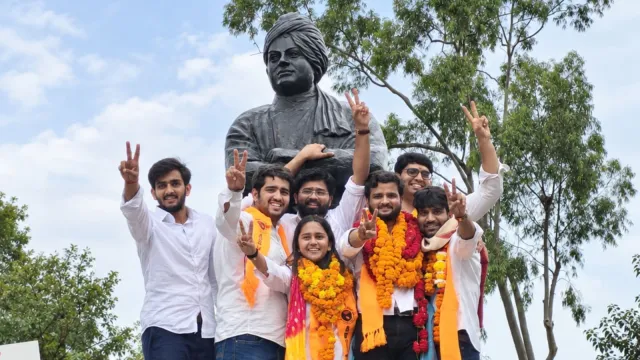
The Delhi University Students’ Union (DUSU) election results have put the focus back on the gap between national-level youth campaigns, student movements and voting inside university campuses.
The Akhil Bharatiya Vidyarthi Parishad (ABVP) won three of the four central-panel posts. Yash Dabas was elected president, Riya Chhawdi won the secretary’s post and Lakshya Raj Singh secured the joint-secretary position. Independent candidate Deepanshu Shokeen, a former NSUI member, won the vice-president’s post.
The results came weeks after the Cockroach Janta Party (CJP)-led student protests over examination-related issues and amid Congress leader Rahul Gandhi’s ‘Chhatron Ki Goonj’ programme aimed at engaging with students and raising youth-related concerns.
ABVP takes three central posts
The presidential contest remained close through the counting process. After 20 rounds, ABVP’s Yash Dabas defeated NSUI’s Vijay Shankar Meena.
Dabas received 24,576 votes, while Meena secured 22,523 votes, giving the ABVP candidate a margin of 2,053 votes.
Riya Chhawdi won the secretary’s post with 21,650 votes, while Lakshya Raj Singh won the joint-secretary election with 16,615 votes, according to election reports.
The vice-president election produced a different result. Independent candidate Deepanshu Shokeen won with 30,615 votes, defeating ABVP’s Ishu Maurya and NSUI’s Vir Chatrath.
The overall voter turnout was 40.46 per cent, with more than 1.51 lakh students eligible to vote.
What about Rahul Gandhi’s ‘Chhatron Ki Goonj’?
Rahul Gandhi held the ‘Chhatron Ki Goonj’ programme in Indore on September 19, where he spoke about students, youth participation and what he described as problems with the existing political system. Reports said the programme drew a significant student presence.
The DUSU results, however, cannot by themselves establish whether the programme influenced student voting in Delhi. The DUSU election was a separate university-level contest involving individual candidates, student organisations and campus-specific issues.
NSUI, which is affiliated with the Congress, did not win any of the four central-panel posts this year.
CJP protests had put student issues in focus
The Cockroach Janta Party (CJP) had led a prolonged student agitation in Delhi during June and July over examination-related issues and demands for reforms.
The protests became a significant part of the wider student debate ahead of the DUSU elections. Delhi University had also issued an advisory asking students and faculty to stay away from the CJP-led demonstrations, while university officials described the protests as having political dimensions.
The CJP-led movement had sought greater accountability over examination issues and called for reforms in the education system.
CJP responds to DUSU results
After the results, CJP chief spokesperson Saurav Das offered a different interpretation of the outcome.
Das argued that the results reflected a divided opposition vote and said the ABVP victory should not be interpreted as support from a majority of students. He also questioned the Congress’s handling of its student organisation and raised concerns about divisions among Left student groups.
These are CJP’s political interpretations of the result, rather than an independently established explanation for why students voted the way they did.
Campus issues vs wider political campaigns
The DUSU election campaign focused on issues directly affecting students, including campus safety, hostel accommodation, infrastructure, food, transport and student welfare.
ABVP’s previous DUSU report card had highlighted issues such as campus safety, affordable food, transportation and internships.
At the same time, the election featured broader political debates involving the CJP protests, examination reforms and the competing national narratives of Congress, BJP-linked student politics and Left student organisations.
Independent candidate adds another dimension
While ABVP won three posts, Shokeen’s victory in the vice-president election prevented a complete sweep.
His result also highlighted the role of candidate-specific and independent campaigns in a contest traditionally dominated by major student organisations. The Indian Express reported that Shokeen’s win was the first independent victory for the vice-president post in two decades.