The C Joseph Vijay-led TVK government in Tamil Nadu has made the disclosure of assets and liabilities mandatory for government employees seeking promotion. The decision has received a positive response from members of the public, who say it could help curb rampant corruption in government offices. They view it as a positive measure that, although already prescribed in the rules, was not strictly enforced during the rule of Dravidian governments.
The Tamil Nadu govt has made it mandatory for all government employees to submit their annual statements of assets and liabilities pic.twitter.com/psMDCCEx5f
— Vasudha Venugopal (@Vasudha156) October 8, 2026
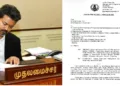
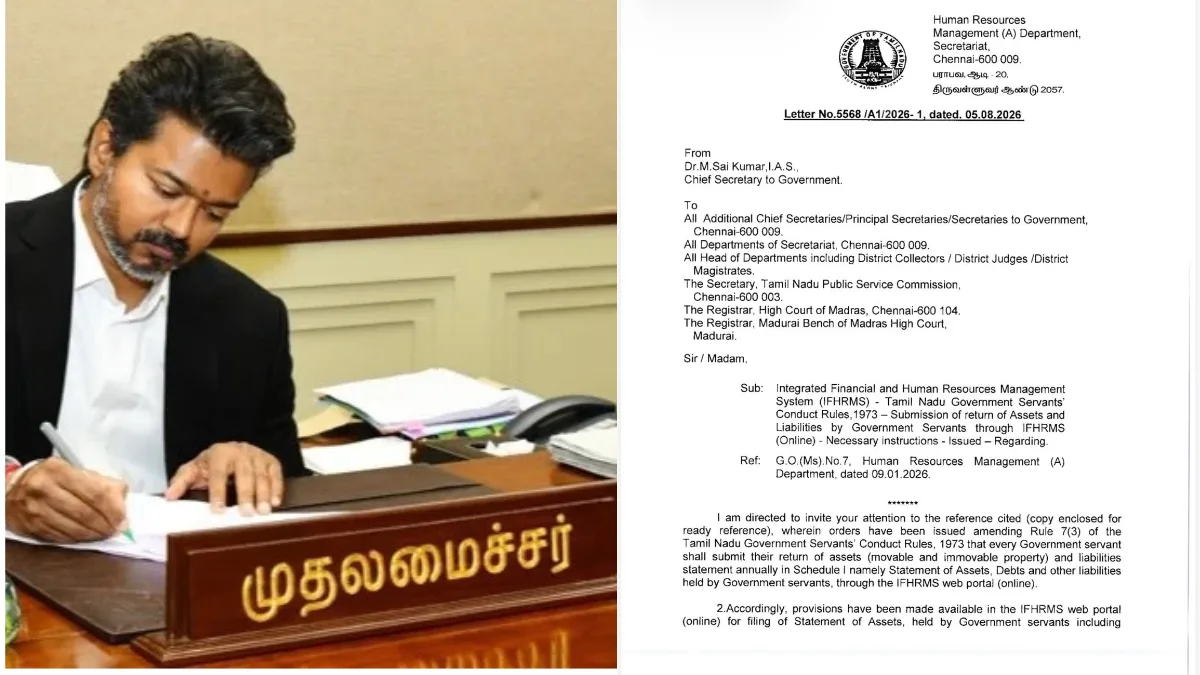
Tamil Nadu Chief Secretary Sai Kumar issued a circular on August 5 this year, directing government employees to disclose their properties, savings, investments and loans by October 31, 2026. It stated that properties purchased in another person’s name must also be disclosed, along with that person’s relationship to the government employee. Those who miss the deadline will be excluded from promotion lists and treated as having violated government conduct rules.
Uttar Pradesh Chief Minister Yogi Adityanath had earlier introduced a similar measure in the state.
No asset disclosure, no promotion for Tamil Nadu government employees
The state government has directed employees to declare their properties, savings, investments and loans by October 31
Even properties purchased in someone else's name must be disclosed, along with… pic.twitter.com/7jpdNPoNp9
— Nabila Jamal (@nabilajamal_) October 8, 2026
The circular stated that the details must be submitted through the Integrated Financial and Human Resources Management System (IFHRMS) portal by October 31. Employees who submit their property details within the stipulated deadline will be included in promotion panels, while those who fail to do so will be treated as having violated the conduct rules applicable to government servants. The declaration of assets has thus been made mandatory for employees seeking promotion.
Circular No. 5568/A/2026-1, dated August 6, was addressed to all Additional Chief Secretaries, Principal Secretaries, Secretaries to the Government, department secretariats, heads of departments, district collectors, district judges, district magistrates, the Secretary of the Tamil Nadu Public Service Commission, and the Registrars of the Madras High Court and its Madurai Bench.
The letter stated: “I am directed to invite your attention to the reference cited (copy enclosed for ready reference), where orders have been issued amending Rule 7(3) of the Tamil Nadu Government Servants’ Conduct Rules, 1973, stipulating that every government servant shall submit their annual return of assets (movable and immovable property) and statement of liabilities in Schedule I, namely, Statement of Assets, Debts and Other Liabilities held by Government Servants, through the IFHRMS web portal (online).”
The circular further stated: “I am therefore directed to request you to issue suitable instructions to all employees, except All India Service officers, under your administrative control to file the statement of assets and liabilities through the IFHRMS web portal for the calendar year ending 31st December 202[0] and complete it within three months, on or before 31st October 2026. After final submission, the employees can download the report of their assets and liabilities statement.”
Letter from CS https://t.co/AehVsoqtvx pic.twitter.com/kHez65g0vL
— Omjasvin M D (@omjasvinMD) October 8, 2026
Concluding the letter, the Chief Secretary said that all government employees should also be informed that, in future, they must submit statements of assets and liabilities held as of December 31 of every calendar year without fail.
In September 2026, the Directorate of Vigilance and Anti-Corruption (DVAC) arrested 15 Tamil Nadu government officials following 19 trap operations across the state. The officials were caught accepting bribes ranging from Rs 1,500 to Rs 7 lakh. Authorities seized Rs 13,78,207 in cash and detected Rs 1,59,70,459 in suspicious digital transactions.
The arrested personnel held various positions, including junior assistants, Village Administrative Officers (VAOs) and municipal engineers.
The DVAC has also initiated probes against former DMK ministers KN Nehru, Anbil Mahesh Poyyamozhi, EV Velu, Senthil Balaji, MRK Panneerselvam and others over alleged corrupt practices.
In July 2003, Tamil Nadu Chief Minister J Jayalalithaa invoked the Essential Services Maintenance Act (ESMA) and an emergency ordinance to summarily dismiss around 1.7 lakh (170,000) state government employees and teachers who had launched an indefinite statewide strike. The move won public support, but she later rolled back several public-friendly measures, fearing that they could affect the party’s electoral prospects. Following Jayalalithaa, C Joseph Vijay has now been cracking down on corrupt public servants.