India gave the coconut palm name as Kalpavriksha, the tree that provides every necessity of life. This palm provides Food, drink, medicine, fibre, timber, fuel and a wide range of raw materials all come from a single palm, which is why civilisations across the tropics have honoured it as the tree of a thousand uses.
In India the reverence rests on nearly three millennia of documented cultivation. The coconut appears at weddings and temple thresholds, in kitchens and medicine chests. Today it also appears on the balance sheets of a rural economy supporting about 30 million people, including roughly 10 million farmers.
The sector is largely the domain of small and marginal cultivators, which makes it a natural vehicle for inclusive growth. When policy strengthens the coconut value chain, the benefit reaches the smallest landholder first, an approach that sits squarely within the Antyodaya vision.
India at the top of the global coconut economy
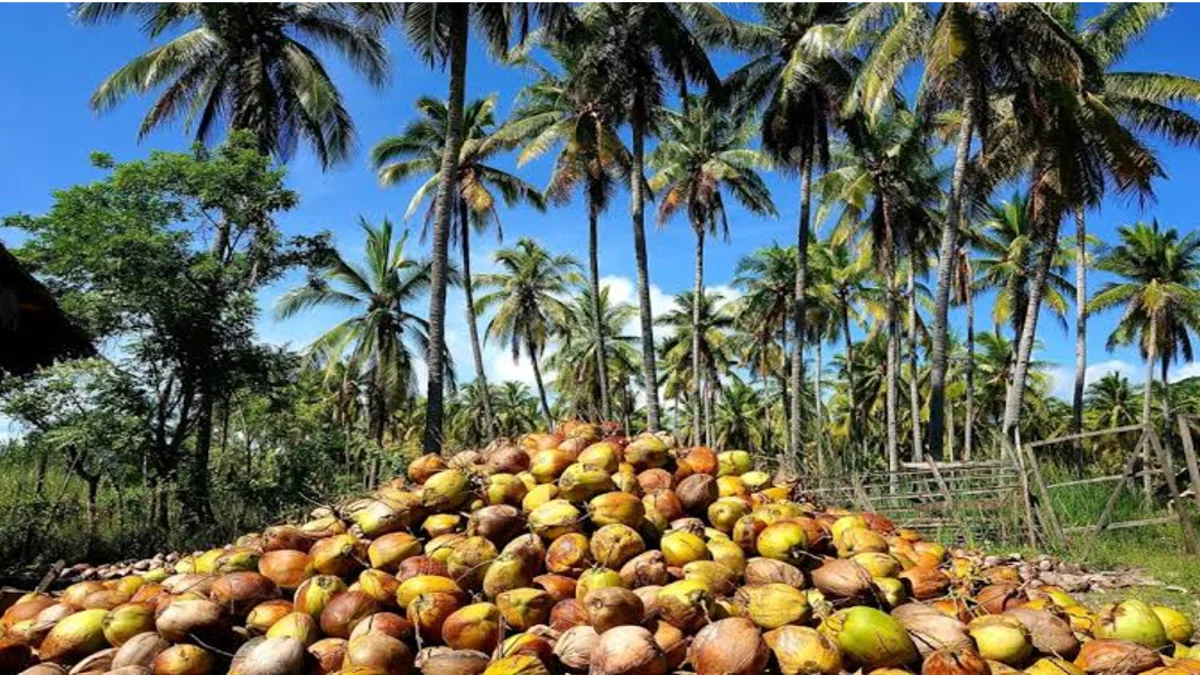
India ranks first in the world in coconut production and third in area under cultivation, accounting for 31.24 per cent and 17.90 per cent of global totals. Department of Agriculture and Farmers Welfare figures show about 20,301.22 million nuts produced during 2024-25 from 2.19 million hectares at an average 9,249 nuts per hectare.
Keralam holds the largest area, nearly 7.54 lakh hectares, producing about 5,149.87 million nuts. Tamil Nadu leads in production, while Andhra Pradesh records the highest productivity, followed by West Bengal and Tamil Nadu. Cultivation now extends into Odisha, Gujarat, Assam and even Arunachal Pradesh, turning what was once a coastal crop into a national livelihood asset.
Bastar Quiet Revolution: Once a land of Naxalism
The clearest proof of that widening map comes from an unexpected place. In the Bastar Plateau of Chhattisgarh, farmers traditionally grew paddy, millets, maize and minor floret produce. Through the Coconut Development Board DSP Farm at Kondagaon, coconut cultivation emerged as a promising livelihood option. Farmers were trained to use vacant spaces between young palms for suitable intercrops, which provided income until the palms began to bear.
Eshansh Singh Rathore, a 36-year-old MBA graduate from Bakawand block, became a leading example. From a farming family and with corporate experience behind him, he took up coconut cultivation systematically after technical guidance from the Board, establishing 2,500 palms, mostly dwarf varieties, of which about 500 had started yielding.
Rathore then built a multitier cropping system. Under his coconut plantation he cultivated 4,000 pineapple plants, 800 dragon fruit plants, 1,000 mango trees and 600 citrus trees, along with banana, guava, papaya, litchi, coffee, strawberry and seasonal vegetables, raising the productivity of his land and ensuring continuous income.
His farm earns Rs 5-6 lakh annually from coconut, while intercrops add around Rs 10 lakh. His success encouraged many farmers in Bastar to treat the coconut-based system as a replicable model, showing how a district once considered agriculturally marginal can turn into a centre of high-value horticulture.
From Copra Sacks to Virgin Oil: The Export Leap
Coconut product exports reached Rs 7,038.35 crore, or USD 794.70 million, in 2025-26, a 62 per cent rise over the Rs 4,349.03 crore of the previous year. In 2001-02, exports stood at just Rs 25.3 crore, largely traditional items such as shell charcoal and coconut oil. Over the last five years alone the turnover rose from Rs 3,236.83 crore.
The composition of the basket has changed as much as its size. India now supplies global demand for virgin coconut oil, coconut milk and coconut water. Key export items include activated carbon, coconut oil, fresh, frozen and grated coconut, copra and desiccated coconut, with activated carbon consistently dominating volumes.
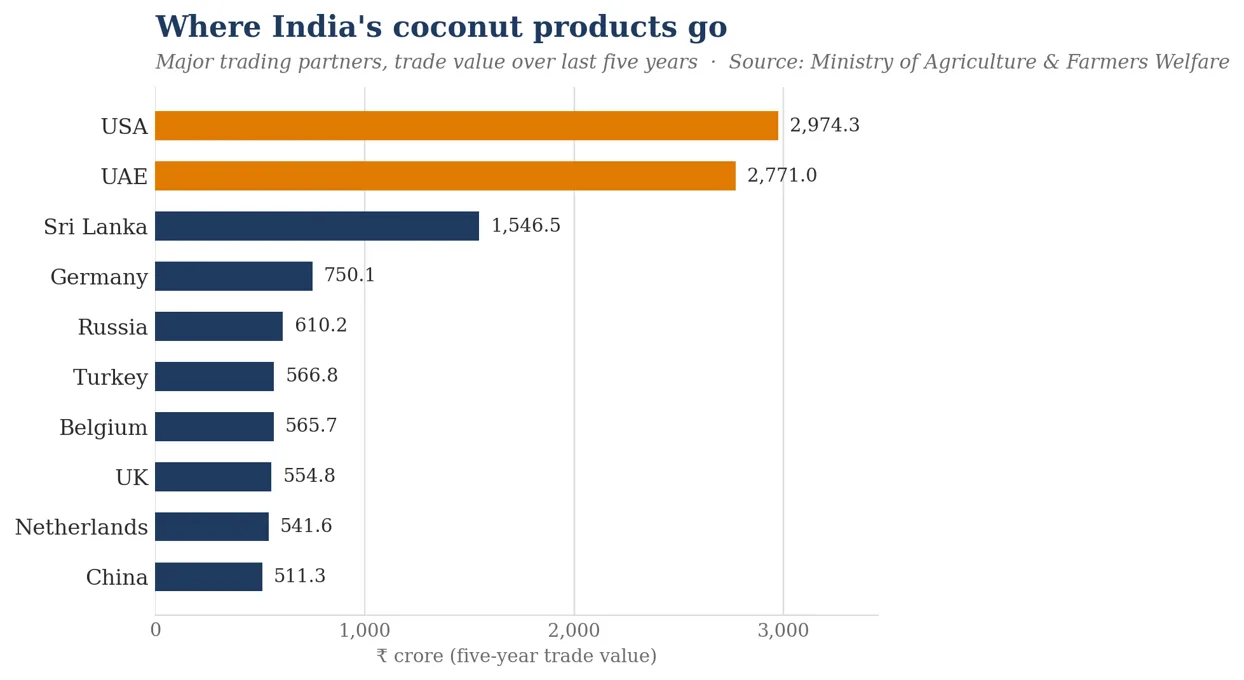
Market outreach has widened too. Once concentrated in the Middle East, exports now reach Europe, the Americas and Australia, with the USA, UAE, Sri Lanka, Germany, Russia, Turkey, Belgium, the United Kingdom and the Netherlands emerging as major partners over five years. This shift from raw commodity to branded value addition is Aatmanirbharta in practical form, feeding into the national goal of USD 2 trillion in exports by 2030 and USD 21 trillion by 2047.
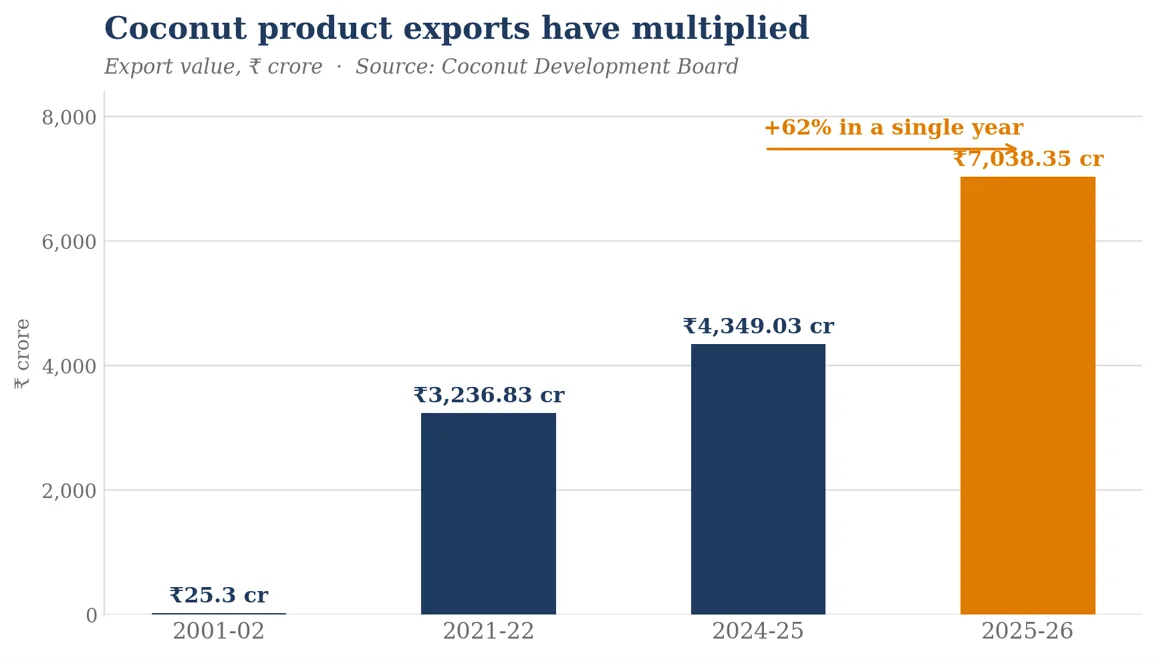
Figure 1: Coconut product exports, ₹ crore
The Institution Behind the Growth
The Coconut Development Board, set up on 12 January 1981 under the Ministry of Agriculture and Farmers Welfare. Headquartered in Kochi, it oversees coconut cultivation and industry across 22 States and Union Territories.
Its thrust areas are straightforward with quality planting material, expansion of area, higher productivity in existing holdings, pest and disease management and finally have a product diversification. During 2025-26, Rs 147.21 crore was released for CDB activities.
The Board is also the Export Promotion Council for all coconut products other than those from husk and fibre. It had registered 8,299 exporters up to 2025-26, rising to 8,700 by 31 July 2026. Over five years it facilitated 72 entrepreneurs at 20 domestic trade fairs, 224 exporters at international fairs and 392 domestic buyer-seller meets.
Price Assurance Through MSP
For the grower, the most immediate support is price certainty. Copra, the dried kernel, is among the 22 mandated crops under the Minimum Support Price regime. India produces two types: milling copra, dried after removal from the shell and used mainly for oil extraction and ball copra, made by drying whole mature coconuts until the kernel hardens inside, eaten as a dry fruit and used in worship.
For the 2026 season, the Union Cabinet approved an enhanced MSP. Milling copra is fixed at Rs 12,027 per quintal and ball copra at Rs 12,500, up Rs 445 and Rs 400 over the 2025 rates of Rs 11,582 and ₹12,100, with both standing 50 per cent above the cost of production. NAFED and NCCF act as central nodal agencies for procurement, supported by state-level agencies.
Planting, Expanding, Rejuvenating the Future
At the foundation stage, the focus is quality planting material. Under the Demonstration cum Seed Production Farm scheme, ₹30 lakh is allocated for newly established farms in the first two years, and up to ₹1.00 lakh per hectare annually from the third year until yield stabilisation, a period of 15 to 20 years. During 2025-26 the Board produced 2.41 lakh quality seedlings across 11 DSP farms.
Nucleus seed gardens received Rs 24 lakh during 2025-26, of which Rs 20.29 lakh was used. Assistance helped establish 12 new nurseries with a combined annual capacity of 1.06 lakh seedlings and maintain six existing ones. Public sector nurseries received Rs 239.35 lakh, supporting 11.97 lakh planting materials, enough for an estimated 6,850 to 7,500 hectares.
For area expansion of plantation, an assistance of Rs 56,000 per hectare comes in two equal annual instalments, for a maximum of two hectares and a minimum of 0.08 hectares per beneficiary. During 2024-25, Rs 209.24 lakh brought an additional 2,979 hectares under cultivation, benefiting 13,068 farmers. In 2025-26, about 2,175 hectares were added across states from Keralam and Karnataka to Odisha, Assam and Arunachal Pradesh with assistance of Rs 632.77 lakh.
Productivity improvement runs through PICCS, the coconut-based cropping system programme, implemented cluster-wise with a 100 per cent subsidy of Rs 42,000 per hectare for up to two hectares. During 2025-26 it covered 18,800 hectares, benefiting 48,696 farmers in 266 clusters with an outlay of Rs 3,943 lakh, while state convergence added 5,935 hectares with Rs 1,246 lakh. Keralam alone accounted for 8,089 hectares and 33,250 farmers. This year it covers 22,430 hectares.
Ageing plantations are handled through replanting and rejuvenation, with up to ₹54,000 per hectare over two years. The scheme covered 25,517 hectares in five years at ₹130.46 crore, including 1,672 hectares in 2025-26. Alongside run water resource creation, organic farming and farm mechanisation.
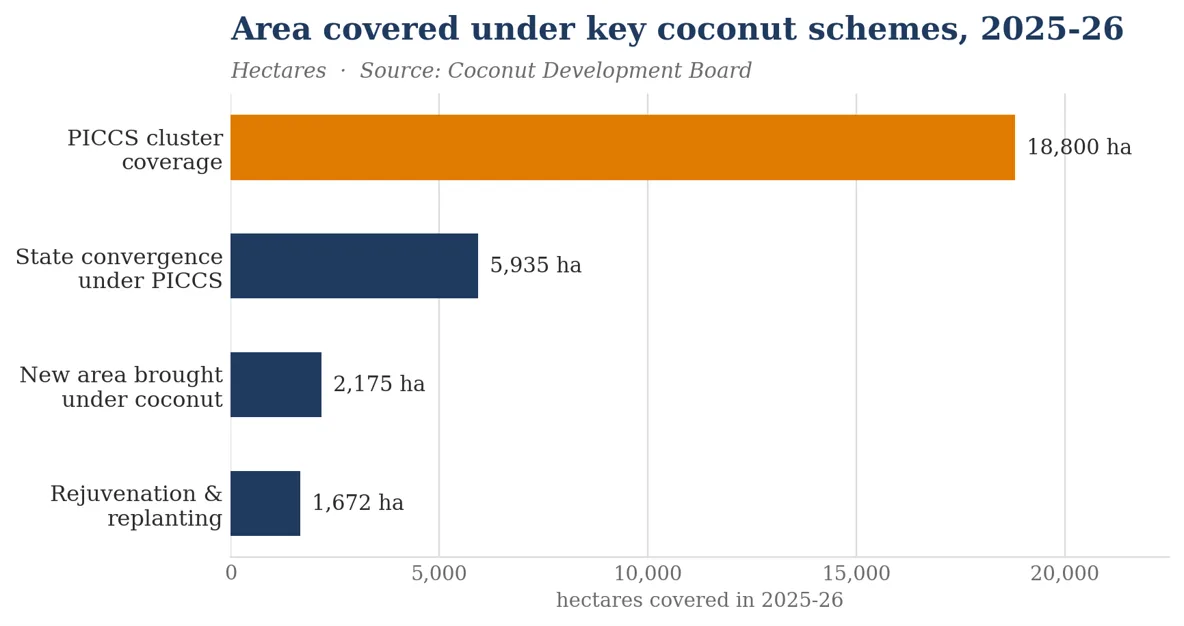
Figure 3: Area covered under key coconut schemes in 2025-26
Skills, Enterprise and the Neera Opportunity
A palm is of little use if nobody can climb it. For over a decade the Friends of Coconut Tree programme has trained unemployed youth in palm climbing with mechanical devices, plus plant protection and entrepreneurship. 378 climbers were also trained during 2024-25. A parallel handicraft programme teaches young people to make items from parts of the plant.
In 2025 the Board moved from stand-alone training to organised enterprise. Cocomitra, the Coconut Climbers Task Force, groups trained climbers into registered units of six to ten members with modern climbing devices, plant protection tools and mobility support.
Kera Kaushal Kendra is building a network of handicraft centres specialising in shell, wood and fibre products, with 15-member groups registered as legal entities and eligible for Rs 2.67 lakh in assistance from 2026-27.
Then there is Neera, the unfermented juice tapped from coconut inflorescences, a nutritious drink with zero alcohol content. A seven-day field-based programme, run through FPOs holding Neera licences, develops technicians for safe and scientific tapping. The Board conducted 414 awareness training programmes during 2025-26.
Protection comes through the Kera Suraksha Insurance Scheme, which gives accident cover to climbers, Neera technicians, hybridisation workers and coconut labourers, while the Technology Mission on Coconut backs pest management and processing technology.
The newest intervention arrived with the Union Budget 2026-27. The Coconut Promotion Scheme addresses pest outbreaks, root wilt disease and ageing plantations through large-scale seedling production, expansion into potential areas, phased replanting, holistic crop health management and integrated processing units for value addition and exports.
It forms part of a broader ₹350 crore allocation for high-value agriculture covering cashew and cocoa as well. Its ambition is to position India as a global leader in coconut and coir exports by the 2030 while raising farmer incomes.
The trajectory suggests that goal is within reach. From Rs 25.3 crore in exports to over Rs 7,000 crore, from a coastal crop to plantations in Arunachal Pradesh, from raw copra to activated carbon and virgin oil, the Kalpavriksha has proved worthy of its ancient name.