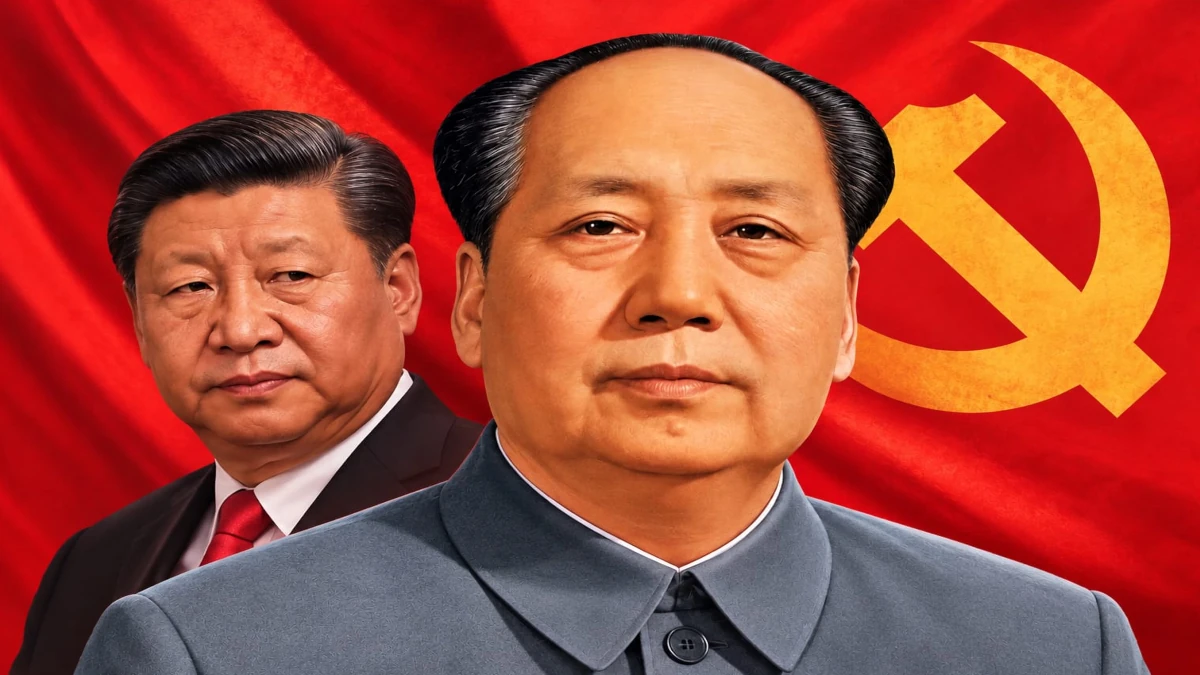
China on September 9 marked 50 years since the death of Mao Zedong, founder of the communist regime, even as his political legacy continues to shape the country’s ruling Communist Party and remains deeply embedded in Chinese public life.
Mao died on September 9, 1976, aged 82. His death hastened the end of the Cultural Revolution, the violent mass movement he had launched in 1966. Half a century later, Mao remains an officially revered figure, while his era continues to be associated with political campaigns, mass persecution, famine, ideological control and the destruction of traditional Chinese religious and cultural institutions.
The anniversary has also brought renewed attention to the way Chinese Communist Party (CCP) leader Xi Jinping has adopted elements associated with Mao-era political practice, including tighter ideological control, censorship and greater state intervention in society.
At the same time, some younger Chinese people have increasingly embraced Mao’s image, particularly amid economic difficulties, unemployment and widening social inequalities.
Mao’s rule and the human cost of Communist China
The Cultural Revolution represented one of the most radical campaigns in the history of the People’s Republic of China. Launched by Mao in 1966, it sought to eliminate perceived political and ideological enemies while transforming Chinese society according to Maoist principles.
The campaign brought the CCP into conflict with religions, traditional Chinese values and culture, as well as modern democratic ideas. Christians, Taoists, Buddhists and followers of popular folk traditions faced persecution as religious institutions and practices were attacked.
The political campaign also removed Mao’s rivals within the Communist Party.
Mass violence and political persecution helped consolidate the CCP’s absolute political authority over Chinese society.
More broadly, the period between 1949 and 1976 witnessed political campaigns, forced labour and catastrophic famines that resulted in tens of millions of unnatural deaths, while hundreds of millions of Chinese lived in poverty.
The Nine Commentaries on the Communist Party puts the estimated number of people who died from unnatural causes under CCP rule at around 80 million, stating that more than half of China’s population had suffered persecution since 1949. The publication further argues that the figure exceeds the combined deaths of the two world wars.
Historian Frank Dikotter, in his book The Tragedy of Liberation, estimates that more than 5 million people died unnatural deaths during the first eight years of CCP rule, from 1949 to 1957. The deaths were associated with mass terror campaigns, land reform and political purges.
The Great Leap Forward, launched in 1958 and continuing until 1962, became another defining catastrophe of Mao’s rule. The campaign sought to accelerate China’s economic development and rapidly catch up with and surpass the United States and the United Kingdom.
Forced collectivisation, the diversion of agricultural labour and flawed central planning severely damaged agricultural production. The resulting Great Chinese Famine produced an enormous loss of life.
Estimates cited in the historical record put the number of unnatural deaths and reduced births associated with the famine at about 40 million. The 1994 book series Historical Records of the People’s Republic of China described it as likely to have been “the world’s greatest famine in this century.”
The Party’s verdict on Mao remains unchanged.
Mao’s death did not lead to a complete political repudiation of his rule. Following his death in 1976, the Gang of Four, which included Mao’s wife, was officially blamed by the CCP for the Cultural Revolution. Its members were subsequently put on trial, allowing the Party to attribute responsibility for the excesses of the Cultural Revolution without directly dismantling Mao’s political legacy.
34 years ago, today, Tianmen Square, #Beijing #China, the Communist Party killed thousands of peaceful students with machine guns and tanks. Never forget today in China’s dark history. pic.twitter.com/A9vv3ZhgCz
— Bin Xie (@bxieus) June 4, 2023
In 1981, the CCP adopted the Resolution on Certain Questions in the History of Our Party Since the Founding of the People’s Republic of China. The resolution characterised Mao’s record through the formula that he was “70 percent right and 30 percent wrong”.
That formulation allowed the Party to acknowledge major errors while preserving Mao as the foundational symbol of the communist state and preventing a comprehensive repudiation of his political legacy.
Xi Jinping and the return of Mao-Era methods
The 50th anniversary of Mao Zedong’s death has renewed scrutiny of the Communist Party’s continuing reverence for its founder and the re-emergence of several Mao-era political methods under Xi Jinping.
The CCP has retained Mao as the symbolic founder of the communist regime while maintaining the official assessment that his record was “70 percent right and 30 percent wrong”. A complete repudiation of Mao would also raise wider questions about the political foundations and historical legitimacy of the Communist Party.
The Mao-era disasters have officially been associated with excessive concentration of power and a cult of personality. However, critics of the CCP argue that the deeper issue was the system of political control established under communist ideology. The continued preservation of Mao’s status has therefore prevented a comprehensive political reckoning with the consequences of his rule.
The anniversary has acquired particular significance because Xi Jinping’s political trajectory has increasingly incorporated elements associated with Maoist ideology and political practice.
Xi’s own family suffered during the Cultural Revolution. His father, former Vice Premier Xi Zhongxun, was purged and brutally persecuted, while the family home was ransacked. Xi, then a teenager, was labelled a “reactionary student” and subjected to interrogation and coercive political study.
At the age of 15, Xi was sent from Beijing to Liangjiahe village in Shaanxi Province, where he worked on a farm under the Mao-era system of “re-education” through rural labour.
After becoming CCP leader, however, Xi increasingly revived practices associated with the Mao period. These have included tighter ideological control, restrictions on speech and the arts, intensified censorship and greater state intervention in society. The current period has also seen renewed discussion of people’s communes and proposals to send millions of unemployed young people to the countryside amid persistent youth unemployment.
Xi’s approach has also been linked to a broader effort to strengthen the CCP’s control over Chinese society after the social changes unleashed by “Reform and Opening Up”.
The introduction of market mechanisms and the return of external ideas created wider social and economic connections with the outside world. Although China did not develop a fully established civil society, these connections contributed to a broader social awakening and presented a challenge to the Party’s control.
At the same time, Reform and Opening Up loosened economic restrictions and enabled people to generate substantial private wealth, while the expansion of economic activity ultimately strengthened the resources and state power available to the CCP.
The ideological dimension of Xi’s rule has extended beyond China’s domestic political system. The leadership has promoted the concept of a “community with a shared future for mankind”, reflecting an effort to position China and its political model within a broader global framework.
Young Chinese look back to Mao amid economic uncertainty
Mao’s continuing appeal was visible during the 50th anniversary commemorations. Following the national flag-raising ceremony at Beijing’s Tiananmen Square, a long queue formed at Mao’s Mausoleum. Elderly visitors stood alongside people from the post-1990 and post-2000 generations.
Jiefang Daily also reported memorial activities involving students in Shanghai and at Mao’s former residence.
In Shaoshan, Hunan Province, Mao’s birthplace, hundreds of supporters began gathering on September 8 at the Mao Zedong Bronze Statue Square. Some carried portraits of Mao, red flags and banners bearing pro-Mao slogans.
Others dressed as Red Guards, the militant groups associated with the Cultural Revolution. Visitors also travelled to Shaoshan from other provinces, according to multiple Chinese-language media reports. The renewed interest in Mao among sections of China’s younger generation comes amid economic uncertainty, unemployment and concerns over future prospects.
China’s “Sinicization” of Tibetan Buddhism is the "second Cultural Revolution". pic.twitter.com/1ZmgUhgGPT
— Nguyen Thi hong (@NguyenThih36) September 4, 2026
Data from China’s National Bureau of Statistics showed that unemployment among the 16–24-year-old urban labour force, excluding students, reached 17.9 percent in July, a new high. Other research has estimated that China’s actual youth unemployment rate could exceed 40 percent.
For some young Chinese people confronting unemployment and widening class disparities, the Mao era has become a point of reference. Some believe that the state-controlled system of that period provided greater economic equality, with authorities determining the distribution of food, clothing, housing and other daily necessities for urban residents.
They view the system as one in which basic necessities were more evenly distributed and social differences were less pronounced, even if that equality meant a relatively equal distribution of poverty. Against the class disparities they see in contemporary China, some young people therefore look back at the Mao era with a sense of nostalgia, believing that life under the earlier system offered greater economic security and a more equal distribution of essential goods.
The phenomenon also reflects the limited avenues available for expressing dissatisfaction with the current political system. Conventional protests have frequently been suppressed, while the CCP exercises extensive control through the internet, the social credit system and other digital tools.
In this environment, Mao’s own words and ideological language can be used to criticise the present leadership. Rather than representing straightforward support for Maoist rule, the renewed use of Maoist symbols and rhetoric can also function as an indirect expression of dissatisfaction with contemporary CCP governance.
Half a century after Mao’s death, his image consequently remains deeply embedded in Chinese political and public life. The Communist Party continues to preserve him as the symbolic founder of the regime, while the darkest episodes of his rule remain subject to the Party’s official historical framework.
The simultaneous revival of Mao-era themes under Xi Jinping and the renewed interest in Mao among sections of younger Chinese society show how the political legacy of the Mao period continues to intersect with China’s present ideological controls, economic pressures and social inequalities.