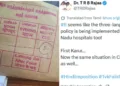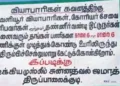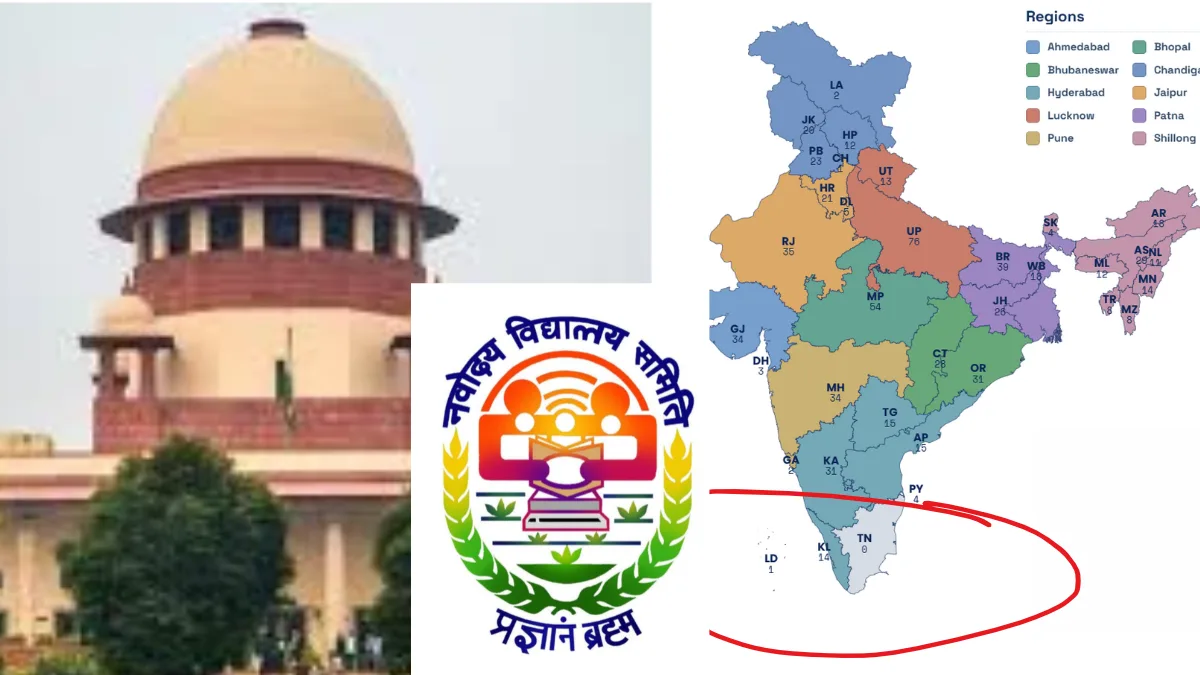
After the DMK, the TVK government too faced questions from the Supreme Court over Jawahar Navodaya Vidyalayas (JNVs) in Tamil Nadu. On September 17, a bench of Justices B V Nagarathna and Augustine George Masih gave a strict three-month deadline to identify land for setting up Jawahar Navodaya Vidyalayas in every district of Tamil Nadu, while asking the State to reconsider its position on Hindi. The Court said Hindi cannot be excluded from Tamil Nadu and asked the Joseph C Vijay-led TVK government to reconsider its stand on the opening of JNVs in the State.
The Supreme Court division bench said, “You (Tamil Nadu) have to change your mindset, it can’t be that Hindi will not be taught in the soil of Tamil Nadu,” while hearing the Tamil Nadu government’s plea challenging and opposing directions related to the establishment of Navodaya schools in every district. The Court gave the State three months to comply with its December 15, 2025 order directing it to identify the required land for JNVs in each district. The directions would be subject to the final order to be passed later. In the meantime, representatives of the Tamil Nadu and Central governments should sit together to work out the details and policy for setting up JNVs in Tamil Nadu.
Justice Nagarathna said, “People in Chennai should not alienate Delhi and vice versa.” The bench said starting JNVs would provide additional quality educational opportunities without lowering the standards of Tamil Nadu’s existing education system.
The judges said, “We are not alienating you and we are not alienating them. Some more types of schools come in your State also, which will only enhance the high standard which we are aware of. This is not going to lower your standards. If Navodaya schools were going to lower the standard of education in Tamil Nadu, we would have said that irrespective of what you would have said. That is not the case here. It will provide more opportunity,” adding, “Ultimately, everybody must work together.” The Court urged the State and Centre to engage in discussions.
Tamil Nadu government counsel Jaideep Gupta submitted that JNVs exist across the country. However, the Tamil Nadu government cannot accept them as the policy runs counter to the State’s educational policies. In Navodaya schools, Hindi is prioritised, while Tamil is relegated to the background. The Central government has not released the Rs 5,000 crore in funds due to Tamil Nadu for the education sector.
“Given this situation, the State should not be compelled to accept the Central government’s policy regarding Navodaya schools. The policy itself states that adoption is optional and depends on the State government’s willingness,” he said.
The counsel further added, “Education is a subject in the Concurrent List. Navodaya is an optional policy. … if the Supreme Court now issues a mandamus to the State to adopt that optional policy of the Centre, then my lords, what you are doing is upsetting 75 years of decision-making by this Court. If you want Tamil as a second language, it is a matter which can be considered.”
To this, the bench said, “What difficulty do you face in identifying land for Navodaya schools? You are receiving additional schools from the Central Government. Given this, what is the need to oppose them? This goes against the federal structure. If individual States were to say we cannot accept a policy introduced by the Central Government, what would become of the federal system?”
Justice Nagarathna said, “Change of government changes nothing. Education is a constant. It does not depend on the whims and fancies of any government. Today, it is Navodaya, but if the same precedent is taken up in other areas of governance, what will happen to our country? You can’t say, ‘I will not allow the national industrial policy or national financial policy’.”
The SC bench said, “You have adopted a rigid mindset that no other language should be taught on Tamil soil. There are countless children deprived of education. In other States, many rural students benefit from Navodaya schools.”
It said, “This is a nation comprising all States. Individual States cannot function as if they were separate countries. You must hold talks with the Central Government regarding the language issue and find a solution. Why is the Tamil Nadu government being so adamant?”
Additional Solicitor General KM Nataraj, appearing for the Centre, said, “The only requirement from the State under the scheme was to provide land. The remaining expenses, including construction and other requirements, would be taken care of by the Central government.”
Following the stand taken by the previous DMK government, the current TVK government is also opposing the JNVs, saying they are fundamentally incompatible with the State’s two-language formula. The DMK government, in March this year, in an affidavit argued that the JNV scheme, based on the three-language formula, deviated from the mandate of the Tamil Nadu Tamil Learning Act, 2006, adding that the scheme was only a backdoor ploy to make Hindi compulsory.
The issue stems from a petition filed in the Madurai Bench of the Madras High Court by the ‘Kumari Maha Sabha’, seeking a direction to the Tamil Nadu government to establish JNVs in every district of the State. The Madurai Bench ordered the Tamil Nadu government to grant permission for the opening of Navodaya schools. Observing that the schools would not violate the Tamil Nadu Tamil Learning Act, 2006, the High Court ordered on September 11, 2017, that temporary accommodation for 240 students be provided in every district within two months.