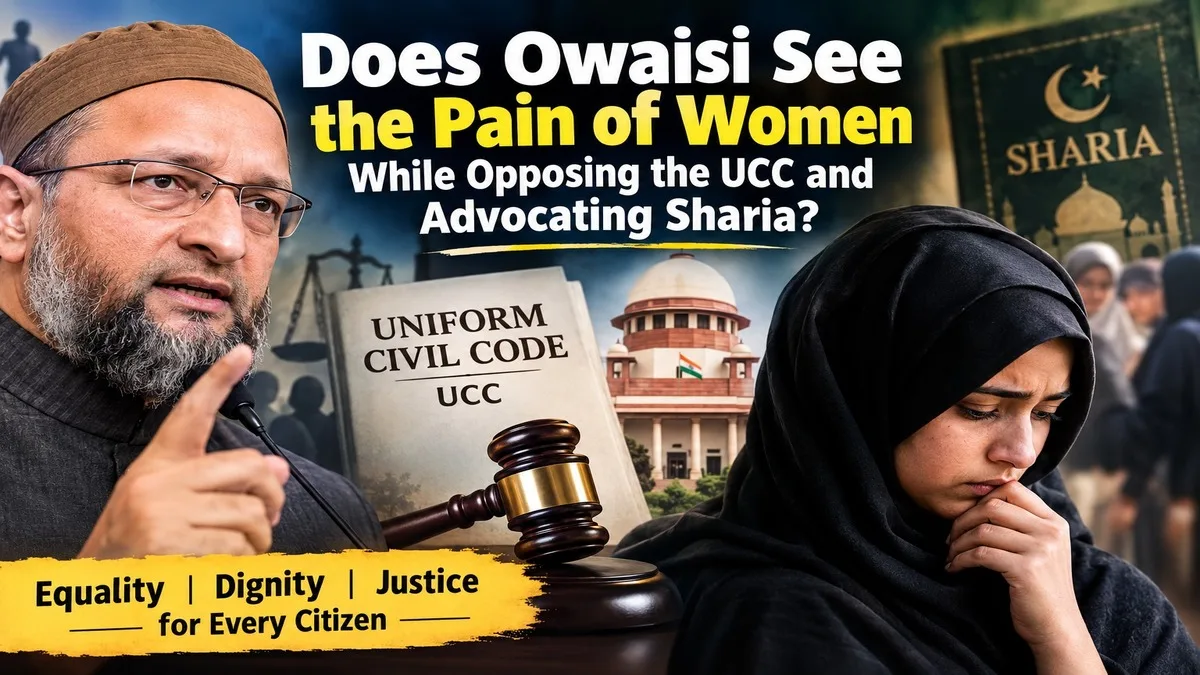
Asaduddin Owaisi’s opposition to the Uniform Civil Code is hardly a new political position. At a gathering held in Bhopal on 15 September, the All India Majlis-e-Ittehadul Muslimeen (AIMIM) chief once again questioned the UCC, saying, “Muslims have their own religious laws and identity, and the rights guaranteed under Articles 14, 25, 26 and 29 of the Constitution cannot be ignored.” His argument is that, in the name of a Uniform Civil Code (UCC), the structure of Hindu personal laws cannot be imposed upon other communities.
This is an entirely legitimate debate in a democracy. Religious freedom, minority rights and personal laws are serious constitutional issues. Let us accept that argument for a moment. But does that mean that, under its cover, the rights of Muslim women to equality, dignity, freedom and security should continue to be compromised? The question to Advocate Owaisi and others like him is therefore straightforward: when a woman’s wishes, dignity or bodily autonomy are affected in the name of personal law or religious tradition, what legal avenue will protect her?
Recent cases relating to nikah halala have repeatedly forced us to ask whether the dignity of Muslim women does not deserve consideration. Is their dignity and respect not equally worthy of protection? In the Amroha case in Uttar Pradesh, the Allahabad High Court in July 2026 refused to quash an FIR in which a woman had alleged that she had been subjected to sexual offences in the name of nikah halala, both while she was a minor and after she became an adult. The court made it clear that a criminal act cannot be given the protection of personal law. At the same time, the court clarified that the constitutional validity of halala was not the issue under consideration before it.
What is important to understand here is that religious faith and a criminal act cannot be treated as one and the same thing. The religious identity of any community must be respected in a democratic society; who can object to that? But forced sexual acts, sexual exploitation or violence against a woman cannot be legitimised by creating religious terminology or by invoking any other justification. That would amount, quite directly, to using religion as a cover for rape against a woman.
After the implementation of the UCC in Uttarakhand, the first case relating to halala emerged in May 2026. In the Buggawala area of Haridwar, police took action against a woman’s husband and members of her in-laws’ family following her complaint and subsequently filed a charge sheet. The woman had stated that she was being pressured to undergo nikah halala. If a woman is forced, in order to return to her married life, to marry another man and then go through a process of separation from him, the first questions that arise concern her free will and dignity. This is precisely why Owaisi, along with all those leaders who oppose the UCC, should be asked what clear alternative legal framework they propose to safeguard the rights of Muslim women.
If their argument is that personal laws must be protected, will that protection also contain equally strong guarantees of a woman’s equality and dignity? If a woman herself approaches a court seeking justice for her rights, should her voice be suppressed beneath questions of religious identity?
It is also worth noting that legal proceedings concerning constitutional questions related to polygamy and nikah halala are continuing before the Supreme Court. On 31 July 2026, a bench headed by Chief Justice Surya Kant sought a response from the Union Government on a petition filed by women’s rights activists Zakia Soman, Dr Noorjehan Safia Niaz and others, and tagged it with matters that were already pending. In fact, this development demonstrates that the issue is no longer confined merely to political speeches. It has reached the constitutional values of equality, dignity and personal liberty.
Of course, the Constitution of India guarantees citizens religious freedom. But the same Constitution also guarantees equality and the right to life and personal liberty. This too should not be forgotten by any advocate, or by individuals such as Owaisi. Therefore, whenever personal laws are discussed, one essential question must be asked: what is their actual impact on the person who occupies the most vulnerable position within that system?
Everyone must also understand that viewing a Muslim woman merely as a representative of Muslim identity is itself an incomplete perspective. For the country, she is first a citizen, then a woman, followed by her other social and religious identities. Her rights cannot be reduced or enhanced because of her religious identity. Whether the framework is the UCC or personal law, the test should therefore remain the same: does the law provide equal protection to citizens? Does it protect a woman’s consent and dignity? Does it provide effective protection against violence and exploitation?
Owaisi has the democratic right to oppose the UCC. He also has the right to argue in favour of Sharia and Muslim personal law, and he is doing so. But alongside that democratic right, he must also be asked how the rights of Muslim women who consider themselves victims of a particular interpretation or misuse of personal law will be guaranteed.
Today, he should be asked: if Muslim women are being subjected to oppression under the cover of Sharia, then, despite being a lawyer, why does he continue to advocate all those Sharia rules, and why does he mislead his own community? If a Muslim woman feels unsafe under Sharia, why does he continue to stand in its defence? And if a woman has to struggle for respect, consent and justice within her own married life, can ignoring her suffering behind the shield of religious identity possibly be consistent with the spirit of the Constitution?
If a woman’s voice disappears from the debate over personal law, that debate remains incomplete. Owaisi and all those who are opposing the UCC today must understand this. In the eyes of the Indian Constitution, every citizen is equal. Those who are vulnerable are, after being recognised as equal, also provided certain special rights and protections. But that does not mean that anyone can invoke rules or regulations as a pretext for exploiting another person.
In this regard, Hindu law is exemplary in itself. What is regarded as exemplary is what society follows, and this has been the tradition for centuries. It would therefore be better if, instead of creating an atmosphere against the UCC, the Muslim community came forward in support of it. That is the need of the hour and the requirement of the times.