UCC Debate: Owaisi’s stand on Sharia and women
September 17, 2026
  • Read Ecopy
  • Circulation
  • Advertise
  • Careers
  • About Us
  • Contact Us
Android AppiPhone AppArattai
Organiser
  • ‌
  • Bharat
    • Assam
    • Bihar
    • Chhattisgarh
    • Jharkhand
    • Maharashtra
    • View All States
  • World
    • Asia
    • Europe
    • North America
    • South America
    • Africa
    • Australia
  • Editorial
  • International
  • Opinion
  • RSS @ 100
  • More
    • World Hindu Congress 2026
    • Op Sindoor
    • Analysis
    • Sports
    • Defence
    • Politics
    • Business
    • Economy
    • Culture
    • Special Report
    • Sci & Tech
    • Entertainment
    • G20
    • Azadi Ka Amrit Mahotsav
    • Vocal4Local
    • Web Stories
    • Education
    • Employment
    • Books
    • Interviews
    • Travel
    • Law
    • Health
    • Obituary
  • Subscribe
    • Subscribe Print Edition
    • Subscribe Ecopy
    • Read Ecopy
  • ‌
  • Bharat
    • Assam
    • Bihar
    • Chhattisgarh
    • Jharkhand
    • Maharashtra
    • View All States
  • World
    • Asia
    • Europe
    • North America
    • South America
    • Africa
    • Australia
  • Editorial
  • International
  • Opinion
  • RSS @ 100
  • More
    • World Hindu Congress 2026
    • Op Sindoor
    • Analysis
    • Sports
    • Defence
    • Politics
    • Business
    • Economy
    • Culture
    • Special Report
    • Sci & Tech
    • Entertainment
    • G20
    • Azadi Ka Amrit Mahotsav
    • Vocal4Local
    • Web Stories
    • Education
    • Employment
    • Books
    • Interviews
    • Travel
    • Law
    • Health
    • Obituary
  • Subscribe
    • Subscribe Print Edition
    • Subscribe Ecopy
    • Read Ecopy
Organiser
  • Home
  • Bharat
  • World
  • Operation Sindoor
  • Editorial
  • Analysis
  • Opinion
  • Culture
  • Defence
  • International Edition
  • RSS @ 100
  • Magazine
  • Read Ecopy
Home Bharat

UCC Debate: Does Owaisi’s defence of Sharia address the rights, dignity and consent of Muslim women?

The debate over the Uniform Civil Code has again brought questions of religious freedom, personal law, and the rights of Muslim women into focus. The article examines whether equality, dignity and consent should receive greater consideration in discussions surrounding Sharia and personal laws

Dr Mayank ChaturvediDr Mayank Chaturvedi
Sep 17, 2026, 05:40 pm IST
inBharat, Analysis, Law
Follow on Google News
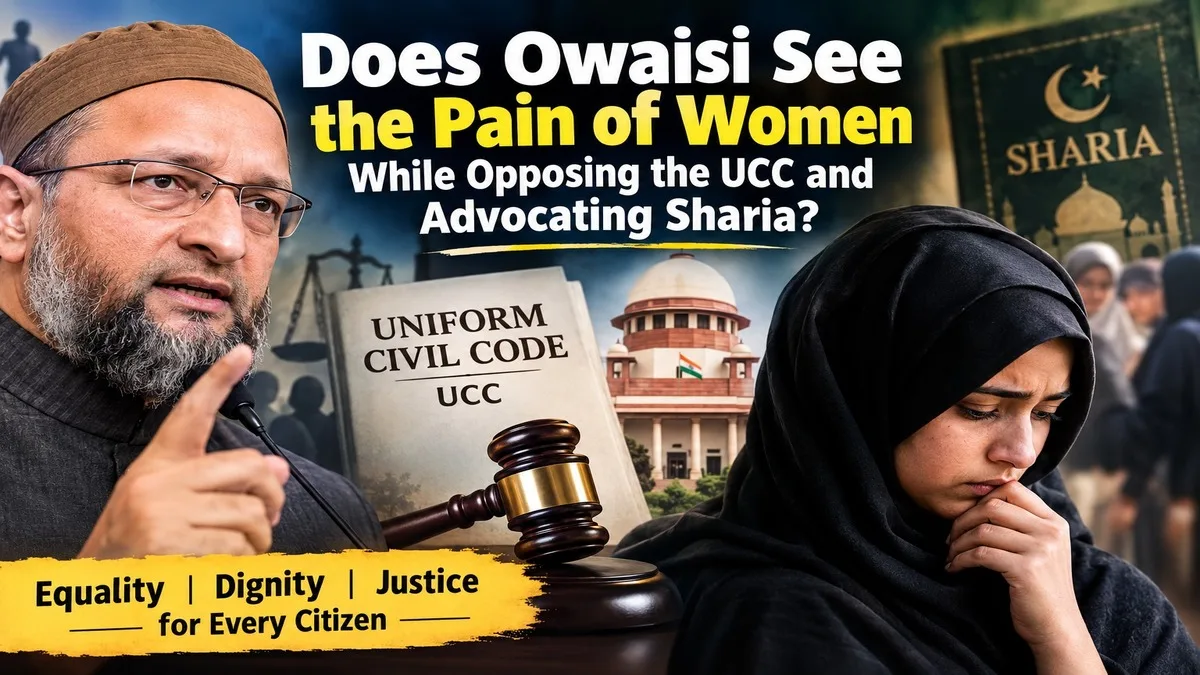
The debate over the UCC has again brought questions of religious freedom, personal law, and the rights of Muslim women into focus

The debate over the UCC has again brought questions of religious freedom, personal law, and the rights of Muslim women into focus

Facebook
Twitter
WhatsAppTelegramEmail

Asaduddin Owaisi’s opposition to the Uniform Civil Code is hardly a new political position. At a gathering held in Bhopal on 15 September, the All India Majlis-e-Ittehadul Muslimeen (AIMIM) chief once again questioned the UCC, saying, “Muslims have their own religious laws and identity, and the rights guaranteed under Articles 14, 25, 26 and 29 of the Constitution cannot be ignored.” His argument is that, in the name of a Uniform Civil Code (UCC), the structure of Hindu personal laws cannot be imposed upon other communities.

This is an entirely legitimate debate in a democracy. Religious freedom, minority rights and personal laws are serious constitutional issues. Let us accept that argument for a moment. But does that mean that, under its cover, the rights of Muslim women to equality, dignity, freedom and security should continue to be compromised? The question to Advocate Owaisi and others like him is therefore straightforward: when a woman’s wishes, dignity or bodily autonomy are affected in the name of personal law or religious tradition, what legal avenue will protect her?

Recent cases relating to nikah halala have repeatedly forced us to ask whether the dignity of Muslim women does not deserve consideration. Is their dignity and respect not equally worthy of protection? In the Amroha case in Uttar Pradesh, the Allahabad High Court in July 2026 refused to quash an FIR in which a woman had alleged that she had been subjected to sexual offences in the name of nikah halala, both while she was a minor and after she became an adult. The court made it clear that a criminal act cannot be given the protection of personal law. At the same time, the court clarified that the constitutional validity of halala was not the issue under consideration before it.

What is important to understand here is that religious faith and a criminal act cannot be treated as one and the same thing. The religious identity of any community must be respected in a democratic society; who can object to that? But forced sexual acts, sexual exploitation or violence against a woman cannot be legitimised by creating religious terminology or by invoking any other justification. That would amount, quite directly, to using religion as a cover for rape against a woman.

After the implementation of the UCC in Uttarakhand, the first case relating to halala emerged in May 2026. In the Buggawala area of Haridwar, police took action against a woman’s husband and members of her in-laws’ family following her complaint and subsequently filed a charge sheet. The woman had stated that she was being pressured to undergo nikah halala. If a woman is forced, in order to return to her married life, to marry another man and then go through a process of separation from him, the first questions that arise concern her free will and dignity. This is precisely why Owaisi, along with all those leaders who oppose the UCC, should be asked what clear alternative legal framework they propose to safeguard the rights of Muslim women.

If their argument is that personal laws must be protected, will that protection also contain equally strong guarantees of a woman’s equality and dignity? If a woman herself approaches a court seeking justice for her rights, should her voice be suppressed beneath questions of religious identity?

It is also worth noting that legal proceedings concerning constitutional questions related to polygamy and nikah halala are continuing before the Supreme Court. On 31 July 2026, a bench headed by Chief Justice Surya Kant sought a response from the Union Government on a petition filed by women’s rights activists Zakia Soman, Dr Noorjehan Safia Niaz and others, and tagged it with matters that were already pending. In fact, this development demonstrates that the issue is no longer confined merely to political speeches. It has reached the constitutional values of equality, dignity and personal liberty.

Of course, the Constitution of India guarantees citizens religious freedom. But the same Constitution also guarantees equality and the right to life and personal liberty. This too should not be forgotten by any advocate, or by individuals such as Owaisi. Therefore, whenever personal laws are discussed, one essential question must be asked: what is their actual impact on the person who occupies the most vulnerable position within that system?

Also Read: Hyderabad: Jeweller installs gold-plated Ganesha murti studded with 3.83 lakh American diamonds on Ganesh Chaturthi

Everyone must also understand that viewing a Muslim woman merely as a representative of Muslim identity is itself an incomplete perspective. For the country, she is first a citizen, then a woman, followed by her other social and religious identities. Her rights cannot be reduced or enhanced because of her religious identity. Whether the framework is the UCC or personal law, the test should therefore remain the same: does the law provide equal protection to citizens? Does it protect a woman’s consent and dignity? Does it provide effective protection against violence and exploitation?

Owaisi has the democratic right to oppose the UCC. He also has the right to argue in favour of Sharia and Muslim personal law, and he is doing so. But alongside that democratic right, he must also be asked how the rights of Muslim women who consider themselves victims of a particular interpretation or misuse of personal law will be guaranteed.

Today, he should be asked: if Muslim women are being subjected to oppression under the cover of Sharia, then, despite being a lawyer, why does he continue to advocate all those Sharia rules, and why does he mislead his own community? If a Muslim woman feels unsafe under Sharia, why does he continue to stand in its defence? And if a woman has to struggle for respect, consent and justice within her own married life, can ignoring her suffering behind the shield of religious identity possibly be consistent with the spirit of the Constitution?

If a woman’s voice disappears from the debate over personal law, that debate remains incomplete. Owaisi and all those who are opposing the UCC today must understand this. In the eyes of the Indian Constitution, every citizen is equal. Those who are vulnerable are, after being recognised as equal, also provided certain special rights and protections. But that does not mean that anyone can invoke rules or regulations as a pretext for exploiting another person.

In this regard, Hindu law is exemplary in itself. What is regarded as exemplary is what society follows, and this has been the tradition for centuries. It would therefore be better if, instead of creating an atmosphere against the UCC, the Muslim community came forward in support of it. That is the need of the hour and the requirement of the times.


 

Topics: Indian ConstitutionShariaUniform Civil CodeUCCAsaduddin OwaisiMuslim Personal LawMuslim womenNikah-Halala
Share
Tweet
SendShareSend
✮ Subscribe Organiser YouTube Channel. ✮
✮ Join Organiser's WhatsApp channel for Nationalist views beyond the news. ✮
Previous News

CBI books Arunachal Congress leader Bhanu Tatak over Rs 20.94 lakh foreign funding, FCRA violations

Related News

From Ambedkar to Goa to Assam: UCC push puts equal rights, women and Janjati safeguards in focus

A representative image

‘Shariya Court’ cannot act as parallel court under Indian law: Chhattisgarh HC rejects triple talaq declaration

A representative image

Imran Hussain refused to remarry ex-wife after ‘Halala’; Jharkhand HC says it is not a criminal offence, no case filed

VHP Central Joint Secretary Vijay Shankar Tiwari

“Sharia cannot be placed above Constitution; citizenship also comes with duties”: VHP’s Vijay Shankar Tiwari

Mirza Rahmath Baig with Asaduddin Owaisi (Left)

Telangana: AIMIM expels MLC Mirza Rahmath Baig over minor girl assault allegations, orders resignation; Owaisi silent

UCC Panel Seeks Stakeholder Views During Raipur Consultation

Chhattisgarh Advances UCC Consultation: Religious entities, social representatives, statutory bodies submit suggestions

Load More

Latest News

The debate over the UCC has again brought questions of religious freedom, personal law, and the rights of Muslim women into focus

UCC Debate: Does Owaisi’s defence of Sharia address the rights, dignity and consent of Muslim women?

Arunachal Pradesh Congress leader and activist Bhanu Tatak

CBI books Arunachal Congress leader Bhanu Tatak over Rs 20.94 lakh foreign funding, FCRA violations

EAM Jaishankar extends series of developmental aid to Bhutan

43 Jersey Cows, Hydropower, Healthcare & Connectivity: India’s assistance to Bhutan echoes Neighbourhood First Policy

Hyderabad Liberation Day: September 17 is reminder of nation-building, says VP CP Radhakrishnan

Madurai Meenakshi Amman Temple Kumbabhishekam commences after 17 years amid lakhs of devotees

Breaking the 17-year deadlock: Six states sign historic Kishau multipurpose project pact to transform Yamuna basin

ED conducted searches across four states in connection with the Ranchi RSS office bomb attack, probing the financial trail of the accused

Ranchi RSS Office Bomb Attack: ED conducts raids in Delhi, Bihar, Jharkhand and Karnataka to trace money trail

Pakistani Beauty Creams Sold in India Despite Restrictions? CDSCO Issues Health Alert

Toxic Pakistani fairness creams in India? Drug regulator warns of toxic heavy metals

India rejects Pakistan-China Joint Boundary Commission as no real geographic border exists between the two countries

India Rejects Pakistan-China Boundary Commission: Hails sovereignty as no real border exists in the occupied territory

Shahzad Bhatti network added to UAPA terror list after security agencies bust alleged ISI-backed terror network

Centre designates ISI-backed Shahzad Bhatti network as terrorist organisation under UAPA over terror activities

Load More
  • Privacy
  • Terms
  • Cookie Policy
  • Refund and Cancellation
  • Delivery and Shipping

© Bharat Prakashan (Delhi) Limited.
Tech-enabled by Ananthapuri Technologies

  • Home
  • Search Organiser
  • Bharat
    • Assam
    • Bihar
    • Chhattisgarh
    • Jharkhand
    • Maharashtra
    • View All States
  • World
    • Asia
    • Africa
    • North America
    • South America
    • Europe
    • Australia
  • Editorial
  • Operation Sindoor
  • Opinion
  • Analysis
  • Defence
  • Culture
  • Sports
  • Business
  • RSS @ 100
  • Entertainment
  • More ..
    • Sci & Tech
    • Vocal4Local
    • Special Report
    • Education
    • Employment
    • Books
    • Interviews
    • Travel
    • Health
    • Politics
    • Law
    • Economy
    • Obituary
  • Subscribe Magazine
  • Read Ecopy
  • Advertise
  • Circulation
  • Careers
  • About Us
  • Contact Us
  • Policies & Terms
    • Privacy Policy
    • Cookie Policy
    • Refund and Cancellation
    • Terms of Use

© Bharat Prakashan (Delhi) Limited.
Tech-enabled by Ananthapuri Technologies