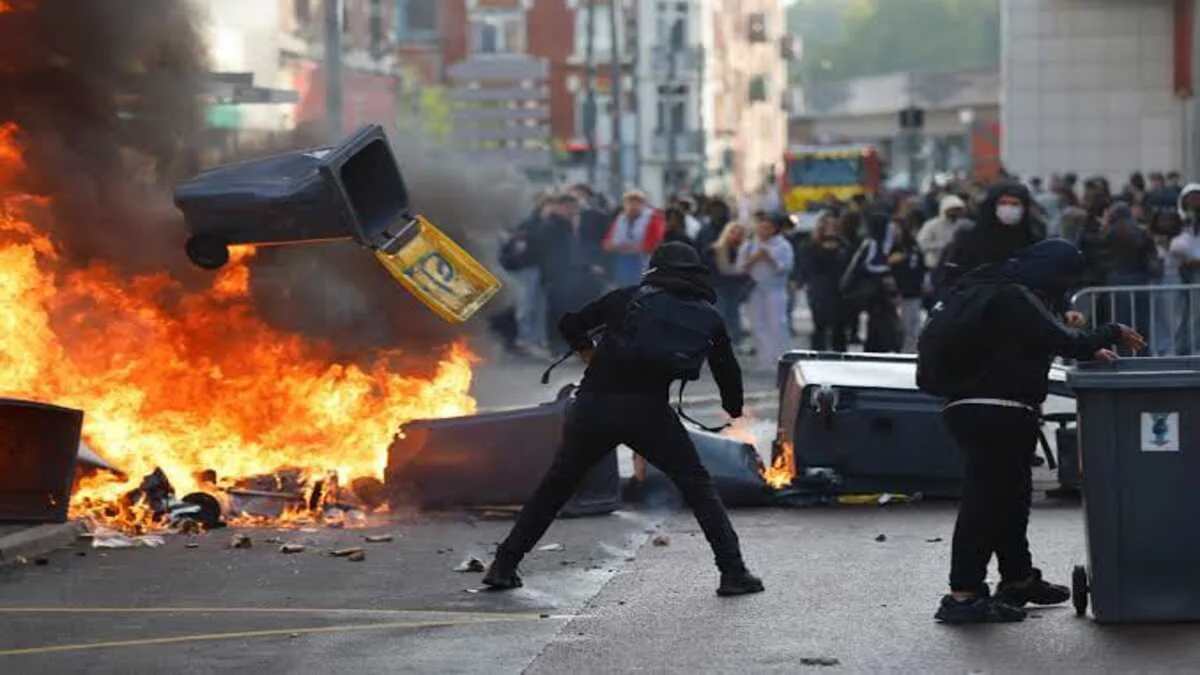
France’s growing wave of high-school protests escalated into street clashes on October 6, with schools blockaded across the country, fires reported in several cities and police deploying tear gas and riot-control measures to contain disorder.
What began in September as demonstrations over deteriorating school infrastructure, teacher shortages and overcrowded classrooms in disadvantaged areas around Paris has expanded into a nationwide movement. The latest mobilisation was described as the biggest day of action so far, with students, teachers and parents joining protests while authorities struggled to keep schools functioning.
The High School Students Union said more than half of France’s high schools were either blockaded or expected to close for the day. Some education authorities attempted to shift lessons online as the disruption spread.
The demonstrations remained largely peaceful in cities such as Marseille and Nantes, where protesters displayed placards criticising the state of France’s education system. In Toulouse, parents joined a march through the city, linking arms at the front of the procession.
But the situation deteriorated elsewhere. In Strasbourg, Lyon and Rennes, clashes broke out between demonstrators and police. Protesters reportedly set fire to objects in the streets and threw projectiles, prompting police to use tear gas and other crowd-control measures.
From school grievances to street disorder
The protests have been driven by complaints about ageing school buildings, teacher shortages and inadequate facilities. Demonstrators have highlighted problems ranging from leaking roofs and poor infrastructure to rat infestations.
Outside Paris’s prestigious Henri IV school, a recent graduate identified as Roberta called for greater government spending on education and the renovation of high schools.
Yet the scale of the unrest has increasingly shifted the focus from educational grievances to public order.
The French government has deployed riot police as demonstrations spread, arguing that the original movement has been exploited by outsiders and transformed into urban violence. Authorities have faced criticism from rights organisations, student groups and parents over the use of force, particularly where minors are involved.
🚨 student protest in France are ongoing: today, approximately 500 schools have suspended classes.
The French Ministry of the Interior stated that it was unable to guarantee safety at these schools. More than twenty schools have been burned or looted during the protests.
For… pic.twitter.com/eIgybMmEp4
— Aleksey The Great 🇷🇺🎖 (@aleksthgrt) October 5, 2026
The government, however, has pointed to the growing number of arrests and injuries as evidence of the increasingly volatile environment confronting police.
The Interior Ministry said around 6,100 people had been arrested since the protests began, with the overwhelming majority reportedly minors. The Justice Ministry said more than 1,800 people were facing prosecution, including 1,483 minors.
According to figures cited by Prime Minister Sebastien Lecornu’s office, at least 715 police officers and 215 teenagers have been injured during clashes.
The confrontation took a particularly serious turn in northern France on Monday when a 15-year-old reportedly suffered devastating injuries after picking up a police dispersal grenade. Regional newspaper La Voix du Nord reported that the teenager lost his hand and part of his lower arm.
Police under pressure as violence spreads
The government’s response has increasingly centred on containing disorder rather than allowing demonstrations to disrupt public spaces indefinitely.
Police have used tear gas in areas where clashes intensified, while riot units have been deployed to deal with protesters throwing objects and setting fires. The authorities face the difficult task of controlling unrest involving large numbers of young people while preventing further injuries.
Teachers and protesters have accused the government of trying to distinguish between “acceptable” and “unacceptable” demonstrators. The government and its political opponents are also engaged in a wider political confrontation.
With a presidential election approaching next spring, President Emmanuel Macron’s government and Marine Le Pen’s National Rally have accused lawmakers and mayors associated with the radical-left France Unbowed party of encouraging the unrest.
Prime Minister Lecornu has nevertheless ordered ministers to respond to the principal demands emerging from the demonstrations. These include measures to ensure that absent teachers are replaced, an examination of the long school day running from 8 a.m. to 6 p.m., longer lunch breaks and repairs to ageing school buildings.
Ministers have been instructed to submit their initial proposals by the end of October.
For many parents, however, government promises have yet to translate into tangible improvements. Emilie Lhomme, speaking outside the Helene Boucher school in Paris, argued that official assurances would not immediately change the everyday experience of children.
Education crisis meets France’s financial strain
The government’s ability to respond with substantial new spending is constrained by France’s worsening fiscal position.
Paris is already under pressure from investors to reduce a widening budget deficit. Concerns over the country’s growing debt, weak economic growth and continued public spending have pushed French borrowing costs higher.
Unrest spread for another day across France on Friday as high-school protests over classroom conditions turned violent in several cities.
Riot police clashed with students in places including Paris suburbs, Strasbourg, Marseille and Rennes.
Protesters set bins and school… pic.twitter.com/LvxKU6RHOj
— Vitamvivere (@Vitamvivere) October 2, 2026
The yield on France’s 10-year government bonds briefly exceeded 5% last week, reaching a level not seen in roughly 24 years. Higher borrowing costs have also begun creating wider concerns across the euro area, adding pressure on policymakers as the euro weakens.
Finance Minister Roland Lescure said Tuesday that there was no immediate need for the European Central Bank to intervene.
The financial pressure is also becoming an important political issue ahead of the election. Marine Le Pen, who is leading the presidential race, has proposed cutting public expenditure while attempting to demonstrate greater fiscal discipline amid mounting concerns in financial markets.
For Lecornu’s government, the education protests therefore present a problem extending beyond school buildings and teacher shortages. It must address genuine concerns over deteriorating infrastructure and staffing while preventing demonstrations from developing into sustained urban disorder.
The challenge is particularly acute because many of those involved are teenagers, raising questions over how far authorities can go in restoring public order without escalating tensions further.
As classrooms remain closed, streets become flashpoints and police deploy increasingly forceful crowd-control measures, France’s education crisis has evolved into a broader test of the government’s ability to balance public spending, political pressure and security.
The coming weeks will determine whether Lecornu’s promised reforms can calm the mobilisation, or whether the protests will continue to spill from France’s schools into its streets.