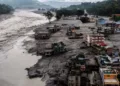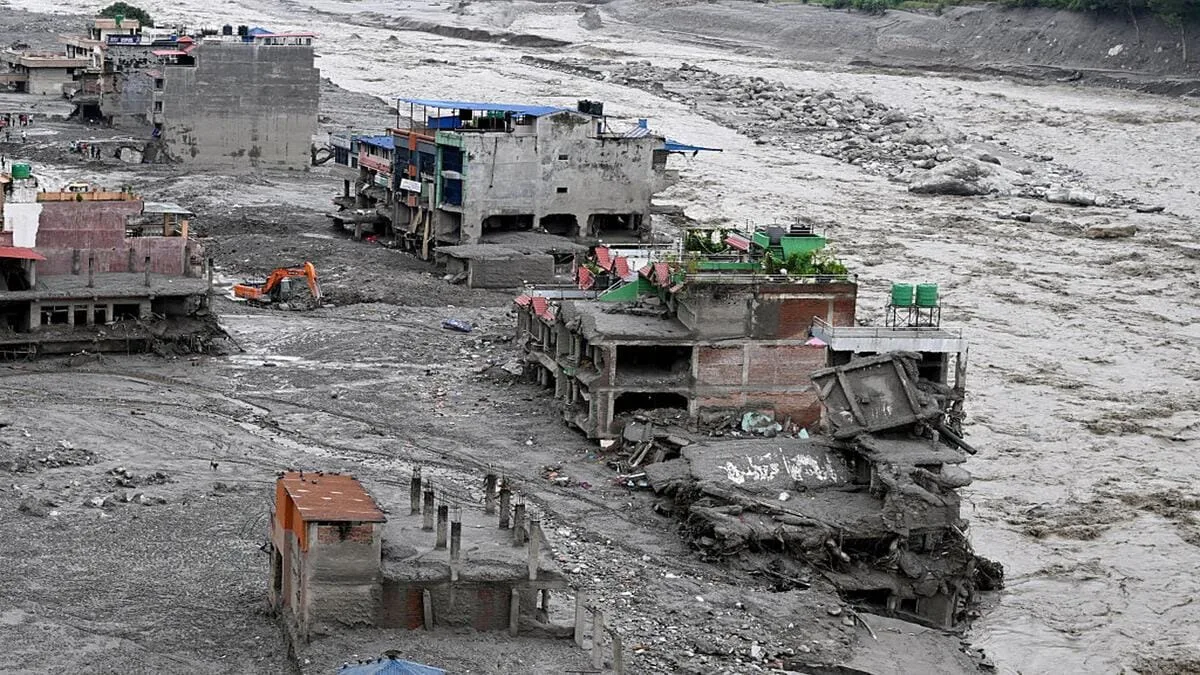
Massive landslides and flash floods along the Nepal-Tibet border have caused widespread devastation. Reports indicate that over a thousand people have lost their lives so far, with hundreds more missing. There have been numerous casualties, and fears of extensive damage persist. While the exact number of fatalities and missing persons remains unclear, the death toll is expected to rise. Search and rescue operations are currently underway.
News of this nature confronts us every year, with only the location and timing changing. The astonishment and surprise stem not from the rivers and floods themselves, but from the massive constructions and large-scale projects undertaken by humans in the rivers’ floodplains.
The Himalayas are a young, fold mountain range currently in the process of formation; characterised by a highly sensitive environment, fragile geological structure, and extremely steep slopes, the region faces a constant threat of geological disasters. Rising temperatures are causing glaciers to melt rapidly. Thousands of glacial lakes have formed in the Himalayas, and their breaching or bursting triggers sudden, devastating floods. A continuous rise in such disasters has been observed over the past two decades, resulting in immense loss of human life, culture and property. Human interventions in the Himalayas—such as unplanned construction, deforestation, and large-scale infrastructure development in river basins—have disrupted the ecological balance. Governments cannot evade responsibility for this transgression by simply labelling the consequences as natural disasters. It is now clearly evident that the primary causes of the recurring disasters in the Himalayan region are geological instability, rapidly melting glaciers, and unchecked human activities.
Listen only to scientists and subject experts. A devastating chain of events—ranging from glacier or ice-mass collapses in the High Himalayas to issues involving rivers, valleys, and fragile infrastructure in the Middle Himalayas, and flooding in the low-lying areas—has once again wreaked massive havoc. The issue is far more serious than just flooding. The situation unfolding in India, Nepal, and Tibet is deeply concerning. There is a need to better understand the Himalayas; determining the pace and direction of development—while balancing the economy and the environment—requires not only the involvement of scientists and experts but also the adoption of authentic Himalayan lifestyles.
The present times call for not only scientists and subject-matter experts who have the courage to call a spade a spade, but also policymakers and political leaders willing to listen to and accept the truth. It is the scientists and subject experts alone who can provide accurate answers to the geographical and environmental questions surrounding the tragedy and show the way forward. The present times call for not only scientists and subject experts who have the courage to call a spade a spade, but also policymakers and political leaders willing to listen to and accept the truth. It is the scientists and subject experts alone who can provide accurate answers to the geographical and environmental questions surrounding the tragedy and show the way forward. Decisions regarding development in remote Himalayan regions must be based on considering geological factors and the ecological capacity to withstand human activity and interference.
It is essential to curb projects driven by economic greed through better monitoring via satellite technology and reliable early warning systems.
Everything—wealth, lives and culture accumulated over a lifetime can be lost in a single minute.
If we live in harmony with nature, we remain safe;
if we act against it, devastation is inevitable.
That is all there is to say.