
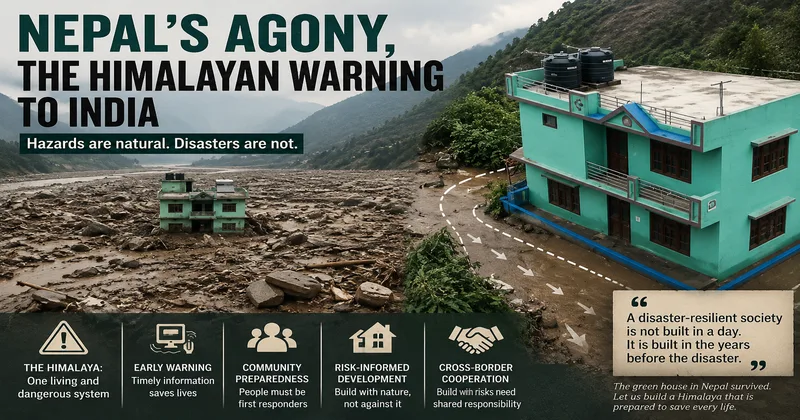
There is something deeply unsettling about watching a disaster unfold in a place that looks so familiar.
The mountains may belong to Nepal. The rivers may have different names. The settlements may lie across an international boundary. But the geological forces that have unleashed devastation in Nepal do not recognise political borders. The same Himalaya rise over India. The same glaciers are melting. The same tectonic plates are grinding against each other. The same mountains feed rivers that sustain millions of Indians.
That is why Nepal’s latest tragedy should not be seen merely as a Nepali disaster. It is a Himalayan warning.
On August 26, devastating flash floods swept through parts of central Nepal after a sudden surge of water into the Bhote Koshi river system, apparently linked to an upstream ice avalanche and temporary damming in Tibet. The torrents carried mud, rocks and debris through valleys, destroying homes, roads, bridges and critical infrastructure. The disaster has also affected the China side of the Himalaya.
As rescue and recovery operations continue, the full human cost remains uncertain. But the message is already clear: a changing climate is interacting with an inherently fragile Himalayan geology to create hazards that can become disasters with extraordinary speed.
For someone who has spent years working in disaster risk management and mitigation with the United Nations Development Programme, this is not merely a story about a flood.
It is a story about preparedness.
From Disaster Response to Disaster Resilience
During my work in disaster risk management, one idea repeatedly stood out: we must stop thinking of disasters only as events to be responded to after they occur.
The more important question is what we do before the disaster.
The objective of disaster-risk reduction was never simply to build a better emergency response system. It was to create a disaster-resilient society — communities that understand the risks around them, institutions that can anticipate them, infrastructure that can withstand them and citizens who know what to do when warnings arrive.
This distinction is critical.
A natural hazard becomes a disaster when human vulnerability intersects with it.
An earthquake cannot be prevented. A glacier cannot be ordered not to melt. A cloudburst cannot be stopped. A landslide cannot be negotiated with.
But deaths can often be prevented.
Homes can be built differently. Roads can be aligned differently. Settlements can be kept away from dangerous channels. Warning systems can be created. Evacuation routes can be marked. Communities can be trained. Schools can conduct drills. Local volunteers can become the first line of response.
The experience of India itself demonstrates this transformation.
The 1998 Kandla cyclone in Gujarat caused enormous destruction and demonstrated the vulnerability of coastal communities. The following year, the 1999 Odisha Super Cyclone became one of India’s most painful lessons in disaster preparedness. Nearly 10,000 people lost their lives. Weak warning dissemination, poor communication, inadequate shelters and limited evacuation preparedness magnified the consequences of a powerful natural hazard.
But India learned.
Over subsequent decades, disaster management moved increasingly towards early warning, evacuation, resilient infrastructure and community preparedness. Cyclone Phailin, Cyclone Bulbul and Cyclone Amphan demonstrated that a powerful cyclone need not automatically translate into a massive loss of life. India’s disaster-management capabilities, early-warning systems and evacuation mechanisms have evolved substantially. The National Cyclone Risk Mitigation Project, for example, explicitly focused on early-warning dissemination, multipurpose cyclone shelters, evacuation infrastructure and community capacity building.
The lesson is profound: hazards may be inevitable; disasters are not.
The Himalaya Are One Living System
This principle must now be applied to the Himalaya.
The Himalaya cannot be divided neatly into Indian Himalaya, Nepali Himalaya, Bhutanese Himalaya or the Tibetan Himalaya simply because political boundaries divide the map.
Geologically, it is one interconnected and constantly changing system.
From the Hindu Kush(Vedic name: Upariśyena) through Pakistan, India, Nepal and Bhutan to Tibet, enormous tectonic forces remain active beneath the mountains. The region combines seismic vulnerability with glaciers, unstable slopes, narrow valleys and rapidly changing river systems.
The earthquakes of 1934 and 1950 remain stark reminders of what Himalayan seismicity can do. The 1934 Nepal-Bihar earthquake devastated large areas across Nepal and northern India. The 1950 Assam earthquake demonstrated again that the Himalayan region possesses the capacity to generate extraordinary seismic destruction.
Yet earthquakes are only one part of the problem. Today, glacial hazards are becoming increasingly important. As temperatures rise, glaciers retreat and glacial lakes expand. When a natural moraine or ice barrier fails, enormous quantities of water can suddenly rush downstream, carrying boulders, mud and debris with devastating force.
These are Glacial Lake Outburst Floods, or GLOFs.
The danger is particularly acute because communities may have very little time to react.
The latest Nepal disaster appears to have involved an ice avalanche and temporary natural damming upstream, producing a sudden and destructive surge downstream. The precise geological sequence remains subject to assessment, but the speed and scale of the flooding illustrate exactly why Himalayan communities require sophisticated early-warning and preparedness systems.
The Most Dangerous Gap Is Between Science and Society
India possesses extraordinary scientific expertise.
We have institutions capable of monitoring earthquakes, glaciers, rivers, weather systems and geological hazards. We have satellites, remote sensing, forecasting models and increasingly sophisticated communication technologies.
But scientific knowledge sitting inside laboratories, government files or technical reports does not save a person standing beside a river.
Knowledge saves lives only when it reaches the community in time.
This was one of the most important lessons from my experience in community-based disaster preparedness. A warning system is incomplete until the last person understands the warning. It is not enough for a district administration to know that a flood is coming. The village must know. The schoolteacher must know. The local shopkeeper must know. The family living beside the river must know where to go and how quickly to get there.
A siren is not preparedness if nobody knows what the siren means.
A risk map is not preparedness if villagers have never seen it.
An evacuation plan is not preparedness if the designated route is blocked by a road, construction or landslide.
Community-based disaster preparedness therefore has to be at the heart of Himalayan risk reduction. People cannot remain passive recipients of relief. They must become active participants in risk reduction.
The Green House That Refused to Fall
Amid Nepal’s devastation, one image has captured public imagination: a small green house standing almost defiantly while structures around it were swept away by the torrent.
https://twitter.com/arcpresentation/status/2094027019260436541?s=20
The image is powerful precisely because it raises a question that disaster-management professionals have been asking for decades:
Why did this structure survive when others did not?
The explanation circulating from Architecture Presentation is only a possible structural assessment, not a definitive engineering investigation. But it offers an important lesson. The house reportedly had a reinforced concrete frame, with steel reinforcement connecting its columns, beams and foundation. Its position also appeared to be slightly away from the deepest central channel of the debris flow and on somewhat higher ground. Its compact geometry may have allowed the torrent to divide around it rather than strike it directly.
The distinction is crucial.
The house may have survived because of engineering plus location plus chance.
But that is precisely the lesson we should take from it.
Disaster resilience is rarely created by one intervention. It is the result of several layers of protection working together. The right building design matters. The right location matters. The strength of the foundation matters. The surrounding topography matters. The warning received by the occupants matters. And the ability of people to move to safety matters.
A disaster-resilient house is therefore not simply a stronger house. It is a house that has been designed with the hazard in mind. The green house should not become merely a viral curiosity. It should become a question for every engineer, planner and administrator working in the Himalaya: Can we design more houses that survive?
Development Cannot Be Separated From Risk
Nepal’s tragedy also forces us to confront an uncomfortable question about development in fragile mountain environments.
For decades, the development imperative has understandably focused on roads, bridges, hydropower, tourism, settlements and connectivity. But infrastructure that ignores geological reality can itself become a disaster multiplier. A road carved into an unstable slope can trigger landslides.
A poorly located settlement can sit directly in the path of a flood. A dam or hydropower installation can become vulnerable to a cascading geological event. A bridge can become a single point of failure, isolating entire communities. This does not mean that development should stop in the Himalaya.
It means development must become risk-informed.
Before approving major infrastructure, governments must ask not only, “What economic benefit will this project generate?”
They must also ask:
What happens if there is a major earthquake? What happens if a glacial lake bursts? What happens if the river changes course? What happens if the mountain above the project collapses? What happens downstream? And, most importantly, who bears the risk?
This approach becomes even more important when infrastructure has consequences across borders.
The proposed Medog hydropower development near the great bend of the Brahmaputra in Tibet has already generated concerns in India. Whatever the merits or otherwise of the project, India cannot afford to ignore the transboundary consequences of major infrastructure in an extremely seismically and geologically sensitive region.
The Himalaya demand greater transparency, scientific information-sharing and meaningful dialogue on transboundary environmental and disaster risks.
India Must Prepare Before the Himalayan Earthquake
There is another danger that must not be forgotten amid the immediate focus on floods and glacial hazards: the earthquake.
Scientists have repeatedly warned about the seismic potential of the Himalayan arc. The question is not whether the region will experience another major earthquake.
The question is when. And prediction cannot currently provide us with the certainty that preparedness demands. That is why India must prepare for the earthquake we cannot predict.
A serious Himalayan preparedness programme should include updated multi-hazard risk maps; community-level early-warning and communication systems; evacuation plans; regular drills; earthquake-resistant construction; resilient hospitals and schools; trained local volunteers; emergency stockpiles; redundant communication networks; and rapid-response arrangements extending down to the village level.
The concept of “last-mile connectivity” should not apply only to roads and telecommunications. It must apply to disaster warnings.
The last person in the remotest Himalayan settlement must receive the warning.
We Need a Himalayan Disaster-Resilience Mission
India should consider developing a dedicated, long-term Himalayan Disaster Resilience Mission involving the Union Government, Himalayan states, scientific institutions, armed forces, disaster-management authorities, local administrations, universities and communities. Its focus should be fivefold.
First, know the risk
Create continuously updated multi-hazard maps covering earthquakes, landslides, floods, GLOFs and other geological threats.
Second, communicate the risk
Convert complex scientific assessments into simple, multilingual warnings that ordinary people can understand.
Third, build for the risk
Review existing infrastructure and ensure that new construction follows rigorous hazard-sensitive standards.
Fourth, train for the risk
Every vulnerable community should know its evacuation routes, safe zones, emergency contacts and first-response procedures.
Fifth, cooperate across borders
The Himalayan ecosystem is transboundary. Disaster-risk information, river data and early warnings should not become casualties of geopolitical mistrust.
Do Not Wait for the Next Catastrophe
There is a tendency after every disaster to ask: Why were we not prepared? That question is legitimate. But an even more important question is: What will we do now that we know?
Nepal has provided India with another warning. The mountains are becoming more vulnerable to a combination of geological instability, climate change, rapid development and human settlement.
The answer cannot be panic. Nor can it be fatalism. The answer is preparedness.
My experience in disaster-risk management has reinforced one conviction above all others: resilience is not created on the day of a disaster. It is created quietly, patiently and often invisibly in the years before the disaster.
It is created when a village practises an evacuation drill. When an engineer refuses to compromise on structural safety. When a school teaches children what an earthquake warning means. When a district administration identifies a safe shelter before the flood. When a family knows which documents and medicines to carry during an evacuation. When a government refuses to permit construction in a known hazard zone. And when scientific knowledge is translated into the language of ordinary citizens.
The green house in Nepal therefore offers a metaphor worth remembering.
It did not defeat the Himalaya.
It survived because, perhaps, several things came together — structural strength, location, geometry and circumstance. Our objective should be to ensure that survival is not left to circumstance.
The Himalaya are a source of rivers, civilisation, culture and life. They are also a young, restless and fragile mountain system. India cannot move the mountains. But India can prepare its people.
And when the next Himalayan disaster comes — whether it is an earthquake, a landslide, a GLOF or a catastrophic flood — the real measure of our wisdom will not be how eloquently we mourn. It will be how many lives we had prepared to save.
Nepal’s agony is not merely a tragedy to be witnessed. It is a warning to be acted upon.