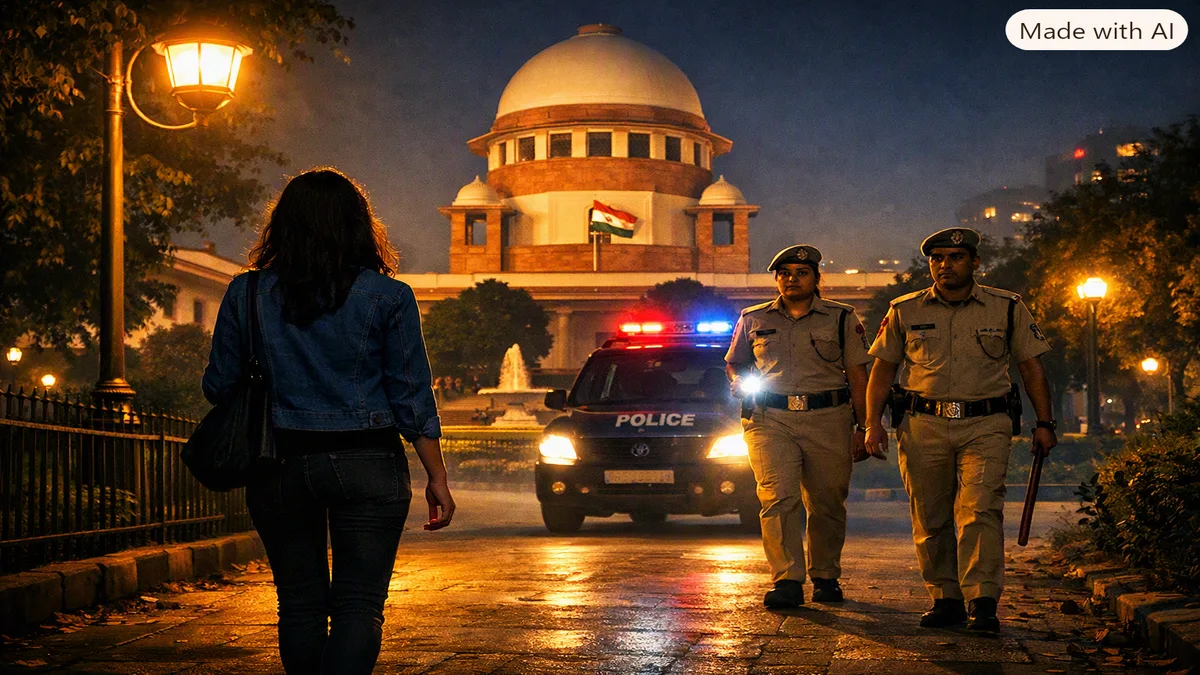
NEW DELHI: The Supreme Court has called upon the Delhi Police to strengthen preventive policing against sexual offences, observing that women in the National Capital must feel safe while travelling or walking alone even late at night.
A Bench of Justices J.B. Pardiwala and K Vinod Chandran made the observations on October 5 while hearing In Re: Recent Rape Incidents in Delhi NCR, a suo motu proceeding concerning recent sexual offences against women and minor girls in Delhi-NCR.
The Bench said the immediate priority should be to prevent crimes rather than merely apprehend and prosecute offenders after an incident has taken place.
“What is important is to prevent the crime, not what you do after the crime is committed,” Justice Pardiwala orally observed. Referring to the need for deterrence, the Court said there should be sufficient fear in the minds of those prone to committing sexual offences about the consequences of their actions.
The Court said authorities must work towards ensuring that every young woman in Delhi feels safe at 10 or 11 at night, whether she is travelling by Metro or walking on the streets.
The Bench asked the police to intensify surveillance across the city, particularly at places where women may be more vulnerable. It specifically referred to bus stands, bus stops, Metro and railway stations, parks, subways and areas outside schools and colleges, including the North and South campuses of Delhi University.
The Court also emphasised regular beat patrolling and effective deployment of Police Control Room vehicles. It questioned the effectiveness of CCTV cameras if footage is not continuously monitored and asked the authorities to examine whether better monitoring mechanisms could facilitate quick police intervention.
The hearing follows the Court’s September 28 order taking cognisance of a series of reported sexual offences in Delhi-NCR, including the alleged gang rape of a minor at Aastha Kunj Park and the alleged sexual assault of a minor inside a moving sleeper bus.
In its earlier order, the Court directed authorities to conduct surveys of vulnerable areas and prepare district-wise vulnerability maps. It also ordered audits of street lighting and CCTV coverage and called for increased patrolling at identified locations.
The Court had observed that public spaces such as roads, parks, buses, Metro stations, subways and footbridges cannot be allowed to become high-risk zones because of inadequate lighting, surveillance or policing. It stressed that expressions of concern following an incident were insufficient and that responsibility and accountability must accompany measures aimed at preventing crime.
During the latest hearing, Solicitor General Tushar Mehta informed the Court that the Government shared its concerns. He said discussions had been held with the Delhi Police, Delhi Government, Municipal Corporation of Delhi and the Ministry of Women and Child Development, among other authorities.
Senior Advocate Liz Mathew, assisting the Court as amicus curiae, also pointed to issues concerning the implementation of beat patrolling mechanisms.
The Bench further emphasised interaction between police personnel and local residents, noting that such engagement could help authorities identify nuisance-makers and vulnerable pockets before serious offences occur.
Justice Vinod Chandran added that surveillance and quick response were important immediate measures, while cautioning that policing should not result in excesses.
The matter is scheduled to be heard next on November 13.