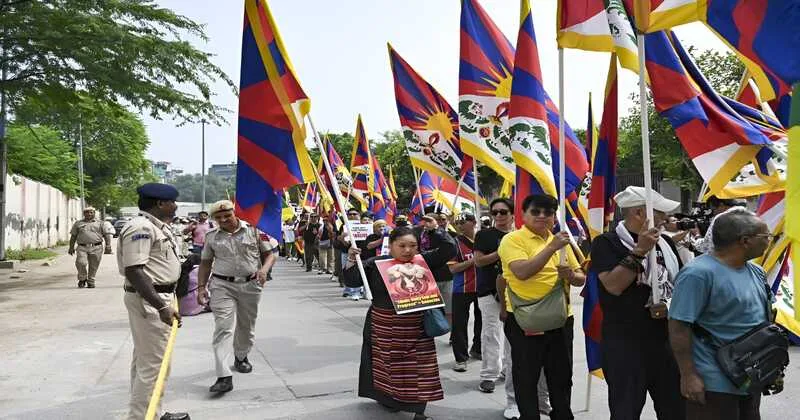
New Delhi: Hundreds of Tibetans protested Chinese President Xi Jinping’s visit to India for the BRICS Summit 2026, demanding that India and other BRICS countries confront China over the repression of Tibetans, the “Ethnic Unity and Progress” law and Beijing’s policies in Tibet. The protests were held at different locations in Delhi on September 11, ahead of the BRICS Summit 2026 at Bharat Mandapam on September 12 and 13.
The main protest was held at Majnu Ka Tila in north Delhi, where scores of Tibetans from Delhi and States including Karnataka, Odisha and Himachal Pradesh gathered under the banner of the Tibetan Youth Congress. The protesters made clear that their opposition was directed at Xi Jinping and the policies of the Chinese Communist Party (CCP), rather than the BRICS Summit itself.
“We are not against BRICS Summit and we congratulate India for hosting it. However, we want to say that Xi Jinping is not welcome here,” said Acharya Yeshi Phuntsok, former deputy speaker of the Tibetan Parliament-in-exile. He accused China of decades of state-sanctioned human rights violations against Tibetans and environmental destruction caused by uncontrolled engineering projects on the Tibetan plateau.
Tibetans target China’s ‘Ethnic Unity’ Law
The protesters strongly criticised China’s “Ethnic Unity and Progress” law, arguing that the legislation has intensified the suppression of Tibetan language, culture and religion. The Tibetan community alleged that the Chinese Communist Party has sought to use the law to legitimise policies aimed at weakening Tibet’s distinct cultural identity.
“The Ethnic Unity law has further intensified the marginalisation of Tibetans’ distinct cultural identity,” said Tenzin Lobsang, general secretary of the Tibetan Youth Congress. He also referred to Tibetan martyr Lobga Rangzen, who self-immolated before the United Nations Headquarters following the imposition of the law on July 1, 2026, describing the incident as a tragic reminder of China’s repression. According to Lobsang, around 170 people have so far self-immolated in protest.
China’s Ethnic Unity and Progress Promotion Law is presented by Beijing as a measure to promote ethnic unity, national cohesion and equal development among the country’s ethnic groups. However, Tibetan groups argue that the law strengthens CCP control over ethnic minorities and facilitates the assimilation of Tibetans by undermining their distinct language, culture and religious identity.
Hundreds of #Tibetans in #Delhi protest against #XiJinping's visit for the #BRICS summit, demanding India press China to repeal its "ethnic unity law" and end repression in #Tibet. pic.twitter.com/AiLGAX1yHo
— Lobsang Yangtso བློ་བཟང་དབྱངས་མཚོ་ (@lobyang) September 11, 2026
The protest began with the singing of the Tibetan national anthem, Gyallu, followed by speeches highlighting China’s policies in Tibet. Speakers also raised concerns over Beijing’s control of major river systems originating on the Tibetan plateau, human rights violations and what they described as growing Chinese border aggression.
Tsering Wangmo, a vendor from Himachal Pradesh, said Tibetan communities had experienced suppression of their culture and language for generations. “Nearly one lakh Tibetans are in exile. We want a free Tibet and want the Chinese government to stop violating the rights of Tibetan people,” she said.
Tenzin Tsering, a 32-year-old Delhi store owner who grew up in Karnataka, said the Tibetan community had not forgotten the mass displacements that occurred decades ago despite more than 60 years of exile. He said younger Tibetans were becoming increasingly politically active, learning more about their culture and working to preserve their identity.
Protest near Bharat Mandapam
Earlier on September 11, at around 7:30 a.m., three members of Students for Free Tibet (SFT) climbed poles inside an underpass near Bharat Mandapam, where the BRICS Summit 2026 was scheduled to take place. They waved the Tibetan flag and displayed banners carrying slogans including “Xi Jinping = Genocide” and “Tibet is facing ecocide: Free Tibet”.
Tibetan exiles in New Delhi told Xi Jinping he’s not welcome.
Protesters waved Free Tibet flags and banners as he arrived for the BRICS Summit. Their message was clear: stop the repression in Tibet.@jenniferzeng97 @Michael7ucci @TibetPeople @CultureTibet @DrewPavlou pic.twitter.com/IJsVisUzQI
— Tashi Dorjey (@TashiDorjey_) September 12, 2026
The protesters were identified as Karma Dolma, 24, Tenzin Nordon, 23, and Tenzin Tsephal, 26. Tenzin Passang, national director of SFT, said the action was intended to challenge Beijing’s narrative of multilateral cooperation and urge BRICS leaders to confront China over its “illegal occupation” of Tibet, human rights violations, control over Asia’s major river systems and expanding border aggression.
The Majnu Ka Tila protest was conducted amid heavy security deployment. DCP North Niharika Bhatt said police had held talks with community leaders and resident welfare associations to dissuade the protesters. It was eventually decided that the demonstration would remain inside the Samyeling Tibetan Colony school and that the protest march would be restricted to 700 metres, stopping before Punjabi Basti. Around 150 police personnel were deployed outside the school.
The Bureau of Dalai Lama also supported the demonstration, maintaining that peaceful protests for the cause of Tibet had always received its support. “Peaceful dialogue is the only solution. So far, we have no trust in the Chinese President for a reliable solution,” said Jigme Tsering, representative of the Dalai Lama.
The protests brought the concerns of Tibetans, including refugees and younger generations born in exile, into focus as Xi Jinping attended the BRICS Summit 2026 in India. The demonstrators called on India and BRICS countries to address China’s policies towards Tibet alongside broader questions of human rights, cultural preservation and regional security.