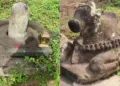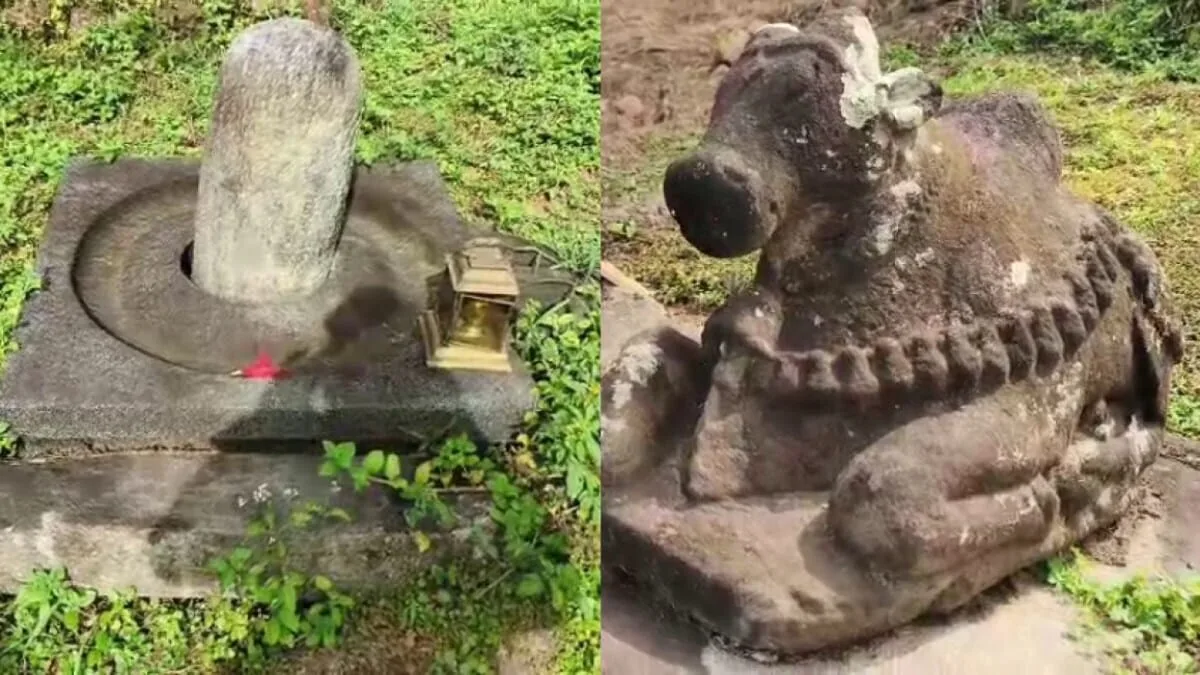
MADIKERI: A centuries-old chapter of Karnataka’s Shaiva heritage has resurfaced from the forested landscape of Aimangala, where villagers have discovered a Shivalinga believed to be around 650 years old along with the remains of an ancient Mahadeva Mandir.
The discovery was made around three kilometres from the Aimangala-Chembebellur road. Along with the Shivalinga, a Basava statue and remnants believed to be associated with the former Mandir complex have been found, including traces of the sanctum sanctorum and a theertha kunda. According to local accounts, the site gradually disappeared into the surrounding forest after regular worship at the shrine came to an end.
An abandoned Mandir reclaimed by the forest
Local accounts indicate that the shrine was once a Mahadeva Mandir and that an elderly archak’s family was responsible for its daily worship. The rituals reportedly stopped after the family moved elsewhere, leaving the shrine without regular puja. Over the years, the Mandir site became part of the forest, with its surviving structures and religious objects remaining largely undisturbed.
Villagers subsequently conducted a traditional tambula prashne to understand the history associated with the shrine. According to the local account, the consultation indicated that the site had been a Mahadeva Mandir where worship had continued for generations.
While these traditional accounts form part of the community’s understanding of the shrine, the reported age and historical significance of the remains would ultimately benefit from formal archaeological documentation.
Plans to revive the ancient Mahadeva Mandir
The discovery has now prompted local residents to initiate plans to revive the Mandir and restore regular worship. According to the report, a tantri has advised the villagers to relocate the Shivling towards the southeast and undertake its re-consecration. The proposed restoration is expected to include a new Shivling peetha and sanctum sanctorum, besides a theertha kunda, kalyani, devara nade, steps, pouli, theertha facilities and a bathing house.
The villagers estimate that the entire rejuvenation project could cost around Rs 2 crore. They intend to raise the funds through contributions from residents as well as associations and other organisations. The proposed Mandir is also expected to remain open to devotees without discrimination based on caste or language.
The first phase of the revival is expected to begin with homa-havana and special pujas, followed by the restoration of regular rituals at the ancient shrine.
Earlier Shivling discoveries in Karnataka
The Aimangala discovery comes against the backdrop of several instances in Karnataka where old Shivlings, Mandir remains and Shaiva sculptures have surfaced from beneath the soil, near old settlements or in areas that had gradually fallen out of regular use.
One notable discovery took place in South Kodagu in January 2024, when a massive Shivling measuring about four feet in height and three feet in width was found beneath a tree in a coffee plantation at the foothills of Kunda Betta in Ponnampet taluk. Local residents associated the Shivling with the Pandava period, although such historical connections require verification by archaeology authorities.
Another important example is the Mahalingeshwara Mandir at K Hemmanahalli near Mysuru, a Hoysala-period shrine dating to around 1188 AD. The Mandir complex contains a Shivling, Hoysala sculptures and other archaeological remains. An inscription discovered during renovation also provided information about the Mandir and events during the Hoysala period.
Karnataka’s archaeological record also preserves medieval Shivlings from major historic centres. The National Mission on Monuments and Antiquities records a granite Shivalinga from the ruins of Hampi, dating to approximately the 14th–15th centuries during the Vijayanagara period.
At Pura in Koppal district, the government records the 12th-century Someshwara, or Kotilingeshwar, Mandir as a Kalyana Chalukyan monument. Its sanctum contains a two-foot-tall Shivling, while the larger complex includes a garbhagriha, sabhamantapa and other architectural elements characteristic of the period.
Ancient Shaiva traditions continue to surface
Such discoveries provide glimpses into the spread and continuity of Shaiva worship across Karnataka’s villages, forests and historic settlements. In several cases, surviving lingas, Nandi or Basava sculptures, Mandir foundations, inscriptions and water structures can help establish the religious and architectural character of an earlier settlement.
The Aimangala site is particularly significant for the local community because the discovery is not merely of an isolated stone object. The presence of the Shivling alongside a Basava statue and structural remains associated with a sanctum and water-related features points towards the possibility of an earlier Mandir complex at the location.
For now, the villagers have taken up the task of bringing the forgotten shrine back into community life. Their proposed restoration would revive not only the daily worship but also the physical landscape of the old Mandir, reconnecting the surviving Shivling and Mandir remains with the traditions remembered by generations of local residents.