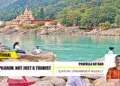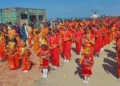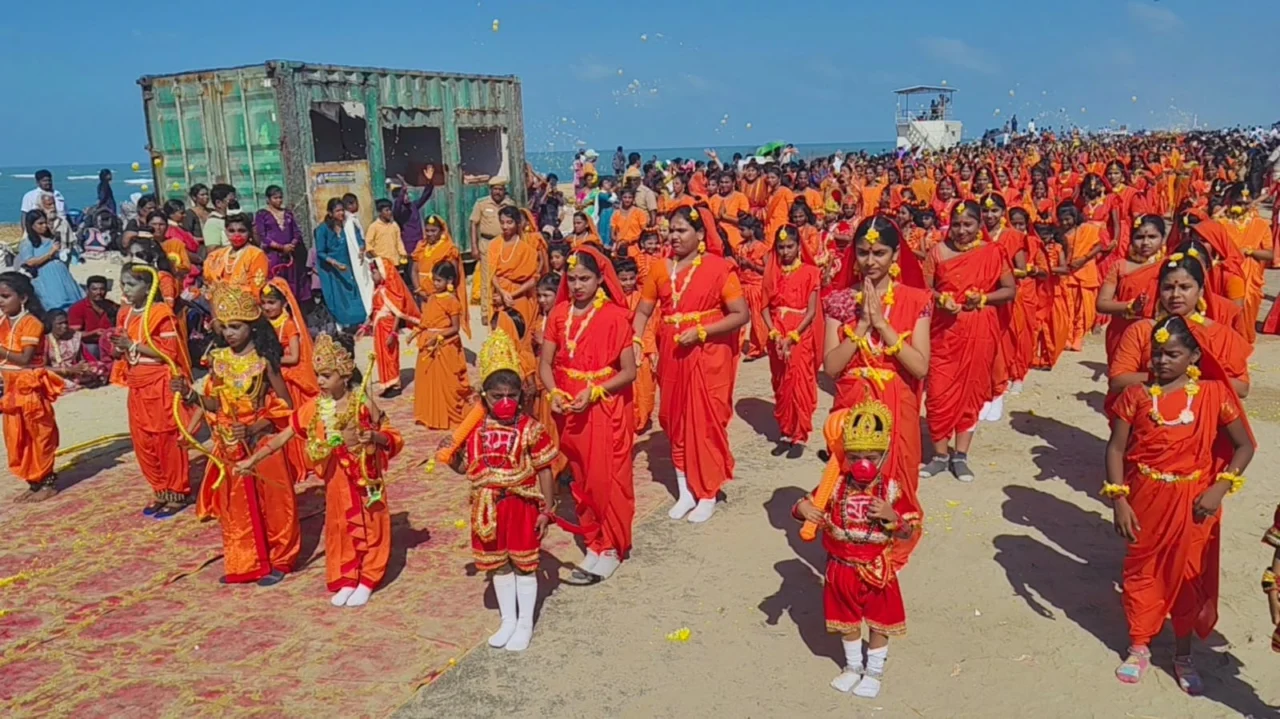
To coincide with World Tourism Day on September 27, the Tamil Nadu Tourism Department, along with Abhinaya Natyanjali Trust, organised a ‘Ram Yatra’ Natyanjali programme at Arichal Munai in Dhanushkodi, Ramanathapuram district. More than 500 children participated in the programme, dressed as characters from the Ramayana, including Lord Ram, Sita, Lakshman and Hanuman. The children performed together, showcasing the Ramayana and the cultural and devotional traditions associated with it.
The programme was organised as part of World Tourism Day, with the Tourism Department seeking to highlight the tourism potential of Rameswaram and Dhanushkodi. Rameswaram attracts pilgrims from across India as well as international travellers and devotees and has significant tourism potential. The event was held at Arichal Munai, where the waters of the Bay of Bengal and the Indian Ocean meet.
Arichal Munai, located at the southernmost tip of Rameswaram island in Dhanushkodi, is a major tourist attraction. Dhanushkodi itself has historical and spiritual significance and is associated with the Ramayana. The location is also known for its coastal landscape and the meeting point of the two seas.
The children’s performance, which featured traditional costumes and depictions of characters from the Ramayana, drew the attention of tourists and the public. The organisers presented the event as a celebration of Tamil cultural heritage, traditional dance and the Ramayana. Reports said more than 500 students participated in the Natyanjali at Arichal Munai.
However, the event has triggered criticism from Dravidar Kazhagam leader K. Veeramani. In a statement, Veeramani questioned the Tamil Nadu Tourism Department’s decision to organise a religious-themed ‘Ram Yatra’ as part of World Tourism Day celebrations and objected to young children being dressed in saffron robes for the performance. His criticism has added a political dimension to the tourism event.
Reacting strongly to Veeramani’s objections, Hindu Munnani leaders and Dr Sharmila Ram questioned why Rameswaram, a major pilgrimage destination, should be viewed differently when religious and cultural traditions are presented as part of a tourism programme. They questioned whether those objecting to the event would similarly question pilgrims visiting other religious destinations, including Jerusalem or Haj.
They also raised the issue of government subsidies and argued that if such facilities are extended to minorities, questions should also be raised about support available to Hindu pilgrims. They maintained that dress and food are matters of individual choice and questioned the objections to children wearing saffron robes.
The Hindu Munnani leaders further argued that saffron has been part of India’s cultural and spiritual traditions for centuries and said that attempts to oppose its use in such cultural programmes should not prevent the event from being held. They said the Ram Yatra would proceed despite attempts to oppose or disrupt it.
The Dhanushkodi event comes against the backdrop of another major Natyanjali programme held earlier in Tamil Nadu.
‘Modi Sahasra Natyanjali’ at Chidambaram
On September 19, a grand dance programme titled ‘Modi Sahasra Natyanjali’ was organised at the Thillai Nataraja Temple in Chidambaram to coincide with Prime Minister Narendra Modi’s 76th birthday.
The event featured a mass Bharatanatyam presentation by 1,008 students at the sacred temple precincts. The programme was organised by Dhara Foundation and brought together the students for a large-scale presentation of Bharatanatyam.
Tamil Nadu Governor Rajendra Vishwanath Arlekar, along with Anagha Arlekar, participated in the event. The Governor felicitated the gurus and teachers of the participating students, appreciating their efforts in nurturing young talent and preserving the cultural heritage of Bharatanatyam.
According to a post by Lok Bhavan, the event featured a mass Bharatanatyam presentation by 1,008 students celebrating the classical dance tradition of India. The Governor also participated in the ceremonial lighting of Deepams marking the commencement of the Deepam Lighting Programme at the temple precincts. Lok Bhavan, Tamil Nadu post
The two programmes — the ‘Ram Yatra’ Natyanjali at Dhanushkodi and the ‘Modi Sahasra Natyanjali’ at Chidambaram — have brought traditional Indian dance, religious and cultural themes into the public space, while the Dhanushkodi programme has also triggered a political debate over the role of religious themes in government-sponsored tourism events.