

NEW DELHI: How did Bharat continue its pace of Gross Domestic Product (GDP) growth despite crude and currency shocks? Which sectors contributed to Bharat’s robust growth? What lies ahead for Financial Year 2027?
In Chapter 33 of the Mahabharata’s Udyoga Parva, the revered sage Vidura imparts a masterclass in leadership and resilience through a classic verse of the Vidur Neeti:
यस्य कृत्यं न विघ्नन्ति शीतमुष्णं भयं रतिः।
समृद्धिरसमृद्धिर्वा स वै पण्डित उच्यते।।
“The one whose purposeful action remains unswerved by extremities—neither chilled by adversity nor blinded by comfort, unfrightened by fear, untouched by passivity, and indifferent to wealth or hardship—is truly wise.”
This ancient ideal of stoic, unyielding focus vividly describes Bharat’s economic posture today. Since early 2026, when the Ramadan Wars started, the global geopolitical landscape has buckled under fierce regional conflicts across West Asia. Escalating hostilities involving major regional actors disrupted trade veins, spiked crude prices, and fragmented critical maritime transit routes. For most of the world, economic priorities abruptly pivoted from ambitious development to defence and fiscal containment.
Rising inflation, surging credit costs, and collapsing capital investments have driven major economies into stagnation or contraction. Yet, amid this pervasive distress, Bharat recorded a staggering 7.8 per cent real GDP growth rate in Q1 FY27 (April–June 2026). Following a robust Q4 FY26, this performance defied international forecasters who had urged caution amid supply-chain shocks and energy inflation.
To appreciate Bharat’s trajectory, one must contrast it against the broader global stagnation. The global economy in mid-2026 is defined by deceleration, elevated interest rates, and trade friction.
Global GDP Growth Comparison (Q2 CY26)
Bharat: 7.8 per cent
China: 4.3 per cent
United States: 1.5 per cent
Japan: 1.1 per cent
United Kingdom: 0.4 per cent
Germany: 0.3 per cent
France: 0.0 per cent to 0.2 per cent
depending on revised data
Saudi Arabia: -4.8 per cent (contracting)
Scores of Major Economies Across the Globe
United States: The world’s largest economy (~$32.49 trillion) saw real growth drop to 1.5 per cent in Q2 CY26, down from 2.1 per cent in Q1, weighed down by high borrowing costs and cooling domestic consumption.
China: The second-largest economy slowed from 5.0 per cent in Q1 CY26 to 4.3 per cent in Q2, troubled by property-sector realignments and weakened external demand.
Japan & Europe: Japan’s expansion narrowed from 1.9 per cent to 1.1 per cent. Across the Atlantic, the United Kingdom managed a modest 0.4 per cent, Germany hovered at 0.3 per cent, and France stagnated at 0.0 per cent.
Oil Exporters: Even major hydrocarbon producers faced volatility. Saudi Arabia’s GDP contracted by 4.8 per cent in Q2 CY26 after growing 2.8 per cent in Q1, highlighting the risks of oil market volatility during regional instability.
While Western and Eastern heavyweights stumbled under energy shocks, Bharat neutralised these pressures, turning macro headwinds into a display of structural self-reliance.
Sovereign Vote of Confidence
International credit rating agencies—traditionally slow to reward structural economic shifts—have begun adjusting their assessments of Bharat’s fundamentals. A sovereign credit upgrade reduces risk premiums, lowers borrowing costs for domestic enterprises, and expands foreign direct investment channels.
A year back in August 2025, Bharat saw an upgrade on the sovereign rating from BBB (negative) to BBB Stable by S&P Global Ratings, whilst Japanese credit rating agency, Rating and Investment Information, Inc. (R&I), upped Bharat’s long-term sovereign credit rating to ‘BBB+’ from ‘BBB ‘.
Now, Japan Credit Rating Agency (JCR), the leading Japanese rating agency, raised India’s country ceiling to ‘A’ and upgraded its sovereign credit rating to ‘A-‘ from ‘BBB+’ with a stable outlook.
Sovereign Rating Upgrade
Aug 2025 – S&P Upgrade : BBB (Stable)
Sept 2025] R&I (Japan) Upgrade : BBB+
Sept 2026 JCR (Japan) Upgrade : A- (Country Ceiling: ‘A’)
The infrastructure growth, domestic consumption and rating momentum mirror strong internal tax collection revenues. Gross Goods and Services Tax (GST) collections reached an all-time high of INR 2.43 lakh crore in April 2026, despite global commodity and crude prices surging following conflict in the Middle East.
By August 2026, collections held firm at approximately Rs 2 lakh crore—a 14.8 per cent
year-on-year increase. This sustained tax intake reflects active internal trade, strong business compliance, and resilient consumer spending, along with steady economic growth.
Engine of Growth: Capital Formation & Supply Chain Pivot
How did Bharat achieve this performance despite currency shifts and high crude prices?
The answer lies in structural industrial changes rather than simple short-term consumption.
Bharat’s Production & Expenditure
The GDP data is built from two sides: the production side, which adds up value created by different sectors of the economy, and the expenditure side, which adds up how that output was used, through consumption, investment, government spending, and trade. Both readings tell a similar story of broad-based acceleration.
Services activity, factory output, and construction all grew faster than a year earlier, while a sharp jump in investment spending gave the economy an additional push.
Services today account for more than half of India’s nominal economic output, and their double-digit growth this quarter Q1FY27) was the single biggest contributor to the overall GDP number. Manufacturing also picked up pace, helped by stronger domestic demand for capital goods, electrical equipment, and transport equipment.
On the expenditure side, the standout feature of this quarter is the sharp rise in investment activity.
Production-Side Drivers
– Manufacturing: +9.2 per cent growth
• Investment (GFCF): +11.9 per cent
• PLI Scheme Expansion
• Real Exports: +12.0 per cent
• Supply-Chain Diversification
• Real Imports: -1.1 per cent
• Double-Digit Services Momentum
Expenditure-Side Driver
Consumption – Private Final Consumption Expenditure (PFCE): +7.1 per cent
1. The Manufacturing Surge: Bharat’s manufacturing sector grew by 9.2 per cent in Q1 FY27. This expansion was driven by targeted Production-Linked Incentive (PLI) schemes and global firms shifting supply chains toward India to reduce concentration risks.
2. Capital Formation Over Pure Consumption: Gross Fixed Capital Formation (GFCF)—measuring investments in machinery, factories, technology, and infrastructure—grew by 11.9 per cent in real terms during Q1 FY27, more than doubling the 5.8 per cent rate from Q1 FY26.
3. Capacity Building: Capital formation increased its share of nominal GDP to 34.3 per cent, up from 31.4 per cent a year earlier. When investment outpaces basic consumption, an economy builds long-term productive capacity rather than merely soaking up existing supply.
Macro Breakdown: Expenditure Dynamics
The structural shift is visible across the key components of GDP expenditure:
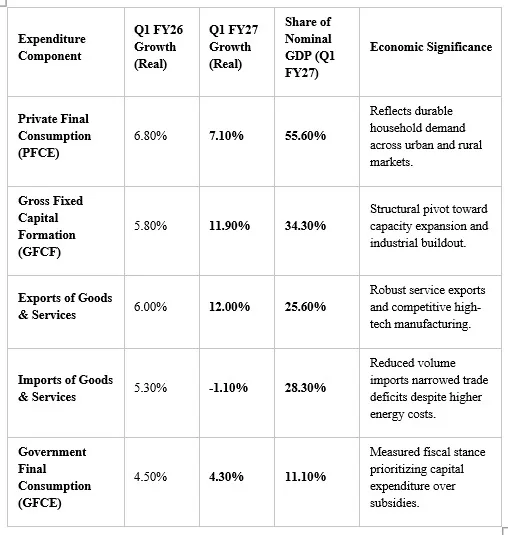
The trade figures highlight this efficiency: real exports grew 12.0 per cent, while real imports contracted by 1.1 per cent. By boosting domestic manufacturing, Bharat reduced its trade gap in volume terms, helping insulate its current account from global energy shocks.
Road to FY 2027 & Beyond
As external analysts and naysayers projected growth below 6.5 per cent and central bank estimates hovered around 7.0 per cent , Bharat’s actual 7.8 per cent growth rate surprised global forecasters. This momentum is supported by clear structural foundations:
- Infrastructure Pipeline: High-speed rail connections, modernised ports, and logistics corridors are steadily reducing domestic freight and business costs.
- Digital Public Infrastructure (DPI): Unified financial and logistics platforms continue to lower transaction costs for small and large enterprises alike.
- Strategic Energy Management: Diversified crude sourcing and expanded renewable capacity have helped absorb external oil shocks.
Bharat’s performance during this period reflects the stoic principle outlined in the Vidur Neeti: maintaining steady execution through external disruption. As the nation advances toward its vision of Viksit Bharat 2047, this combination of fiscal discipline, manufacturing growth, and steady investment offers a working blueprint for economic resilience in an uncertain world.