Rashtriya Swayamsevak Sangh progressively unfolds her eight-fold action matrix encompassing four endavours and four ends, deriving reverent inspiration from motherhood of Bharat. In the enlightened national interest of regenerating an integral, organic and harmonious eco-system, Sangh pursues four endeavors such as, public outreach, mobilization, orientation and responsibility identification and also envisages four ends including character building, public sensitization, qualitative societal changes and systemic transformation.
Etymologically connoting concentration in enlightenment, Bharat is a geo-culturally evolved living civilization space, standing tall in the face of cultural onslaughts of medieval-colonial perpetrators. Devotion, ideation and action towards an ethical quest characterizing her cultural essence and civilizational substance, thereby, resonate in ‘progressive unfoldment’ of Sangh through her eight-fold action matrix.
Vedic world view of eco-conscious aspirations and cosmic habitations gets nurtured by Bharatiya Rushi tradition, bearing worship, work and war through body, mind and speech as an eternal pursuit. In the prolonged yet ongoing quest for her selfhood against externally inflicted and structurally embedded self-amnesia, self-contempt and lack of unity, Bharat Mata has given birth a Rishi, who was later known as Dr Keshav Baliram Hedgewar.
The founder of Sangh, Hedgewar gave a meaningful shape to Swami Vivekanand’s strong conviction for creating ownership within society in terms of training individuals who could take responsibility for national regeneration. On September 27, 1925 of Vijaya Dashmi, Sangh was founded and formed in Nagpur, vital part of Madhya-Bharat, signifying a turning point in her liberation history, when cultural liberators working in Indian National Congress (INC) had almost taken a back seat.
The reversal of 1905 communal division of Bharat (Banga Bhanga under British rule) under the leadership of Lal, Bal, Pal with Vande Matram of Bankim Chander Chatterjee as the unifying warring slogan of liberation fighters had ushered in and awakened cultural self-respect in the hearts and minds of all Bharatiyas. Indeed, the movement of Hindutva (quality of being Hindu) had since regained prominence in greater Punjab, Maharashtra and Bengal.
The literary creations of Tilak and Gandhi in the forms of Geeta Rahasya and Hind Swaraj became the ideational milestones in the Bharatitya path towards cultural emancipation. In 1920, during the Congress session, Dr. Hedgewar proposed a resolution for INC to call for Poorna Swaraj (Complete Independence). He envisioned of Bharat not only striving for her own freedom but also working for the liberation of the world from the shackles of eco-cidal capitalist forces.
The positioning of INC on inter-imperial war between the British and Caliphate abruptly reversed the momentum that the penchant for realizing the enlightening nationhood gathered. For checkmating the sudden cultural recession, Sangh of Dr. Hedgewar had taken upon itself the commitment and solemn affirmation of sustaining the spirit and response that was spontaneously evoked by Vedic Enlightenment monks like Ram-Krishna Paramahansa, Vivekananda and Aurobindo.
Sangh has derived its consciousness and organizational legacy from discursive torch bearers like Valmiki, Gargi, Vyasa, Shankara, Tulasi, Ravi Das, Guru Nanak, Vivekananda, Tilak, Gandhi, Gopa Bandhu, Lohia and Dr. Ambedkar. It has taken similar inspiration from Dharmic warriors of history such as Rama, Krushna, Shivaji, Rana Pratap, Guru Govind Singh, Jai Raj Guru, Birsa Munda, Surya Sen, Kalpana Datta, Veer Kunmwar Singh, Chakhi Khuntia, Baji Rout, Rani Laxmi Bai, Laxman Nayak, Saheed Bhagat Singh, Khudi Ram, Subhash Chandra Bose and innumerable others.
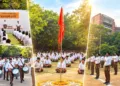
Sangh has remained steadfast in its cultural commitment amid freedom struggle by conducting character building exercise among children, youth and later on elderly people in Shakhas (daily congregation of Sangh volunteers). Sangh members have performed self-sacrificing functions while protecting the Hindus in the blood-spilling tragedy of partition. It continued its cultural expedition after political independence of Bharat, with timely intervention in externally perpetrated and internally induced crises.
However, Sangh has faced existential challenges through government proclamation of ban in the false pretext of its involvement in assassination of Gandhi. Sangh has managed to come out of such super-imposed crises with a feeling of self-authenticity. In the interest of addressing complex challenges for self-respecting Bharatiyas in multiple fronts and carrying out hassle-free ideational change through original mission of character building, some Sangh volunteers have started forming systems-changing front organisations.
Consequently, Sangh inspired organizations have come up in various fields, including education, worship, livelihood, trade, polity- public opinion refinement, economy, industrial work, agriculture, science, public health, social service, so on and so forth. These frontal organizations have registered and attained substantial success in their respective fields with autonomous and coordinated mandates. Evidently, Jayaprakash Narayan said: ‘If I get 100 Nanaji Deshmukh;’ ‘I will change India, If RSS is fascist then I am also a fascist;’ ‘If RSS is not revolutionary then nothing can be a revolution.’ Systemic transformation in terms of fundamental change in normative, institutional and procedural edifices indeed becomes demonstrated accomplishments of Sangh.
As Sangh intends to regenerate an integral, organic and harmonious eco-system, systemic transformation is predicated upon prerequisite accomplishments including character-building, public sensitization and qualitative societal changes. Experience illustrates that qualitative social change truly brings about desired systemic transformation with ease. The historical irony of entrenched cultural indignation and persisting social fragmentation due to normative, institutional and procedural subservience impels Sangh to adopt five-pronged social change initiatives under its Panch Parivartan campaign.
The creative interventions in five identified spheres such as harmonious living, family values, eco-consciousness, self-hood and sense of obligation remain the cornerstone of Sangha’s ongoing efforts toward the comprehensive reinvigoration of social life. Regeneration of such locally-rooted and globally inclusive eco-system is a function of four-fold endeavors such as, public outreach, mobilization, orientation and responsibility identification. Sangh has extensively engaged in societal training, sensitization and upliftment exercises through its own organizational verticals, schemes and programmes as well as through extending motivation, encouragement and support to organizations working with similar objectives.
Civilizational history has witnessed very few organizations likes of Sangh which have been able to celebrate their centenary year. The commitment of mainstreaming motherhood of Bharat as an inspirational template for national regeneration presently runs into an accelerated mode. Sangha through its all inclusive efforts undertakes functional consolidation by the means of activating untapped, enthused, creative, constructive, familial, youth, feminine forces to fructify ultimate objective of inter-belongingness between Sangha and society. Cherishing an integral worldview of organically inter-connected individuality, collectivity, creation and creator, Sangha throughout its journey has practiced easy confluence of devotion, ideation, action towards reverent motherhood of Bharat.