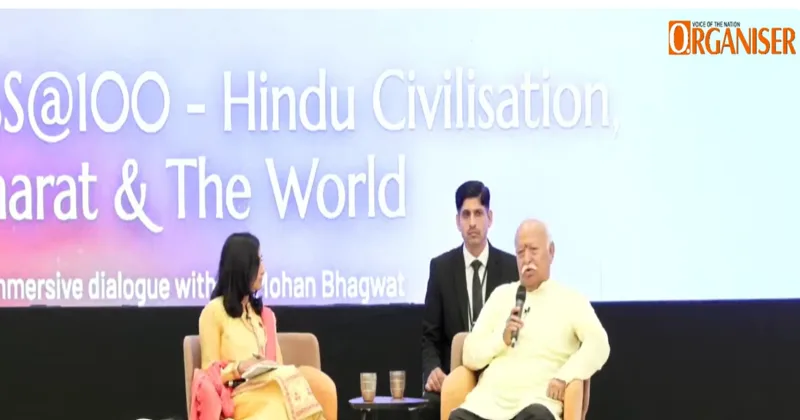
London: RSS Sarsanghchalak Dr Mohan Bhagwat expressed confidence in the younger generation, saying they has the urge to make the world a better place and is willing to rise above petty differences, while urging the older generation to provide them with purpose and experience without imposing methods.
Responding to a question on what gives him the greatest hope that the present generation will carry forward the work begun by earlier generations, Dr Mohan Bhagwat said he is confident about future generations and their ability to contribute towards making the world a better place.
“I’m more confident about future generations. They have the urge to make world a better place. And they are ready to shed their petty differences of all kinds for this purpose,” he said.
Dr Bhagwat said that younger people are often more honest and willing to act when they believe something is right. He explained that as people grow older, they gain experience and consequently become more cautious about the possible consequences of their actions.
He said the responsibility of the older generation is to provide the younger generation with a clear purpose and the necessary information gained through experience, without imposing methods on them.
“Set the goal. Not the method. And let them do it,” Dr Bhagwat said, adding that the younger generation could achieve the desired objectives in a more beneficial manner and more quickly than previous generations.
Responding to a question on the responsibilities of British Hindus if British and Indian interests were ever to diverge, Dr Bhagwat said there should ordinarily be no conflict between the interests of Britain and Bharat.
“If British Hindus are good and true Hindus, there will never be a conflict between British and Bharat interests,” he said.
He added that if such a situation arose, British Hindus would naturally stand with Britain, which is their Karmabhoomi.
Dr Bhagwat explained that Karmabhoomi is the land where a person lives and where his or her loyalties lie, while Janmabhoomi refers to the land of birth or origin. According to him, the values received from one’s Janmabhoomi or Punyabhoomi should be lived out in one’s Karmabhoomi.
“Hindutva never asks to betray your Karmabhoomi. You are living there, you are earning there, you have to pay,” he said.
He further said that people should live the values they have received from their Janmabhoomi or Punyabhoomi fully and rightly in their Karmabhoomi so that humanity may benefit from them.
Responding to a question on how the Indian diaspora, particularly younger generations in the UK and across the Commonwealth, can translate the values of Vasudhaiva Kutumbakam, service and unity in diversity into practical economic, social and humanitarian partnerships, Dr Bhagwat said that such an approach was already emerging globally.
He said the world had already begun using concepts such as “global” and “one world”, with several initiatives moving in that direction.
Dr Bhagwat said members of the diaspora could remain honest to their Karmabhoomi and strengthen themselves to serve their Karmabhoomi as well as humanity.
“If you have spare means and spare time to serve Bharat, remaining loyal to Britain, nobody prevents you to do that,” he said.
He referred to the contemporary approach of “think globally, act locally”, saying that people can contribute to global service while remaining faithful to the country in which they live.
According to Dr Bhagwat, being faithful to one’s Karmabhoomi while thinking and acting as a global citizen is not a contradiction but a logical evolution of one’s thought.
He explained that an individual’s progress benefits the family, the family’s well-being benefits the locality, and this process continues to expand. “It is expected that if a nation benefits, whole world should benefit from its development,” he said.
Dr Bhagwat said that the older model of development also contained an understanding of the relationship between human beings and nature.
He recalled how children in Bharat were traditionally told not to touch trees after evening because trees were considered to be resting at that time. He noted that while scientific evidence for such practices was not available then, it is available today.
He also referred to festivals in which plants and animals are worshipped, saying that such worship was symbolic and intended to develop concern for the well-being of nature among children.
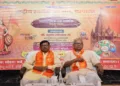
Notably, the dialogue was moderated by Mamata Subranhamnyam, a wellness expert based in the UK. The event, organised and initiated by the Hindu Swayamsevak Sangh (HSS), drew 600 people in the audience representing 326 organisations. Among important attendees during the event were Members of the House of Lords, MPs (Members of the House of Commons), Mayors, Councillors and the High Commissioner of Bharat to UK, Periasamy Kumaran, Deputy High Commissioner of Bharat to UK Kartik Pande and other leaders of community. The Programme began in silence, in memory of lives lost and families displaced by the Nepal floods. As it was informed during the event, Seva UK has raised 100,000 pounds through donations for relief efforts in Nepal.
During his visit to London, Dr Bhagwat met faith leaders, academics, researchers and other public figures. As part of his interfaith engagement, he visited Shree Swaminarayan Mandir in Willesden, Khalsa Jatha British Isles Gurdwara, and other religious places in London. More than 310 community organisations and associations from across the UK took part in the celebration. Notably, 11 Language communities in the UK, across sections of Hindu society, attended the event.