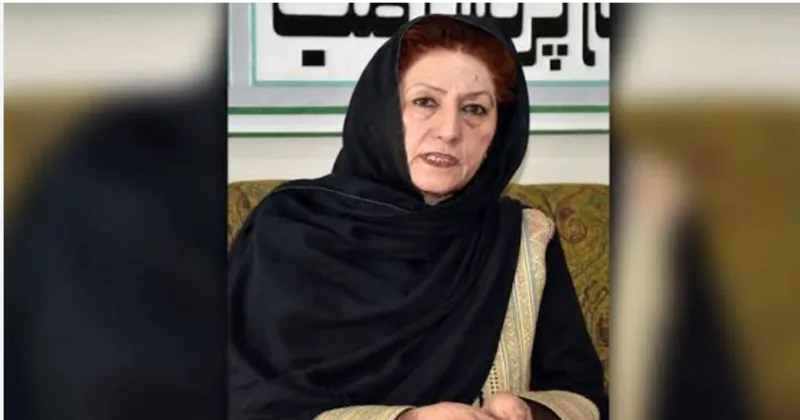
A well known and widely respected retired police surgeon, Dr Ayesha Faiz, has been arrested by the Counter Terrorism Department (CTD) on terrorism charges for speaking against Balochistan Chief Minister Sarfaraz Bugti. Earlier, a case was registered against her under Pakistan’s Anti-Terrorism Act (ATA), according to police sources.
Police said the case was filed following a press conference held at the Quetta Press Club. At this interaction with the media, Dr Faiz hasd criticised Balochistan Chief Minister Mir Sarfraz Bugti and the provincial Home Minister, according to a report of The Balochistan Post.
During this event, held a few days earlier, Dr Faiz spoke about the overall political situation in Balochistan, its historical background and recent developments. She also discussed the role of women in the Baloch independence movement and criticised CM Bugti’s reported remarks regarding the bulldozing of apple orchards in Mastung. She had also assailed the possible displacement of residents in the event of future violent incidents.
CM Sarfaraz Bugti to displace residents from several areas
Incidentally, CM Bugti has now said, on record in the provincial assembly that around 1,000 residents of the mountainous Shoor Paarod area in Kalat will be relocated and resettled elsewhere before a military operation is carried out in the region. Bugti said that camps belonging to what he described as “Fararis” (absconders) had never been completely eliminated from the mountains of Shoor Paarod since 1970.
Bugti said that “terrorists” had killed members of the public and security personnel, and defended his earlier remarks regarding the cutting of orchards, claiming that his statement had been taken out of context. “I cannot accept that armed militants could be hiding in an orchard without the owner’s knowledge,” he said, adding that those who fail to report such activity could be viewed as facilitators.
Police sources said the case had been registered under various provisions of the Anti-Terrorism Act. However, the specific sections invoked, the detailed grounds for her arrest and further information regarding the legal proceedings have not yet been disclosed.
Meanwhile, a senior politician Nawabzada Haji Lashkari Raisani condemned Dr Faiz’s arrest, stating that the government had crossed “legal and moral boundaries”. He further claimed that the arrest suggested Pakistan’s Constitution and the rule of law were not being applied in Balochistan.
Raisani also called on international human rights organisations to pay attention to the human rights situation in Balochistan and to play a role in preventing alleged violations. Separately, Baloch Yakjehti Committee (BYC) leader Dr Sabiha Baloch strongly criticised the arrest, describing it as an attack on civil liberties and public rights in Balochistan.
In a statement issued on September 5, Dr Sabiha said Dr Ayesha Faiz, who recently retired after serving for many years as the region’s only female police surgeon, was a senior citizen who deserved respect and dignity rather than arrest and mistreatment. She said Dr Faiz’s arrest was not merely an action against an individual doctor but reflected what she described as the rapidly shrinking space for civil and democratic freedoms in Balochistan.
Destruction of orchards in Balochistan criticised
Dr Sahiba referred to CM’s remarks regarding the destruction of orchards in Mastung and the displacement of local residents. She said many conscientious citizens had raised concerns over the potential consequences of such measures, including Dr Ayesha Faiz.
She argued that the orchards represented years of labour, investment and care by local communities and served as a source of livelihood for numerous families as well as a key component of the local agricultural economy. According to her, their destruction would not only damage private assets but also undermine livelihoods and economic stability in the area.
Dr Sabiha further said the destruction of orchards could have serious environmental consequences. She noted that trees play an important role in maintaining soil fertility and stability, protecting biodiversity, supporting local ecosystems and preserving environmental balance. Their removal, she said, could contribute to soil erosion, habitat loss, agricultural degradation and broader environmental risks.
She added that the issue was not simply about trees, but concerned environmental protection, economic security, the preservation of agricultural land and the right of local communities to have a say in decisions affecting their future.
Criticising the authorities’ response, Dr Sabiha questioned why a citizen who raised concerns over the potential consequences of a policy was arrested, while officials responsible for making such policy statements were not being held accountable.
She further stated that the arrest exposed what she described as an increasingly authoritarian approach to governance in Balochistan. She added that governments which respond to criticism with arrests demonstrate intolerance and insecurity.
Dr Sabiha called for the immediate release of Dr Ayesha Faiz and urged the authorities to address concerns regarding the proposed destruction of orchards, environmental impacts and the possible displacement of local residents.
No official statement responding to the remarks made by Raisani or Dr Sabiha Baloch had been issued by the government at the time of publication.
Enforced disappearances is the fate of 25 Zehri residents
Meanwhile, a curfew has reportedly been intensified in Zehri, where restrictions have remained in place for several months, amid reports of an operation by Pakistani forces. During the operation, Pakistani forces allegedly detained 25 residents from the Sunni area and subjected them to enforced disappearance. Operations have also reportedly been carried out in other parts of Zehri.
According to sources in Sunni, a woman who had gone to fetch water was killed in an alleged quadcopter attack carried out by Pakistani forces. Another woman and a man were also injured in the attack. Mobile phone services have been suspended in Zehri due to the curfew, making it difficult to obtain information about the identities of those reportedly subjected to enforced disappearance, as well as the woman killed and those injured in the attack.
Zehri, a tehsil of Khuzdar district in Balochistan, has reportedly remained under curfew for several months. Residents have been given designated hours to leave their homes and visit markets, while permission from security forces is required to travel outside the area.
Previously, during the curfew in Zehri, Pakistani forces allegedly killed more than 20 civilians during an operation in the Sohanda area. Dozens of people from different locations have also allegedly been subjected to enforced disappearance.