Every age retells the Ramayana in its own idiom, and every age discovers the same truth inside it. When Ram’s work is to be done, it calls for a particular kind of person: the strongest one in the room who wants nothing for himself. The tradition gives that figure a name. Hanuman.
Hanuman could leap an ocean and burn a fortress city, yet the image the devotees carry of him is not one of conquest. It is of a warrior with folded hands, his strength laid quietly at the feet of the Lord. Power, the epic teaches, is completed only by service.
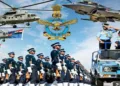
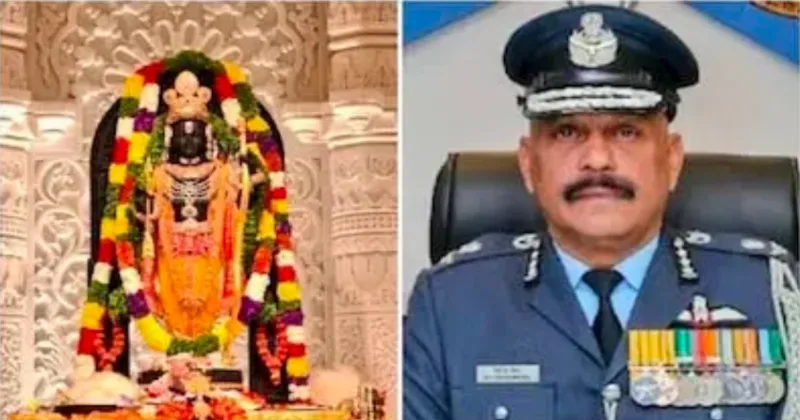
Ayodhya is about to watch that old pattern repeat itself. The Ram Janmbhoomi Teerth Kshetra Trust has chosen as its new Chief Executive Officer a man who spent 39 years as a warrior of the republic, Air Marshal Jeetendra Mishra, the commander who led the air campaign of Operation Sindoor and holder of the Sarvottam Yudh Seva Medal, a wartime honour only ten officers have ever received.
The devotional grain runs deep in him, and it begins with his very name for himself. Mishra is a Saryuparin Brahmin, of the community that takes its identity from the banks of the Saryu, the river on whose ghats Ayodhya stands and in whose waters Ram Lala’s city bathes every morning. He was born in Deoria in eastern Uttar Pradesh, in the heartland where the Ramkatha is not literature but daily life. Hindi is his mother tongue, he studied Sanskrit through school, and he belongs to the Vaishnav tradition.
The warrior’s half of the story is just as complete. He entered the National Defence Academy at seventeen, took a fighter cockpit at twenty, and spent the next four decades in the most demanding corners of the Air Force: experimental test flying, command of frontline fighter bases, the rebuilding of Pathankot after the 2016 terror attack, and finally the apex command of the western front. In May 2025, when India answered the Pahalgam massacre, the air war was his to run. On Independence Day that year, the President decorated him for it.
Then came the fork in the road that every retired commander knows. Delhi is generous to men with records like his. There are boards to sit on, consultancies to sign, comfortable years available for the asking. He chose instead to fill out an application form, one of 5,585 the Trust received, scrutinised through secretariat lead by Shri Sameer Panda using AI, Information Technology, personal interactions and verifications through a team of dedicated volunteers like Nitesh Mishra, Nippon Dash, Nikhil Srivastava, Gyana Ranjan Panda, Vaibhav Jape and others; and to be tested like everyone else: screened, verified, assessed online, and finally interviewed face to face in Ayodhya in August, one of sixteen finalists with no rank on his shoulders, only a lifetime of service behind him.
His written application contains a sentence worth quoting, because it reads less like a vision statement and more like a vow. He wants a temple, he wrote, where every devotee experiences safety, dignity and darshan of the highest spiritual order, where every rupee entrusted to the Trust is stewarded with complete transparency, and where the temple’s traditions and security are governed with the discipline befitting a national institution of enduring significance.
Safety. Dignity. Darshan. Discipline. It is the vocabulary of a soldier put entirely at the disposal of the divine, and it is why the comparison that has begun to circulate in Ayodhya does not feel like flattery. The belief is old and beloved: wherever Ram’s name is sung, Hanuman is present, listening. Ayodhya now adds a corollary of its own. Where Ram’s house must be kept, a warrior has come to keep it.
The Saryu will flow past the temple tomorrow as it has for thousands of years. What changes is the man standing watch on its banks: a fighter pilot who once guarded the nation’s skies, now guarding something older than the boundaries of the today’s nation state itself.