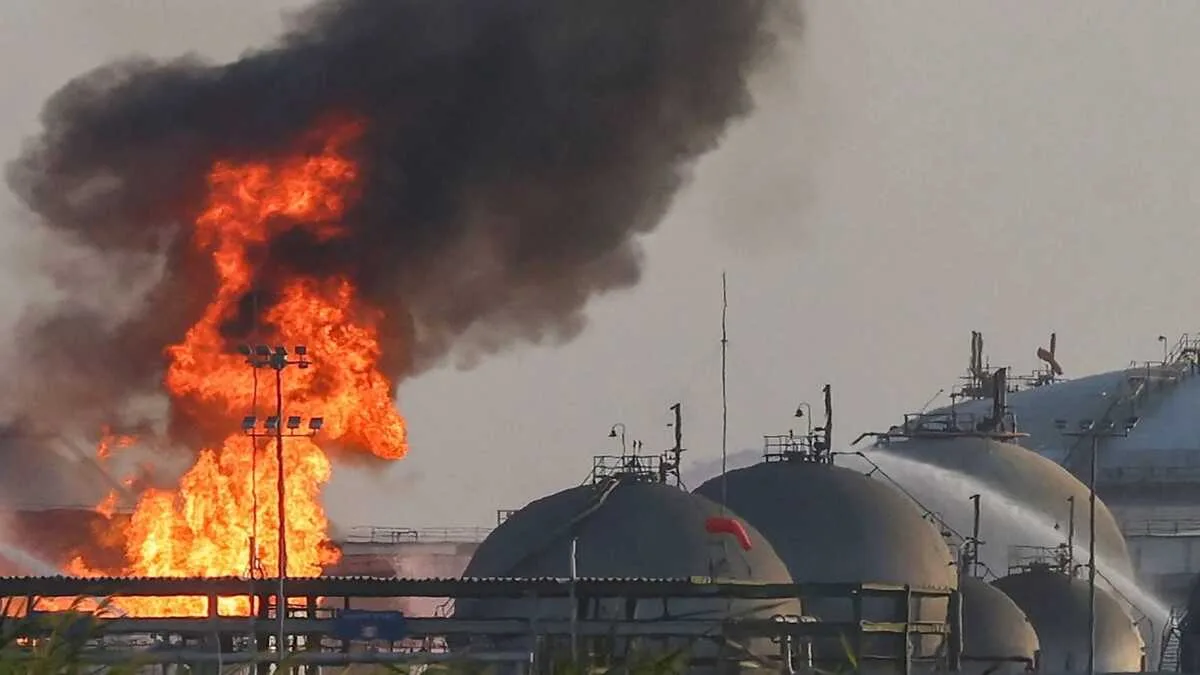
West Asia witnessed a fresh escalation on October 13 after a ballistic missile struck an administrative building at Saudi Arabia’s state-owned oil giant Saudi Aramco in Dhahran, following Saudi military strikes on an oil facility in Yemen’s Houthi-controlled capital, Sanaa. The attacks marked a sharp intensification of hostilities between Saudi Arabia and the Iran-aligned Houthi terror movement, raising concerns over the security of critical energy infrastructure and regional shipping routes.
A source familiar with the incident told Reuters that the ballistic missile hit the Saudi Aramco headquarters complex in Dhahran, damaging the top three floors of an office tower. Saudi Arabia’s Ministry of Energy confirmed that an administrative building had been attacked and that a limited fire broke out. Authorities responded to the incident, and the ministry reported no casualties.
The strike followed Saudi military action against the Yemen Petroleum Company’s al-Sabah central station, a fuel depot on the outskirts of Sanaa. The Saudi-led coalition had issued an evacuation warning to civilians before the operation. Houthi-affiliated media reported explosions at the facility, while the group’s spokesperson, Yahya Saree, threatened retaliation against Saudi targets.
Houthis threaten retaliation after Sanaa oil facility strike
The confrontation intensified after Houthi officials accused Saudi Arabia of attacking Sanaa and warned of a response against the kingdom’s oil infrastructure. Saree had earlier warned that Saudi strikes on the Yemeni capital would trigger a “harsh and painful” response, naming Saudi Aramco’s headquarters in Dhahran and an oil refinery in Riyadh among the potential targets.
Houthi-run Al-Masirah television reported that the Saudi-led coalition had struck the Yemen Petroleum Company’s al-Sabah central station. The coalition said the operation was intended to neutralise the Houthis’ capabilities to threaten Saudi Arabia, Yemen and international waterways. Coalition spokesperson Major General Turki al-Maliki accused the movement of using the facility and underground fuel depots to store weapons and support its missile and drone operations.
Saudi Arabia has resumed military operations in support of Yemen’s internationally recognised government as fighting between government forces and the Houthis intensifies. The renewed campaign followed Houthi advances along Yemen’s western coast towards the strategically important Bab el-Mandeb Strait, a major maritime passage connecting the Red Sea with the Gulf of Aden.
The conflict has also spread across several areas of Yemen, including Taiz, where government forces and Houthi terrorists have continued to clash. The group’s recent territorial advances and the government’s counteroffensive have added to concerns about civilian safety and the stability of vital trade routes.
Missile attacks injure Riyadh residents as regional tensions rise
The attack on Saudi Aramco came amid a wider Houthi missile and drone campaign against Saudi targets. Riyadh’s King Khalid International Airport was struck on October 10, 2026, in an attack that reportedly killed 13 people and injured more than 300, making it the deadliest such incident in Saudi Arabia in a decade. Another projectile reportedly killed one person and injured 11 others at the airport on October 11.
Saudi authorities said they had intercepted missiles and drones directed towards Riyadh, Dhahran and southern parts of the kingdom. According to Saudi Civil Defence, debris from two intercepted Houthi missiles injured four people in Riyadh and damaged 15 homes. The injured included two women, a man and a child.
The attacks have disrupted air travel across the region. Several international airlines, including Air France-KLM, Air India, Etihad Airways, Lufthansa, Delta Air Lines, Gulf Air and Qatar Airways, suspended or altered flights to Saudi Arabia and neighbouring countries following the escalation.
The worsening security situation has also raised concerns about the potential impact on global energy supplies. Saudi Aramco operates an extensive network of oilfields, pipelines, refineries and export terminals, making its infrastructure central to the kingdom’s energy sector. The company’s Dhahran complex houses a major operations centre overseeing its activities.
Saudi Arabia’s Cabinet, chaired by Crown Prince Mohammed bin Salman, had warned that the Houthis would face consequences for repeated attacks on the kingdom. Meanwhile, the United States, Saudi Arabia’s longstanding security partner, had not committed to direct military intervention against the Houthis.
The renewed fighting is unfolding against the backdrop of the wider US-Iran conflict, which began on February 28, 2026. Iran’s Foreign Minister Abbas Araqchi has offered to mediate between Saudi Arabia and the Houthis, according to statements reiterated by Iran’s Foreign Ministry.
With missile attacks reaching major Saudi cities and military strikes hitting fuel infrastructure in Yemen, the latest escalation has placed energy facilities, civilian populations and strategically important maritime routes at growing risk.
Israel has also been drawn into the widening regional tensions, with its security establishment monitoring Houthi missile and drone capabilities and the threat to Red Sea shipping. The Houthis have previously launched attacks towards Israel in support of Iran-aligned groups, prompting Israeli military responses in Yemen. Any further escalation involving Israel could widen the confrontation beyond Saudi Arabia and Yemen, increasing risks to regional security and international maritime trade.