New Delhi : China’s Communist Party regime has taken two significant legal steps that are raising fresh concerns about its preparations for a possible Taiwan war or a wider Indo-Pacific conflict. On Aug. 28, the Chinese Communist Party (CCP) regime revised its National Defense Mobilization Law, substantially expanding the state’s authority to mobilize civilian resources, seize private assets and integrate the technology sector into national defence preparations.
Separately, new Regulations on Exit-Entry Administration are scheduled to take effect on Sept. 15, tightening the government’s ability to control who enters and leaves China.
The revised National Defense Mobilization Law, which will come into force on Oct. 1, is the first major overhaul of China’s national defence mobilisation framework since 2010. Analysts have warned that the timing and scope of the changes could indicate that the CCP is strengthening the legal and logistical foundations required for a rapid transition from peacetime to wartime.
The changes are particularly significant because they extend mobilisation beyond conventional military manpower. China can now draw more extensively on civilian transportation, industrial capacity, technology, data, equipment and technical personnel. The law also creates a broader legal framework for requisitioning and expropriating civilian resources, potentially giving the Communist Party of China greater control over the private sector during a national defence mobilisation.
Private property and foreign businesses face new risks
One of the most consequential changes is the expansion of the previous concept of “requisition of civilian resources” into “expropriation and requisition of civilian resources.” Under the revised framework, civilian means of transport, sites, equipment, manufacturing capacity, data and technical personnel can potentially be mobilised by the state.
Article 64 makes the obligation explicit, stating that “Any organization or individual has the obligation to accept the requisition or expropriation of civil resources in accordance with the law.” The provision effectively reinforces the CCP government’s authority over resources that would normally remain under private ownership.
There is an important distinction between requisition and expropriation. Requisition is generally temporary, with the government required to provide compensation or a daily fee and compensate for damage. Expropriation, by contrast, involves permanently transferring private property into state ownership for public use. If expropriated property is damaged, the consequences for the private owner can be severe, including the loss of the underlying investment.
"We should not make compromises because of China's bullying." Taiwan's Foreign Minister Lin Chia-lung defended the country's participation at the Pacific Islands Forum in Palau. pic.twitter.com/Bh2UghhBDY
— TaiwanPlus News (@taiwanplusnews) September 1, 2026
The implications extend beyond Chinese-owned companies. Businesses and ventures owned by Taiwanese or foreign investors, including joint ventures and wholly foreign-owned enterprises operating in mainland China, can also fall within the scope of requisition or expropriation. The revised framework does not establish a separate exemption for Chinese, Taiwan-owned or foreign-owned businesses where the assets fall within China’s sovereign jurisdiction.
For foreign investors, the possibility that private assets could be mobilised or permanently transferred to state ownership during a national defence emergency could further deepen concerns about operating in China. Such provisions could potentially accelerate the existing exodus or diversification of foreign businesses away from mainland China.
The significance becomes even greater in a potential Taiwan war or broader Indo-Pacific war. If military conflict erupted in the Taiwan Strait, East China Sea or South China Sea and democratic countries imposed sanctions on China, the CCP would have a much broader domestic resource base from which to sustain military operations.
China’s tech sector drawn deeper into the war machine
The revised law also strengthens the connection between China’s civilian technology and industrial sectors and the People’s Liberation Army (PLA). Advanced technologies and civilian technological and industrial capabilities are to be integrated more closely into the national defence system.
This has particular implications for strategic technologies such as artificial intelligence, drones and cyberspace. China’s enormous technology and manufacturing ecosystem could therefore become increasingly important to the PLA in the event of an Indo-Pacific war.
The underlying concept is consistent with the CCP’s broader effort to fuse civilian and military capabilities. In a Taiwan conflict, modern warfare would not be restricted to soldiers, tanks, ships and aircraft. Artificial intelligence, unmanned systems, communications networks, data, cyber capabilities, semiconductor-related infrastructure, logistics and industrial production could all become strategically important.
The revised National Defense Mobilization Law provides a legal mechanism for bringing these civilian capabilities into the defence system. That could give the Chinese Communist Party greater capacity to redirect industrial production and technological resources towards military requirements during a crisis.
Chen Kuan-ting, a Democratic Progressive Party legislator serving on Taiwan’s Legislative Yuan’s Foreign and National Defense Committee, told Taiwanese media outlet FTNN on Aug. 31 that China had significantly revised its national defence mobilisation system for the first time in 16 years. He said the revisions explicitly incorporated economic and social resources into the mobilisation framework and strengthened China’s ability to move rapidly between peacetime and wartime operations.
Chen warned that Taiwan must remain highly vigilant about China’s increasing integration of civilian resources, industrial capacity and technological capabilities into its military system.
Exit-Entry rules add another layer of control
The revised defence law is being accompanied by another development that has attracted attention: the CCP’s new Regulations on Exit-Entry Administration. The regulations are scheduled to officially take effect on Sept. 15.
The timing has fuelled concern because the new exit-entry framework could strengthen the Chinese regime’s ability to restrict citizens from leaving the country at a moment when it is simultaneously broadening the legal basis for national defence mobilisation.
Under the revised National Defense Mobilization Law, male citizens aged 18–60 and female citizens aged 18–55 are required to perform national defence service. Individuals possessing special expertise are not subject to the same age restrictions.
The age provisions are particularly significant in the context of China’s demographic challenges. The Chinese regime is confronting a low birth rate and an ageing population, making the available pool of military manpower an increasingly important strategic consideration. Clearly defining the age groups subject to national defence service also ensures that the wider Chinese public understands that they could potentially be called upon during a war.
On Taiwan's Penghu Islands, troops and civilians are preparing for what military experts say could be the front line of a Chinese attack on Taiwan. Reuters looks at how the strategically important archipelago is bolstering its defenses https://t.co/3J2t1lAgQp pic.twitter.com/gxtkejfWwZ
— Reuters (@Reuters) August 28, 2026
The new exit-entry rules have therefore generated speculation that restrictions on overseas travel could help the CCP retain a pool of potential military manpower and other strategically valuable personnel inside China. After Sept. 15, wealthy Chinese citizens and others seeking to leave the country could potentially face greater difficulties depending on how the rules are applied.
Together, the exit-entry regulations and the revised defence mobilisation law raise a broader question that is Beijing simply strengthening routine national security legislation, or is the CCP systematically preparing Chinese society for a possible wartime environment?
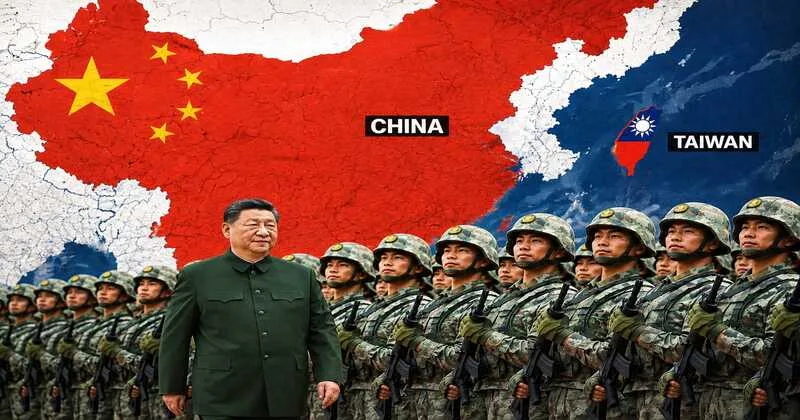
Taiwan, Xi Jinping and the shadow of a war
The geopolitical backdrop makes the developments particularly striking. Tensions have steadily increased because of China’s growing military and political pressure on Taiwan and its increasingly assertive behaviour in the South China Sea. A confrontation could potentially involve Taiwan, neighbouring Indo-Pacific countries or the United States.
Any attempt by China to launch a Taiwan war would require extensive logistical preparation. Beijing would need access to manpower, transportation, industrial production, technology, data and other civilian resources. The revised National Defense Mobilization Law appears to provide the CCP with considerably greater legal authority to mobilise precisely these resources.
The law does not itself prove that Xi Jinping has decided to attack Taiwan. However, its provisions demonstrate that the Chinese Communist Party is preparing the legal architecture for a society in which civilian resources can be rapidly redirected towards national defence.
The reaction inside China has also revealed public anxiety. One social media post warned that by suddenly approving the revised National Defense Mobilization Law, the “Supreme Leader” could drag the Chinese people into the “abyss of war.” Another warned that the current trajectory suggested preparations for the forced annexation of Taiwan.
Concerns are particularly pronounced among younger Chinese citizens. China’s official youth unemployment rate stood at 17.9 percent in July, an 11-month high. Other research has suggested that the actual unemployment rate among young people could be substantially higher, potentially exceeding 40 percent amid China’s sluggish economy.
The combination of economic frustration, unemployment and demographic pressure creates another layer of domestic vulnerability for Xi Jinping’s government. Some observers have argued that a military conflict could be used to redirect public dissatisfaction.
Nevertheless, the possibility cannot be completely dismissed that Xi Jinping could eventually take a high-risk decision to attack Taiwan if domestic and geopolitical pressures intensify.
For now, the revised National Defense Mobilization Law and the new exit-entry regulations do not amount to proof that a Taiwan war is imminent. But together they reveal a China preparing for a far more comprehensive mobilisation of society, industry, technology and manpower.
If conflict erupts in the Taiwan Strait, East China Sea or South China Sea, the CCP would have a stronger legal foundation for commandeering civilian resources and directing private economic and technological capabilities towards the war effort. The Oct. 1 implementation of the revised defence law and the Sept. 15 entry into force of the new exit-entry regulations therefore deserve close attention.