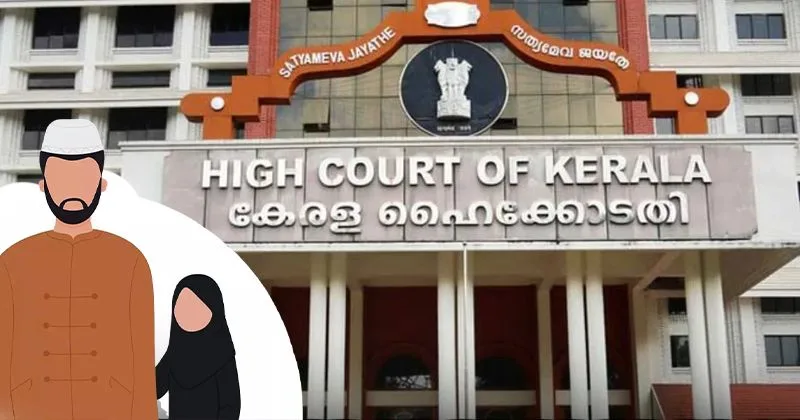
The Kerala High Court has held that even if a marriage with a minor girl is assumed to be valid under Muslim personal law, it cannot override the Protection of Children from Sexual Offences Act, 2012.
The ruling came in a petition filed by the first accused in Crime No. 461 of 2022 of Mannarkkad Police Station. He sought quashing of proceedings for offences including kidnapping, repeated rape and aggravated penetrative sexual assault under the IPC and POCSO Act.
According to the prosecution, the accused took the girl to his residence on October 23, 2021 and repeatedly subjected her to sexual intercourse over the following days. These allegations are yet to be tested at trial.
Download the Kerala High Court Order: Crl.M.C. No. 8899 of 2024, Kerala High Court, Justice Jobin Sebastian, decided on August 19, 2026; Neutral Citation: 2026:KER:64110..
The accused, however, argued that the prosecution was an abuse of process because the girl was his legally wedded wife. His counsel submitted that the marriage had been solemnised according to Islamic religious rites on July 23, 2021, when the girl was 17 years and one month old, in the presence of both families. Statements of the girl, her brother and the Khazi were relied upon to support the claim.
Justice Jobin Sebastian first held that whether a valid marriage had in fact taken place was itself a matter for trial, particularly in the absence of documentary evidence establishing its solemnisation.
But the Court went further.
Even assuming that the marriage had been solemnised according to Muslim religious rites, it held that this would not “salvage” the accused from criminal liability under POCSO.
The reason is statutory. Section 2(1)(d) of POCSO defines a child as any person below 18 years. Section 42A gives the Act overriding effect wherever its provisions are inconsistent with another law. POCSO therefore applies where one party to the marriage is a minor, irrespective of the validity of that marriage under personal law.
Relying on its earlier decision in Khaledur Rahman v. State of Kerala, the Court reiterated that marriage is not excluded from the sweep of POCSO and that personal or customary law must yield to the statute to the extent of inconsistency.
The Court also rejected reliance on the old marital exception under Section 375 IPC. Referring to the Supreme Court’s judgment in Independent Thought v. Union of India, it noted that the exception had already been read down so that intercourse with a wife below 18 could not be kept outside the definition of rape merely because of marriage.
Importantly, this is not a judgment declaring the accused guilty. The High Court was deciding only whether the criminal case should be terminated at the threshold. It found that the allegations, if accepted at face value, prima facie disclosed the offences and therefore refused to quash the proceedings.
The legal principle is nevertheless clear: where Parliament has fixed 18 as the age below which a child receives POCSO protection, personal law cannot create an exception. The protection attaches to the child, irrespective of the religious form in which a marriage is claimed.