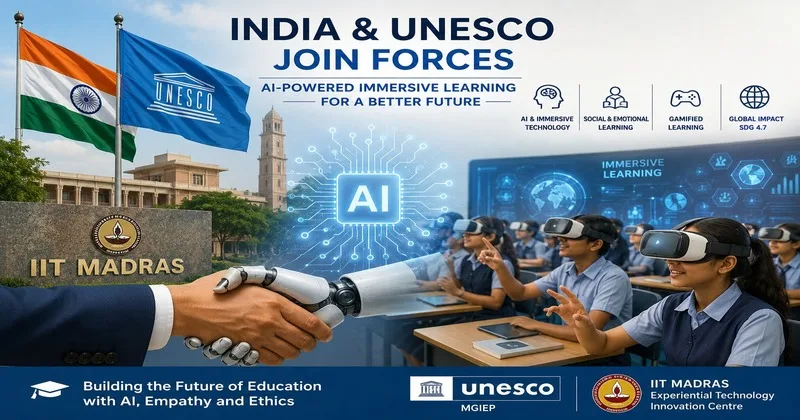
New Delhi: The world of education is moving towards a transformation in which artificial intelligence, extended reality and gamification will become part of the learning process alongside books, blackboards and traditional classrooms. It is in this direction that UNESCO has sought India’s assistance, a task that the Indian Institute of Technology Madras is now set to undertake.
In fact, the UNESCO Mahatma Gandhi Institute of Education for Peace and Sustainable Development, the first and only specialised institute of its kind in the entire Asia-Pacific region, is set to develop next-generation AI-powered immersive learning technology in collaboration with India. The objective is to bring about a fundamental transformation in the way education is delivered across the world.
The aim is not to replace the existing curriculum or create a new subject. Instead, the AI tools to be developed will seamlessly incorporate social and emotional learning into existing educational content. Gamified and immersive experiences will encourage students to participate more actively in the learning process.
UNESCO MGIEP Emphasis on AI Ethics
Speaking about the partnership, Prof Obijiofor Aginam, Director of UNESCO MGIEP, said, “UNESCO MGIEP will contribute its expertise in social and emotional learning, and this initiative has been undertaken in line with UNESCO’s recommendations on AI ethics and learner-centred education. The tools will provide teachers with a practical framework for incorporating SEL into lesson planning, teaching activities and assessment, which is expected to reduce their workload. Teachers will also be able to further customise the tools to make them more precise and relevant to a particular context.”
Global Initiative Aligned with SDG 4.7
Prof Obijiofor Aginam further explained that the technology developed under the partnership would be designed for large-scale implementation, making it possible to use it across different countries and education systems. The initiative is aligned with United Nations Sustainable Development Goal 4.7, which seeks to promote education that contributes to the development of peaceful, inclusive and sustainable societies.
He said, “Alongside technology development, both institutions will undertake joint research in the fields of educational technology, pedagogy, AI and the science of learning. Research collaboration across disciplines will be encouraged through exchanges of faculty and researchers, workshops, conferences and seminars.”
Prof M. Manivannan, faculty member in the Department of Applied Mechanics and Biomedical Engineering at IIT Madras and Head of the Experiential Technology Innovation Centre, said, “One of the major benefits of this partnership will be the development of AI-powered tools capable of bringing about a fundamental transformation in the existing curriculum. It will achieve this by integrating social and emotional learning concepts and adding gamified and immersive learning experiences.”
He clarified, “Rather than being introduced as a separate subject, this technology has been designed to integrate SEL effectively into existing educational content. As a result, studying is expected to become more engaging for students, teaching easier for teachers, and implementation easier for educational institutions.”
Personalised and Gamified Learning Pathways
The proposed AI tool will analyse the existing curriculum and create personalised and gamified learning pathways incorporating social and emotional learning components. Through immersive technology, the classroom will be transformed from a space where students passively receive instructions into an environment where they learn through experience.
The process is also envisaged to increase student engagement while providing real-time emotional feedback. This is expected to help develop life skills such as self-awareness, self-management, responsible decision-making, relationship-building and social awareness.
Efforts to Make SEL an Integral Part of Education
Om Sharma, National Co-Convenor of the Shiksha Sanskriti Utthan Nyas, said, “The education sector has long faced the challenge of practically incorporating social and emotional learning into the mainstream curriculum. Undoubtedly, one of the key objectives of this partnership is to develop a technological solution to this challenge. Through AI and immersive technology, SEL will become part of daily classroom activities, so that instead of being viewed as an additional educational requirement, it becomes integrated into the normal process of education.”
The collaboration agreement was signed in the presence of Prof Obijiofor Aginam, Director of UNESCO MGIEP; Prof Manu Santhanam, Dean of Industrial Consultancy and Sponsored Research at IIT Madras, representing India; and Prof M. Manivannan, Head of the Experiential Technology Innovation Centre at IIT Madras.