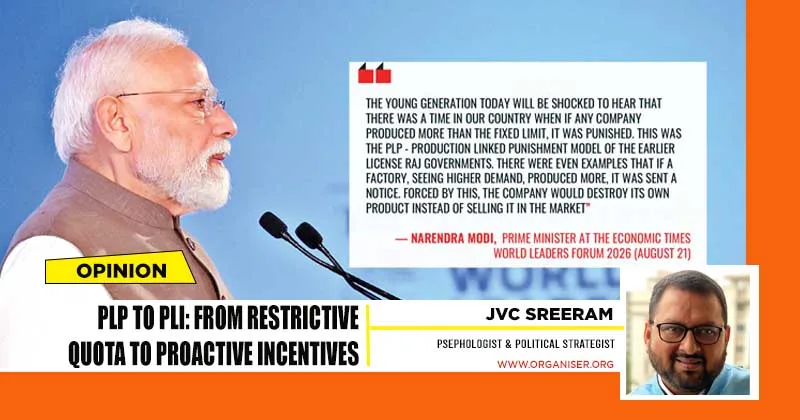
While Prime Minister Narendra Modi was addressing the Economic Times World Leaders Forum on August 21, 2026, he mentioned that “Bharat has moved from Production Linked Punishments to Production Linked Incentives.” He also added that there was a time when companies were penalised for producing beyond prescribed limits. The underlying system which the PM described was true. Bharat had a system of industrial licensing and Government-controlled production capacity. Companies could not always meet rising demand by simply increasing production.
“Production Linked Punishment” was not the name of the law. But the laws of yesteryear clearly indicate that, if you apply the spirit of the law, the Prime Minister’s description of the old law was apt.
Dubious License Raj
The legal foundation for this system was laid in the year 1951 with the introduction of the Industries (Development & Regulation) (IDR) Act, 1951. The IDR Act established the framework for industrial licensing. It provided Government control through:
- Licensing of new industrial undertakings
- Licensing of new articles/products
- Licensing of substantial expansion
- Control over production capacity
- Government was empowered to regulate production and fix standards
In short, this was when the infamous License Raj began during the first term of late Jawaharlal Nehru’s premiership. This meant companies had to run from pillar to post to get permits to open a factory, expand operations, add new production lines, and even diversify their industries. Entrepreneurs worried more about approvals, permits, and even punishments for deviating even slightly from regulations. The system was designed in such a manner that industrial houses had very little incentive to invest in Research & Development, market expansion and innovation, which are the primary drivers for businesses to succeed.
When the infamous License Raj began during the first term of late Jawaharlal Nehru’s premiership, companies had to run from pillar to post to get permits to open a factory, expand operations, add new production lines, and even diversify their industries
In 1969, the second layer of control came through late Indira Gandhi’s Government with the MRTP Act (Monopolies and Restrictive Trade Practices Act, 1969). This legislation created a new set of problems for industrial houses and citizens. Large business houses had to obtain more approvals to establish new undertakings, undertake substantial expansion, or pursue mergers or amalgamations; they also faced restrictions on production capacities, and the Restrictive Trade Practices (RTPs) clause was draconian because RTPs could block the flow of capital or profits in the market.
The deadly combination of the IDR Act 1951 and the MRTP Act 1969 meant the Government treated business houses with suspicion and appointed several committees to formulate mechanisms to check the concentration of power in the hands of a few. During Indira Gandhi’s regime, the Government’s socialist policies hit their zenith, causing irreparable harm to the country and its economy.
Proof of conventional economy
Demand 🡪 Production🡪Supply
Regulation🡪License🡪Permitted Capacity🡪Production🡪Supply
What this meant for Industrial Houses?
- Expansion required Government permission
- Increasing production capacity was becoming a nightmare
- Any new industrial activity, including adding one more line of production, required approval from Government officials
- Businesses became dependent on administrative decisions
- Industry was in no way able to respond to the market demand
What this meant for Citizens?
- Scarcity
- Queues
- Huge waiting period
- Limited choice
- Poverty
In short, the system was designed to fail. Forget about ‘Ease of Doing Business’. Doing business itself was a nightmare: if they produced even a little more than what was licensed, the business house was issued notices and penalties were charged. Let us look at how these two Acts impacted citizens.
- People had to wait years after booking a scooter because scooter companies were allowed to produce only so many each year.
- Even if a citizen could afford to buy a car, it was not possible because automotive companies were instructed to produce only so many vehicles each year.
- Pharma companies were not allowed to produce vaccines according to the requirements, but policies and bureaucrats dictated that, thereby depriving citizens of life-saving drugs. This also made hoarding and black marketing the order of the day.
- The Government heavily restricted private electronic and consumer goods manufacturing to protect PSU’s like HMT
- Licenses decided how much you were going to produce.
- Even FMCG essentials like Horlicks would go out of stock, depriving children of a healthy drink
- The dream of building and owning a home remained a dream on paper for many, since cement and steel production was regulated. Companies were told that their maximum production could only be so much and if they tried to produce more, they were penalised. l From my own personal experience, I can say that in our home we waited for more than six long years after booking for an LPG connection. We had to wait for years to get a telephone line connection. The joke in those days was that if someone wanted an urgent telephone connection, they would contest elections so they could get a telephone
line on priority.
A nation can grow only when money flows in the market. Successive Congress Governments under Nehru, Indira Gandhi, and Rajiv Gandhi kept the nation in a state of poverty. They did not see entrepreneurs as partners in nation-building. Instead, they saw them as people there to loot money.
Recounting Nightmarish Ordeal
An example is the story from TCS. In the early 1970’s TCS wanted to import a Burroughs mainframe computer to offer advanced computing services. What TCS faced was Red Tapism, delays and obstacles from Department of Electronics, Ministry of Finance, Ministry of Commerce, Ministry of Industries, MRTP authority and others. The estimated delay was two years. Neither TCS nor their clients could afford to wait. Engineers wrote software on ICL 1903 was available in India. A software filter was developed to run the programmes on Burroughs system in the USA for testing. Finally, instead of bringing the mainframe to India, TCS took their engineers to the USA to deliver. In fact, this was when the brain drain started.
Finally, TCS got permission to import the machine, but it came with a 100 per cent import-duty clause: to import a $300,000 machine, TCS had to pay an additional $ 300,000 to the Government, on the condition that it export software worth $600,000 in the next five years. If TCS failed to achieve that target, the Government had every right to confiscate the machine, impose heavy financial penalties, and impose business sanctions. The larger story is that:
- System punished the entrepreneurs
- They were not seen as partners in nation building
- They were viewed as suspects who must be controlled
- Production Capacity was capped
- Growth was capped
- Innovation was stifled
- Potential was wasted
And citizens suffered from scarcity, limited choices of product availability in the market, years of waiting to get even LPG & Phone connection, unavailable medicines, scarcity of electronics and poor standards of living.
In the year 1991, Congress formed a minority Government with PV Narashimha Rao as the Prime Minister. He appointed Manmohan Singh as Finance Minister. India’s economy was in shambles and was on the brink of breakdown.
- Foreign exchange reserves fell to about 2 weeks of imports
- Fiscal deficit was 8.4% of GDP
- Current Account deficit was above 2.5% of GDP
- There was a real threat of default on external debt obligations
On July 1st and July 3rd 1991, the Rupee was devalued by about 18 per cent to 19 per cent. Financial reforms were announced and Indian markets were opened up. The reforms were significant steps toward ending the License Raj. It was done on compulsion.
Thirty-five years after the financial reforms, today we are witnessing a policy transformation from Production Linked Punishments to Production Linked Incentives.
License 🡪 Permission 🡪 Capacity Restriction 🡪Limited Production🡪Supply Scarcity
This was how Production Linked Punishments looked like.
Today, under Narendra Modi’s Premiership the formula is: Investment🡪Production🡪Sales/Exports🡪Incentive from Government
Produce More🡪Sell More🡪Earn More🡪Get Rewarded.
Production Linked Incentives:
Modi Era(December 31st 2025)
Actual Investment: Rupees 2.16 lakh crores
Production & Sales: Rupees 20.41 lakh crores
Exports: Rupees 8.3 lakh crores
Direct & Indirect Employment: 14.39 lakhs generated
836 Applications Approved
Production Linked Incentives Disbursed: Rupees 28,748 crores distributed
This is the transformation that is happening right in front of our eyes. From 1947 to 1991, successive Congress Governments under Jawaharlal Nehru, Indira Gandhi and Rajiv Gandhi punished people who strived to produce more, but today the Government under Narendra Modi is incentivising people who produce more. This is a chalk-and-cheese difference.