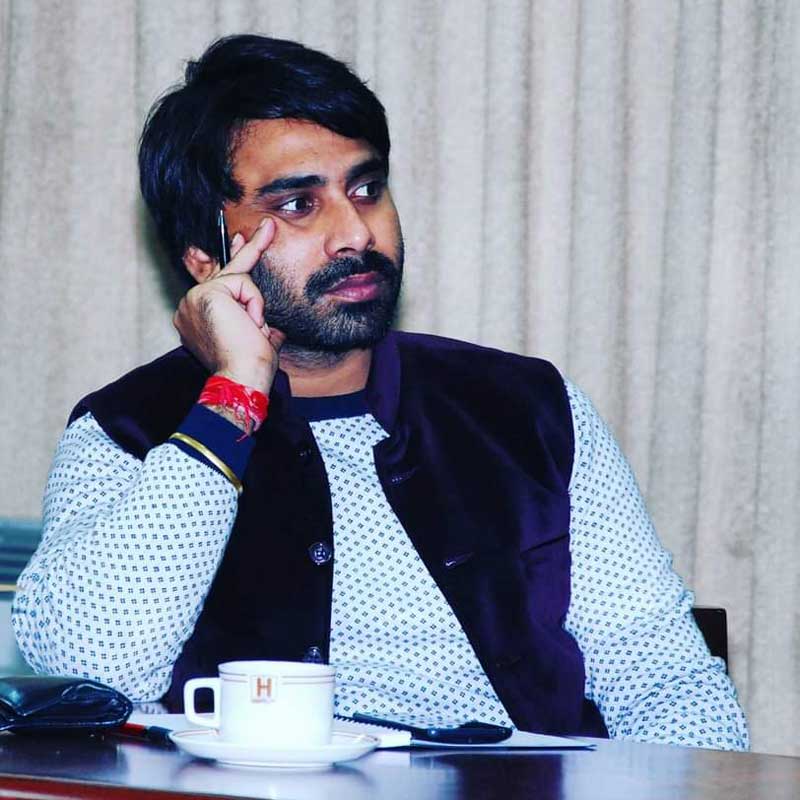

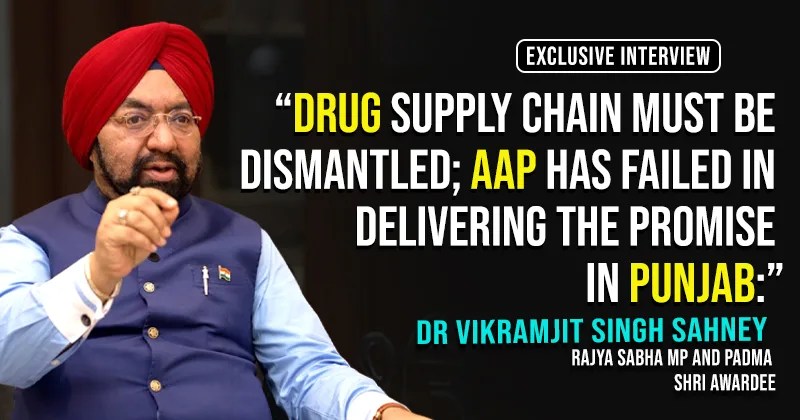
In an exclusive conversation with Organiser Assistant Editor Nishant Kumar Azad, Rajya Sabha MP and Padma Shri Awardee, Dr Vikramjit Singh Sahney speaks about his decision to leave the Aam Aadmi Party (AAP), Punjab’s governance crisis, drug menace, missionary conversion, and why he believes the State needs a new development model. Excerpts:
You spent more than four years with AAP. What compelled you to leave the party?
There were two principal reasons behind my decision. First, my ideological and personal association with the BJP goes back to nearly twenty-five years. When AAP formed the Government in Punjab, it was looking for credible faces beyond their organisational cadre. That is how I was nominated to the Rajya Sabha.
However, despite being a Member of Parliament, I was never called for any party’s political or parliamentary strategy. No forum existed where Members of Parliament could sit with the leadership and discuss governance priorities. We were never regularly invited for consultations by either Arvind Kejriwal or Chief Minister Bhagwant Mann. Even when we wanted to initiate development projects in Punjab, there was very little encouragement or handholding from the Government. After four years, it became clear that precious time was being wasted without meaningful outcomes.
Punjab has witnessed a culture of migration for decades. According to some reports, every year, nearly 1.5 to 2 lakh young people leave for countries such as Canada, Australia, and the United Kingdom. Why has migration become almost a social aspiration in Punjab?
Punjab was once India’s most prosperous State in terms of per capita income. However, after the years of militancy, industrial stagnation and inadequate economic diversification, young people increasingly began looking outside the State. Agriculture alone could no longer absorb the aspirations of the younger generation.
Canada, in particular, actively encouraged immigration because of its demographic requirements. Families started selling land to finance overseas education or migration. Eventually, this became a social trend where almost every household aspired to send at least one member abroad.
What is unfortunate is that Punjab has failed to create sufficient opportunities to retain its own talent. Many Punjabis have achieved extraordinary success across the world – as entrepreneurs, professionals, doctors and political leaders. The question is: if Punjabis can excel everywhere else, why can’t they build similar success within Punjab itself? The answer lies in the lack of opportunities at home.
AAP had promised to make Punjab drug-free within one month of coming to power. How do you assess the Government’s performance on that promise?
Many promises were made – not only regarding drugs but also MSP and several agricultural commitments. Unfortunately, delivery has fallen far short of expectations. The drug problem is complex. It involves cross-border trafficking, organised supply chains and local distribution networks.
Through our organisation, we operate twelve de-addiction and rehabilitation centres. We have rehabilitated many young people, and our experience has taught us that rehabilitation is not simply about medical treatment. A recovering addict needs counselling, yoga, meditation, sports, skill training and sustained psychological support. We try to transform their mindset over several months before reintegrating them into society. However, rehabilitation alone cannot solve the problem. The supply chain must be dismantled, employment opportunities must improve and administrative coordination has to become much stronger. The drug trade involves supply chains, distribution networks and local operatives. Without the involvement, or at least the failure, of influential individuals and sections of the State machinery, such activities cannot continue on this scale. We have repeatedly witnessed that the challenge is not merely the availability of drugs but the ecosystem that allows trafficking and distribution to continue. Unless that ecosystem is dismantled, Punjab will continue to face this crisis.
Religious conversion has become a major concern in Punjab. Reports suggest that missionary activity has expanded rapidly in recent years. What, according to you, is driving this phenomenon?
This is one of the most serious challenges facing Punjab today. The most worrying aspect is that conversions are taking place in regions that have historically been the heartland of Sikhism, particularly Majha and Doaba.
In my view, the root cause lies partly within the society. Sikhism was founded on the principles of equality, dignity and social harmony. However, over time, sections of Scheduled Caste communities often felt excluded or inadequately integrated into mainstream religious and social institutions. Missionary organisations recognised this vacuum. They reached villages, visited families facing illness or hardship, extended emotional support, provided assistance and gradually built trust within these communities.
Has SGPC failed to respond adequately to this challenge?
The SGPC remains the premier institution managing Sikh religious affairs. It has made significant contributions in preserving historic gurdwaras and running educational and medical institutions.
However, on the specific issue of religious conversions, I believe it should have given greater priority. I have personally urged the SGPC leadership to allocate dedicated financial and organisational resources to address this challenge. The institution has both the reach and the credibility to play a much larger role.
This is not merely a religious issue. It has long-term implications for Punjab’s demographic balance and social cohesion.
When SAD leader Sukhbir Singh Badal met Prime Minister Narendra Modi, there were talks that the BJP may fight the polls with the former ally. But the BJP has recently declared it will go solo in the upcoming Assembly polls. How do you see this decision?
The decision regarding alliances is entirely the prerogative of the party high command. However, I must put it on record that one cannot ignore the remarkable momentum and organisational strengthening that the BJP has witnessed in Punjab in the last few months. The party’s campaign received a major push with the rally of Union Home Minister Amit Shah in Moga in March 2026. Thereafter, party President Nitin Nabin’s visit to the State, during which he participated in several public programmes and held extensive organisational meetings, further energised the cadre.
The historic rally of Prime Minister Narendra Modi in Jalandhar gave tremendous confidence and enthusiasm to BJP workers. Today, BJP in Punjab is a strong and rapidly expanding political force. The enthusiasm among workers, growing acceptance of party and strengthening of our organisation at every level will undoubtedly have a significant impact in the 2027 Assembly elections.