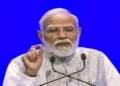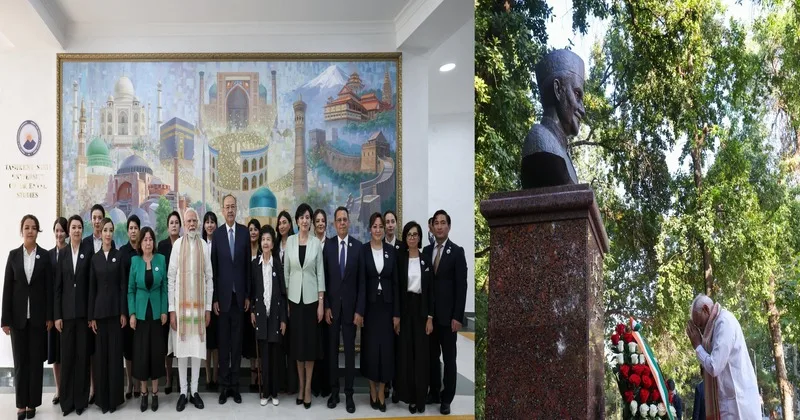
Tashkent: Prime Minister Narendra Modi on August 31, Monday shared highlights of his visit to the Mahatma Gandhi Centre at Tashkent State University of Oriental Studies, saying he witnessed a vibrant Indology ecosystem, strong interest in India and growing interest in Tamil culture.
PM Modi said that the visit on August 30, Sunday was “interesting for quite a few reasons”, including the “great passion towards studying about India”, “immense work on Gandhi Ji’s life” and “growing interest in Tamil culture”. He also noted that students recited a few lines from poems written by him.
Speaking during the interaction, PM Modi said that hearing the students recite his poems was an emotional experience. “Poems written by me a very long time ago, today I had the opportunity to hear them recited by these young people. And I noticed that although they were speaking in Hindi, Hindi is not their native language, yet the emotions were expressed exactly as they were in my heart when I originally wrote them”, he said. “This only becomes possible when you live that language, when you immerse yourself completely in it”, PM Modi added.
Yesterday’s visit to the Mahatma Gandhi Centre at Tashkent State University of Oriental Studies was interesting for quite a few reasons:
Got to see a vibrant Indology ecosystem.
Saw great passion towards studying about India.
Immense work on Gandhi Ji’s life.
Growing… pic.twitter.com/K4BM69UJwb
— Narendra Modi (@narendramodi) August 31, 2026
During the interaction, an Uzbek Indologist told PM Modi, “Perhaps you will not find many countries in the world where people love India as much as the people of Uzbekistan do. Every single one of our citizens knows the greeting Namaste”. The scholar also highlighted interest in Indian arts, dance, music, philosophy and Yoga and said, “To truly understand India, you must read the Ramayana and the Mahabharata”.
Tamil literature flies high in Uzbekistan
PM Modi also highlighted the importance of Tamil literature and the Tirukkural, asking whether the ancient text could be translated into Uzbek. “As you celebrate 80 years [of this institution], can you envision undertaking a mission to translate the ‘Tirukkural’ into the Uzbek language?” he asked. The speaker present on the podium responded, “Yes, we will make every effort and try”.
PM Modi said the translation would help deepen appreciation of Indian philosophical thought, adding, “The philosophical thought found in one of the world’s most ancient languages will help us appreciate how deep human thought has been right from the beginning of our civilisation’s journey”.
The Tirukkural (also known simply as the Kural) is a classical Tamil masterpiece focused on ethics, morality and practical wisdom. Composed by the revered poet-philosopher Thiruvalluvar between the 2nd century BCE and the 5th century CE, it is widely celebrated for its absolute secularism and universal applicability to everyday human life.
Prime Minister Narendra Modi’s two-day state visit to Uzbekistan has imparted fresh momentum to India-Uzbekistan ties, with the two countries elevating their relationship to a Comprehensive Strategic Partnership and announcing a series of initiatives spanning digital payments, mining, critical minerals, uranium, trade, healthcare, education, environment and culture.
PM Modi paid tribute to Lal Bahadur Shastri at the memorial in Tashkent
Prime Minister Narendra Modi on August 30, Sunday paid a floral tribute to former Prime Minister Lal Bahadur Shastri at the Shastri Memorial in Tashkent. PM Modi remembered the late leader as a “towering statesman” whose unwavering commitment to the nation continues to inspire generations.
Paid homage to former Prime Minister Lal Bahadur Shastri Ji in Tashkent.
We remember a towering statesman whose unwavering commitment to the nation continues to inspire generations.
Toshkentda sobiq Bosh vazir Lal Bahodur Shastri Ji xotirasiga hurmat bajo keltirdim.
Biz… pic.twitter.com/wn06aHxSGi
— Narendra Modi (@narendramodi) August 30, 2026
The Ministry of External Affairs (MEA), in a post on X, said PM Modi paid floral tribute at the Shastri Memorial, honouring the legacy of the former Prime Minister whose life was marked by simplicity, courage and devotion to the nation. “His timeless call of ‘Jai Jawan, Jai Kisan’ continues to inspire generations”, the MEA post read.
Former Prime Minister Shastri died in Tashkent on January 11, 1966, shortly after signing the Tashkent Declaration with Pakistan’s then President Ayub Khan following talks aimed at ending hostilities between the two countries after the 1965 India-Pakistan war.
India and Uzbekistan established diplomatic relations on March 18, 1992, when a protocol establishing diplomatic ties was signed in Tashkent. India was among the first countries to recognise Uzbekistan’s sovereignty following its independence. The two countries elevated their relationship to a Strategic Partnership in 2011, with bilateral ties since supported by institutional mechanisms at the political and official levels.
(With Inputs from ANI)