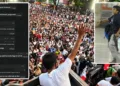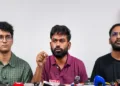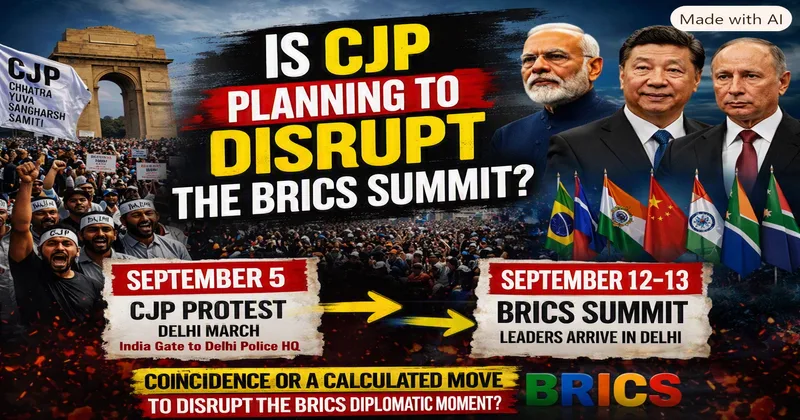
The repeated, orchestrated street agitations by foreign-returned activist Abhijeet Dipke and his Cockroach Janata Party (CJP) expose a deliberate pattern of calculated disruption against Bharat’s national interest. Dipke previously returned to the country right before a crucial Parliamentary session-aiming to sabotage important legislative proceedings like key FCRA reforms-and engineered protests to create internal chaos. Now, Dipke has scheduled another major march in New Delhi for September 5, timed precisely ahead of the high-stakes 18th BRICS Summit.
https://twitter.com/Courageous1s/status/2091939479879880775?s=20
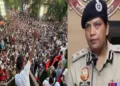
The upcoming September 5 march called by Abhijeet Dipke in the national capital has raised serious national security concerns, coming just days before Bharat hosts world leaders for the 18th BRICS Summit. Beginning at the iconic India Gate and heading toward the Delhi Police Headquarters, this planned escalation comes shortly after Dipke publicly characterised previous street agitations as a mere “trailer.” With high-profile heads of state including Russian President Vladimir Putin and Chinese President Xi Jinping slated to attend the summit on September 12–13, the timing of this mobilisation points toward a deliberate attempt to create optical disruption and undermine Bharat’s global standing.
The calendar tells the real story.
Scheduling a national disruption on September 10, right before India hosts world leaders for the BRICS Summit on September 12–13, isn’t accidental. It’s tactical.
This movement was never about student rights; it was a foreign-backed push for… pic.twitter.com/hzwTquAXO0— Augadh (@AugadhBhudeva) August 20, 2026
Amid growing scrutiny over potential foreign linkages and covert political networks backing the movement, the planned demonstration appears designed to project a narrative of domestic instability precisely when Bharat is poised to demonstrate its leadership of the Global South. Staging a high-decibel protest in the heart of New Delhi on the eve of a major diplomatic event risks manufacturing imagery of unrest and clashes with law enforcement, serving external interests that seek to compromise the country’s sovereign dignity and internal security.
This will not be the first time that such event has been planned, if we investigate the past there has been numerous events which were planned on important occasions to tarnish the government and the country’s image internationally.
Few Examples of Protests Coinciding with International Events
Violence During the US Presidential Visit (2020)
During the official visit of US President Donald Trump to New Delhi, large-scale anti-CAA protests escalated into severe street violence in the capital. The timing was specifically co-ordinated to steal headlines away from high-level trade and diplomatic talks, ensuring global news outlets focused on burning streets rather than bilateral partnerships.
Demonstrations During the G20 Summit & Prep Meetings (2023)
As Bharat hosted the G20 leadership summit and related working groups, localised fringe groups and union factions staged blockades and protests opposing global trade agreements. Opponents framed these disruptions as targeted efforts to portray the host nation as unstable and hostile to global governance, attempting to embarrass the administration in front of world leaders.
Republic Day Disruption During Farm Law Agitations (2021)
During the national Republic Day parade-an event watched globally and attended by international diplomatic corps-protesters stormed symbolic landmarks in the capital, leading to chaotic scenes. National security analysts highlighted how agitators used a solemn national event to create visuals of lawlessness, effectively broadcasting an image of an unruly state to the global community.
How Anti-National Factions Tarnish the Nation’s Image
Exploiting Foreign Media Parachute Journalists: By organising blockades during international events, agitators leverage foreign press teams already in the country to amplify domestic fault lines into sensationalised international headlines.
Economic Sabotage: Creating visuals of civil unrest while foreign investors and economic delegations are visiting signals operational risk, directly aiming to discourage foreign direct investment (FDI).
Undermining Sovereign Diplomacy: Disrupting host duties during major summits projects internal vulnerability, giving hostile foreign nations ammunition to question the country’s stability and regional leadership.
Impact on Decision-Makers: Hosting a major event puts pressure on governments to avoid disruption or public instability. Protesters use this leverage to force immediate dialogues or concessions from authorities who want to preserve the host nation’s global image.
The multi-layered developments surrounding the CJP and its founder, Abhijeet Dipke, point toward a calculated framework designed to orchestrate internal chaos. Under the guise of a student-led agitation, a network involving foreign diplomatic interest, banned anti-national outfits, compromised NGOs, and domestic political operatives appears to be converging to destabilize Bharat’s domestic tranquility.
Premature Foreign Intelligence and Embassy Warnings
Three days prior to the “Sansad Chalo” rally on July 20, the US Embassy in New Delhi issued a detailed Demonstration Alert advising its citizens of imminent disruptions around Jantar Mantar and Parliament House. While diplomatic posts routinely release safety advisories, the precise foreknowledge and timeline tracking of a supposedly “spontaneous” student protest raise fundamental questions. Washington’s hyper-awareness of local street movements before they even materialised points to active monitoring-and potential tacit encouragement-of anti-establishment networks on Indian soil
Banned Separatist Backing and Financial Infiltration
More alarming from a national security standpoint is the explicit support provided by Sikhs for Justice (SFJ), a banned US-based Khalistani organization led by designated terrorist Gurpatwant Singh Pannun. Pannun publicly pledged USD1 million to the CJP campaign, explicitly directing agitators to refuse dialogue with the Union Government and boycott Independence Day celebrations. Though Pannun’s claims of an initial USD250,000 transfer remain unverified, the endorsement by a foreign-based anti-Bharat movement demonstrates how easily domestic agitators become instruments for external forces seeking the balkanisation of Bharat.
The SECMOL Connection and Compromised Border Activism
The involvement of Sonam Wangchuk adds a troubling dimension along Bharat’s strategic frontier. His organisation, SECMOL, had its Foreign Contribution Regulation Act (FCRA) license revoked by the Ministry of Home Affairs in September 2025 due to serious financial discrepancies and foreign funding violations. MHA investigations flagged unauthorised funds from a Swedish entity linked to sensitive themes like regional “sovereignty.” Wangchuk’s transition from a praised educator to a key player in street politics across sensitive border zones like Ladakh highlights how foreign-funded entities exploit local grievances to threaten national integrity.
The Bangladesh Playbook: Subverting Democracy via Student Masks
The operational blueprint of the CJP mirrors the destabilization template recently witnessed in Bangladesh, where genuine student anxieties were hijacked by radical networks, political opposition, and foreign intelligence apparatuses to overthrow an elected government. CJP’s strategy-combining viral digital propaganda, hunger strikes, demands for ministerial resignations, and deliberate street pressure near constitutional centres-follows a textbook regime-change playbook designed to bypass democratic mandates through lawlessness.
Political Operatives and Opposition Patronage
Dipke’s background dismantles the facade of an “apolitical student leader.” Armed with an MS in Public Relations from Boston University and years of experience managing social media and communications for the Aam Aadmi Party (2020–2023), Dipke is a trained narrative strategist. The movement’s deep establishment linkages were further exposed when senior opposition figures like Kapil Sibal funnelled Rs1 crore into a legal-aid fund for the group. This immediate institutional backing proves that CJP serves as a front for entrenched political interests seeking to destabilise the government from behind the scenes.
The Strategic Threat of the September 5 Mobilisation
The pattern of events-foreign embassy alerts, Khalistani funding offers, foreign-funded NGO linkages, trained political handlers, and high-decibel street pressure-culminates in the planned September 5 march toward Delhi Police Headquarters. Scheduled just days before world leaders gather in New Delhi for the 18th BRICS Summit, this mobilisation is designed to manufacture optics of domestic turmoil. By engineering street clashes on the eve of a major diplomatic summit, these forces seek to undermine Bharat’s sovereign dignity and diminish its rising stature as the leader of the Global South.