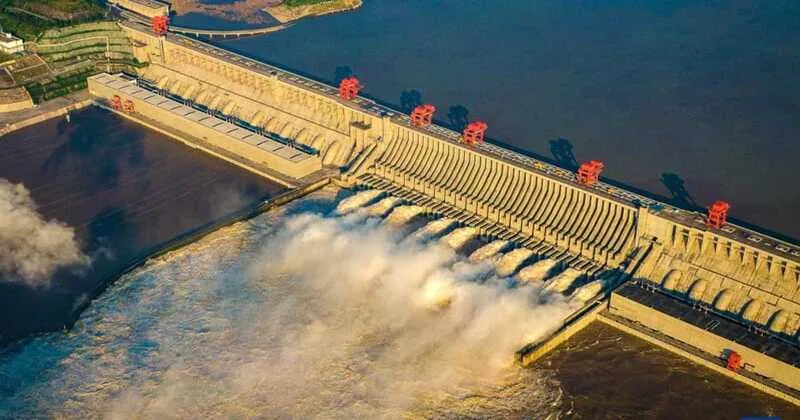
Kathmandu/Beijing: As rescue crews continue digging through mud, debris and devastated settlements along the Nepal–Chinese occupied Tibet border, the catastrophic flash floods that struck on August 26 have revived serious concerns about the expanding network of Tibet dams and the Chinese Communist Party’s (CCP) massive hydropower push across the Tibetan plateau.
With the death toll from last week’s disaster approaching 500 and well over 1,000 people still missing, the tragedy has exposed the extreme vulnerability of millions living downstream from the Tibetan plateau. The floods devastated Nepal’s Rasuwa and Nuwakot districts after a catastrophic surge originated upstream in the Chinese occupied Tibetan Autonomous Region, destroying roads, bridges and vital infrastructure while leaving entire communities isolated.
The disaster is now being closely watched not only in Nepal but also in India and other downstream countries dependent on rivers flowing from Tibet. Human rights organisations and Tibet advocacy groups are renewing calls for greater scrutiny of the Chinese Communist Party’s development activities, warning that the rapid expansion of Tibetan dams could create enormous risks for millions of people, agricultural communities and fragile Himalayan ecosystems.
Tibet dams and the growing fear of a Himalayan ‘Water Bomb’
Scientists from the International Centre for Integrated Mountain Development (ICIMOD) say the likely trigger of the August 26 disaster was an ice-rock avalanche that temporarily dammed a tributary, the Lhende Khola, before the obstruction burst. The event was initially speculated to be a glacial lake outburst, while some also raised concerns about major Chinese dam projects upstream. The precise cause, however, remains officially unconfirmed.
Yet the Nepal flood disaster has inevitably intensified scrutiny of the Communist Party of China’s increasingly ambitious programme of dam construction in Tibet.
Days before the devastating Nepal–Tibet floods, footage showed massive Chinese hydropower construction near the border—blasting, excavation and riverside engineering across Tibet’s fragile Himalayas.
Then came the mud, destruction and loss of life downstream.China has pursued a… pic.twitter.com/fUBJHafvzB
— Bodpa Warriors (@BodpaW) August 29, 2026
At the centre of those concerns is the massive Medog Hydropower project, also known as the “Great Bend” dam, being constructed on the Yarlung Zangbo river, the upper reaches of the Brahmaputra. The project is located in Nyingchi, in the Chinese occupied Tibetan area, and has been described as part of Beijing’s plan to build the world’s largest hydropower station.
Chinese Premier Li Qiang broke ground on the project in July 2025. Total investment has been estimated at an extraordinary 1.2 trillion yuan, or approximately USD 168 billion. Critics argue that placing such an enormous project in one of the world’s most seismically volatile and environmentally fragile regions represents a potentially dangerous gamble with the lives of downstream populations.
For India, the concerns are particularly significant. The Yarlung Zangbo becomes the Brahmaputra as it flows towards Arunachal Pradesh and Assam before continuing into Bangladesh. Any major disaster involving Tibetan dams could therefore have consequences far beyond the Chinese occupied Tibetan area, potentially affecting agriculture, settlements, infrastructure and millions of people across South Asia.
A massive dam or reservoir in such a sensitive Himalayan region has increasingly been described by critics as a potential “water bomb”, particularly because a catastrophic structural failure, landslide or sudden release of water could send destructive floods downstream.
Earthquakes, dam risks and the threat to Nepal and India
The dangers of building huge Tibetan dams in a seismically active landscape have been further highlighted by recent earthquake activity.
A magnitude 5.0 earthquake struck the Tibet region late on August 27, according to the German Research Centre for Geosciences (GFZ). The quake occurred at a depth of 10 kilometres in northern Tibet. Its epicentre was hundreds of miles north of the regions of Nepal and China devastated by the August 26 flash flood.
China’s earthquake networks centre also reported a magnitude 4.7 earthquake in Nagqu, Tibet, on August 26, according to the state-run Xinhua news agency.
Earthquake risks have long been central to concerns about the safety of large dams in the Himalayan region. On January 7 last year, a magnitude 7.1 earthquake struck the southern Tibetan plateau. According to the information available, CCP authorities emptied three reservoirs and relocated 1,500 residents downstream of existing dams as a precaution against possible structural failure.
Terrifying footage shows a flash flood sweeping through the Nepal–Tibet border, trapping people on rooftops and balconies. At least 469 have been killed, with hundreds still missing. pic.twitter.com/xRgRWmwut7
— Weather Monitor (@WeatherMonitors) August 28, 2026
Critics say these events demonstrate why the expansion of Tibet dams must be subjected to much greater independent scientific scrutiny.
Chinese-born hydrologist Wang Weiluo, who resides in Germany and is known for his work on hydraulic engineering and dam safety, previously questioned the necessity of the project. In comments to global media last year, Wang argued that China did not require such an enormous new hydropower facility, pointing to power surpluses and underutilised solar facilities.
He attributed the project to what he described as a political endeavour connected to CCP leader Xi Jinping’s ambitions and national prestige. Such criticism has strengthened calls for Beijing and the Communist Party of China to reconsider mega-development projects across Tibet, particularly in regions where earthquakes, landslides, glacier instability and rapidly changing climate conditions already pose major threats.
Millions at risk as CCP expands Tibetan dams
The International Campaign for Tibet has warned that the dangers associated with large-scale dam construction are not merely theoretical.
In a report published last November, the organisation linked the collapse of a bridge in eastern Tibet to what it described as “reservoir-induced geological destabilisation” associated with a nearby dam. It warned that a rupture involving a much larger project such as the Medog Hydropower project could unleash catastrophic flooding downstream, including in parts of India.
The organisation has also estimated that as many as 1.2 million people could face displacement if all of the Chinese Communist Party’s planned hydropower projects in Tibet go ahead.
The Australia-Tibet Council has similarly called for international pressure on Beijing following the Nepal flood disaster. “At the very least, Australia should be questioning China’s mega development activities in Tibet in the wake of this tragedy,” the council’s executive officer, Zoe Bedford, said in a statement to the media.
🇳🇵 Disaster in Nepal..⚠️🚨
New Released video, captured more than 50 km downstream from the site of the glacier collapse, shows the rapid arrival of the flood wave, obliterating everything in its wake.#Nepal #NepalFlooding #Floods #Rasuwa #flasfloods #NepalFloods… pic.twitter.com/3Ofw8n7OBA
— sustainme.in® (@sustainme_in) August 27, 2026
Bedford called on the Australian government to demand access for international scientists, journalists and observers to investigate the effects of large-scale development projects on Tibetans, the Tibetan environment and countries downstream.
The organisation is campaigning for a total moratorium on new mines, Tibetan dams and other mega-development projects in Tibet. It argues that Tibetans do not have a genuine mechanism to provide consent for projects imposed under Chinese administration. It has also cited the arrest of more than 1,000 Tibetans, including monks, following a 2024 protest against a dam on the Drichu River.
Beijing has dismissed concerns over the Medog project and other Tibet dams. Responding to India’s objections, Chinese Foreign Ministry spokesperson Guo Jiakun said the project would not negatively affect the ecological environment, geological conditions or the water resource rights of downstream countries. He further claimed that the project could contribute to disaster prevention and mitigation.
However, independent verification remains difficult because Tibet remains largely inaccessible to many foreign journalists, researchers and observers. Rights groups argue that this lack of transparency creates serious concerns when projects of such enormous scale are being constructed in one of the world’s most environmentally sensitive regions.
The stakes extend far beyond Tibet and China. The Tibetan plateau is the source of eight of the world’s largest river systems and contains vast freshwater reserves that sustain some of Asia’s most densely populated regions. Rivers originating in Tibet support agriculture, drinking water, ecosystems and economies across Nepal, India, Bangladesh, Vietnam and China itself.
As Nepal struggles with one of its worst recent flood disasters, the destruction has therefore renewed a wider question that how safe are the rapidly expanding network of Tibetan dams, and who will bear responsibility if another Himalayan disaster turns a major reservoir or dam failure into a catastrophic water bomb?
For millions of people living downstream, from vulnerable communities in Tibet and Nepal to farmers and river-dependent populations in India, the answer could carry consequences for generations. The Nepal flood tragedy has once again placed the Chinese Communist Party’s hydropower expansion under intense scrutiny, raising urgent questions about Tibet dams, earthquake risks, environmental transparency, agriculture and the safety of millions of lives across South Asia.