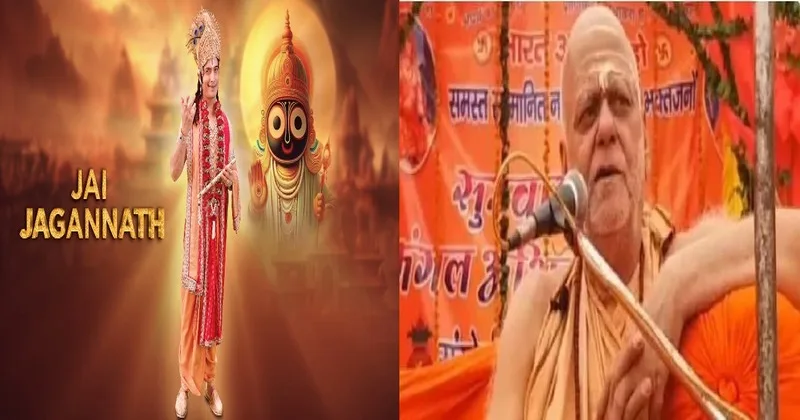
Bhubaneswar: A fresh controversy has erupted over the proposed animated film and serial ‘Jai Jagannath’, with Jagadguru Shankaracharya Swami Nischalananda Saraswati of Puri’s Govardhan Math strongly objecting to the alleged portrayal of Mahaprabhu Jagannath and demanding a complete ban on the production and its dissemination through all forms of media.
According to a press release issued by the residential office of Puri Gajapati Maharaja Dibyasingha Deb, the Shankaracharya has expressed serious reservations over the animated productions made by Bhubaneswar-based Eli Animations Private Limited. His objections were subsequently conveyed to the Gajapati Maharaja by the Mukti Mandap Pandit Sabha of the Sri Jagannath Temple.
Shankaracharya objects to portrayal of Mahaprabhu Jagannath
The Puri Shankaracharya has alleged that the depiction of Mahaprabhu Jagannath in the animated production is contrary to scriptural prescriptions and the established traditions of the Jagannath culture. He termed the alleged portrayal an “unforgivable” offence and called for restrictions on the film’s release as well as its circulation through television, digital platforms, social media and other forms of mass media.
He maintained that portraying sacred deities in forms that differ from or distort established religious traditions is a serious matter and requires careful examination from religious, philosophical and practical perspectives.
According to the Shankaracharya, the culture, philosophy and worship practices associated with Mahaprabhu Jagannath are rooted in long-established traditions. Any visual representation that departs from these traditions, he said, could affect the traditional understanding of the deity and Jagannath culture among future generations.
Concern over impact on Jagannath tradition
The Shankaracharya has also expressed concern over the possible impact of the film on children and younger generations. He maintained that fictional or distorted representations of Mahaprabhu Jagannath could influence the way devotees, particularly children, understand and relate to the deity.
He has argued that Mahaprabhu Jagannath cannot be treated merely as a fictional character for the purpose of cinematic or animated storytelling, given the deity’s central position in the religious and cultural traditions of Odisha.
He further maintained that the forms and divine leelas of Mahaprabhu Jagannath and other deities described in Sanatana Vedic scriptures should not be represented differently through moving images without scriptural evidence or a foundation in established tradition.
Objection to ‘Daru Brahma’ representation
The Shankaracharya has also raised specific objections to what he described as an inappropriate portrayal of Mahaprabhu Jagannath in the ‘Daru Brahma’ form.
Referring to scriptural sources, including the Atharvaveda Parishishta and Gopala Sahasranama, he maintained that the Daru Brahma form has a specific religious and philosophical significance and should not be presented in a manner that distorts its established understanding.
He argued that any depiction of the deity must take into account the scriptural traditions and established practices associated with the Jagannath cult.
Mukti Mandap Sabha conveys objections to Gajapati Maharaja
The Mukti Mandap Pandit Sabha, the traditional body of scholars associated with the Sri Jagannath Temple, has also taken up the issue.
The Sabha subsequently apprised Gajapati Maharaja Dibyasingha Deb of the Shankaracharya’s views and his decision to seek a ban on the film. Jagannath Sahu, manager of the Gajapati Maharaja’s Srinhara, informed the media about the development through a press release issued by the royal residence.
The Sabha has also sought reconsideration of an earlier Supreme Court decision that declined to stay the release of the film.
Legal battle over film’s release
The controversy over ‘Jai Jagannath’ is not entirely new. The Gajapati Maharaja had earlier raised objections to the proposed release of the film, following which a case was filed before the Odisha High Court seeking a stay on its release.
The Odisha High Court had granted a stay on the film’s release. The filmmakers subsequently challenged the order before the Supreme Court, which lifted the stay, clearing the way for the film’s release.
With preparations for the release reportedly resuming, the issue has once again generated opposition among sections of temple servitors and devotees of Mahaprabhu Jagannath.
Devotees have urged the Sri Jagannath Temple administration to approach the Supreme Court and seek a review of its earlier decision in view of the concerns raised by the Shankaracharya and the Mukti Mandap Pandit Sabha.
Shankaracharya raises broader religious and judicial questions
The Shankaracharya has also described the controversy as a serious religious and human-rights issue and expressed his views on the role of the judiciary in matters involving religious beliefs and traditions.
He maintained that religious leaders and followers of the Sanatana Vedic tradition have the right to disagree with judicial decisions and seek their review through lawful means, without undermining the functioning or authority of the judiciary.
He stressed that such disputes should be examined on the basis of facts and established principles. He also referred to philosophical and religious concepts concerning the formless and manifest aspects of the divine, maintaining that these principles have a well-established basis in Sanatana Vedic thought.