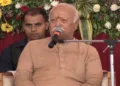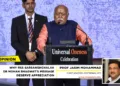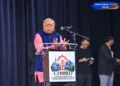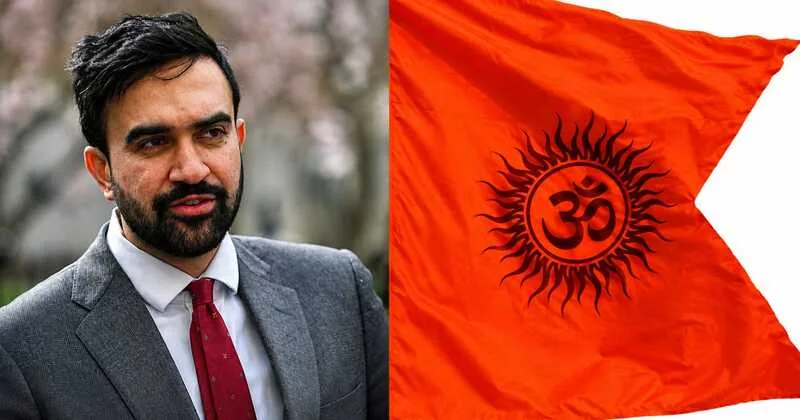
New Delhi: New York City Mayor Zohran Mamdani has drawn sharp attention after opposing the ‘Universal Oneness Celebration’, a major cultural programme scheduled at Madison Square Garden on August 29 , featuring RSS Sarsanghchalak Dr Mohan Bhagwat.
Mamdani’s stand has added to a series of disputes involving established religious and ethnic communities in the city. “I don’t support the rally,” Mamdani said in reference to the programme. Following earlier controversies involving Jewish and Italian-American groups, Hindu organisations have now found themselves confronting political and religious opposition over a high-profile cultural gathering.
The opposition to Dr. Bhagwat’s visit has brought New York’s increasingly polarised identity politics into focus. Mamdani’s political approach has generated friction with communities whose cultural traditions and political positions differ from his ideological-religious worldview, raising questions about the space available for religious and cultural groups in the city’s public life.
By opposing a peaceful programme involving a prominent Hindu leader at one of New York’s most prominent venues, Mamdani has placed the Hindu-American community at the centre of a new political controversy. The dispute extends beyond disagreement over the RSS and its leadership, touching on the right of Hindu Americans to gather publicly and celebrate their cultural and religious heritage.
The controversy surrounding the Universal Oneness Celebration has consequently widened an existing divide. After disputes involving Jewish institutions and Italian-American civic groups, Hindu organisations have now emerged as another community confronting Mamdani’s political opposition, intensifying questions over whether New York’s administration is strengthening pluralism or deepening divisions among the city’s diverse religious and ethnic communities.
Mamdani’s hostility towards New York’s Jewish community
This latest controversy comes on the heels of previous disputes that alienating key civic groups across the city. Tensions between New York City Mayor Zohran Mamdani and local Jewish organizations have intensified over municipal policy decisions, administrative appointments, and safety concerns across the five boroughs.
Criticism centered on Mamdani’s rejection of the International Holocaust Remembrance Alliance’s definition of antisemitism, his long-standing alignment with the Boycott, Divestment and Sanctions (BDS) movement, and his public opposition to Israeli state policies. Concerns further escalated in August 2026 when legal coalitions condemned Mamdani’s newly appointed 18-member Mayor’s Advisory Committee on the Judiciary for excluding Jewish legal professionals, despite Jews representing a major segment of the city’s legal community.
Mamdani praises Prophet Muhammad’s legacy.
Islam is NOT compatible with the west. Deport them all. pic.twitter.com/jhJCogS8vA
— Chris Ripa (@CHRISsW0RLD) August 26, 2026
Rising crime figures targeting Jewish New Yorkers have fueled additional friction between City Hall and community leaders. Official data released by the New York Police Department in July 2026 revealed that from January 1 to June 30, 2026, spanning the first six months of the administration, Jewish residents were targeted in 178 confirmed hate crimes. This total represented a 2.3 percent increase compared to the 174 confirmed anti-Jewish incidents recorded during the exact same period in 2025.
The statistics highlighted a stark disparity in bias-motivated targeting citywide. While Jewish residents account for approximately 10 percent of New York City’s total population, they were the victims of over 55 percent of all confirmed hate crimes recorded across the five boroughs during the first half of the year. Initial figures from January 2026 even recorded a sharp 182 percent spike in reported anti-Jewish incidents compared to the prior year, prompting changes in how the city publicly releases monthly hate crime data.
Critics argue that administrative rhetoric and policies have created a permissive environment for hostility, pointing to prominent incidents like synagogue vandalisms and public assaults. In response to the growing public scrutiny, City Hall emphasized that overall violent crime across the city dropped during the same timeframe, while noting an expanded budget for the Office of Hate Crime Prevention. Nevertheless, civic representatives maintain that targeted outreach and equal institutional representation remain necessary to address security concerns and repair trust between municipal leadership and the Jewish community.
Italian Christians face Mamdani’s politics of erasure
Similarly, representatives of several Christian Italian-American groups have repeatedly raised concerns over administrative policies and public statements by Mayor Zohran Mamdani, which they view as a direct dismissal of their heritage and contributions. The ongoing friction underscores a deep divide over civic representation, historical legacy and the cultural recognition of established Christian communities across New York City’s five boroughs.
The rift deepened following the release of an official city map detailing immigrant neighborhoods in July, which omitted Manhattan’s historic Little Italy alongside other legacy ethnic enclaves. Representatives for the Christian Italian-American community vehemently criticized the decision, arguing that the mapping project minimized the vital contributions made by generations of Italian immigrants who built local neighborhoods, churches, schools, and civic institutions.
City Hall defended the mapping criteria by noting that the publication focused strictly on modern foreign-born demographic data rather than historic enclaves. Despite this explanation, civic leaders insisted the exclusion represented a broader pattern of neglect toward their community’s historical footprint, prompting the administration to consider adjustments to better honor legacy neighborhoods.
Furthering the divide are long-standing grievances surrounding monument removals, historical memory, and local event coordination. Christian Italian-American advocacy groups have frequently highlighted past public opposition to Christopher Columbus monuments, citing a 2020 social media post targeting a statue in Queens as an ongoing point of contention.
Additionally, leaders from organizations such as the Italian American Civil Rights League have voiced frustration over public permitting hurdles for traditional heritage celebrations. Critics argue that administrative priorities selectively favor contemporary demographics over foundational groups whose faith and labor shaped the city. While city officials emphasize that municipal policies aim to balance contemporary demographics with historic legacies, leaders within the Christian Italian-American community maintain that their historical contributions deserve equal standing in the city’s civic life.
In this increasingly polarised political climate, Mamdani’s critics argue that a troubling pattern has emerged that first the Jewish community, followed by Christian Italian-Americans, and now Hindu organisations have found themselves at odds with the mayor and his administration.
While City Hall maintains that its policies and positions are guided by political and administrative considerations, community leaders see a broader pattern of ideological hostility towards established religious and cultural groups. The controversy surrounding Dr Mohan Bhagwat’s New York visit has consequently intensified concerns over whether Mamdani’s approach is fostering genuine pluralism or deepening divisions among communities that have long shaped the social, cultural and civic identity of New York City.