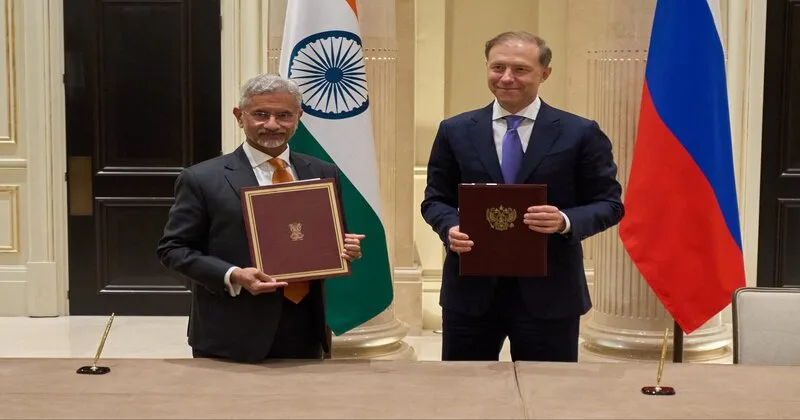
Moscow: External Affairs Minister Dr. S. Jaishankar on August 24, Monday called for decisive measures, including the removal of non-tariff barriers, the strengthening of national payment systems and the swift conclusion of a Free Trade Agreement, to push bilateral trade between India and Russia to USD 100 billion by 2030.
EAM flags steep trade imbalance; Suggests bridging mechanisms
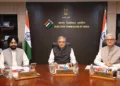
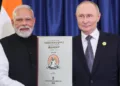
Addressing the 27th India-Russia Inter-Governmental Commission (IRIGC-TEC) in Moscow alongside Russian First Deputy Prime Minister Denis Manturov, EAM Jaishankar emphasised that resolving the mounting trade imbalance between the two nations is now “one of our foremost priorities”. EAM Jaishankar noted that while bilateral trade in goods has expanded more than fourfold, from approximately USD 13 billion in 2021-22 to nearly USD 60 billion in 2023-24, the surge has triggered a massive widening in the trade gap from USD 6.6 billion to over USD 50 billion.
A productive visit to Russia to further our bilateral ties.
Here is a glimpse.
🇮🇳 🇷🇺 pic.twitter.com/VaCzqvSSFK
— Dr. S. Jaishankar (@DrSJaishankar) August 25, 2026
“This demonstrates the immense potential of our partnership. And the rapid expansion of trade has, however, been accompanied by a significant widening of the trade imbalance, which has also increased from 6.6 billion to over US dollars 50 billion”, the External Affairs Minister added. “Addressing this imbalance is today one of our foremost priorities. Excellency, colleagues, progress on market access, removal of tariff and non-tariff barriers, strengthening payment mechanisms and stronger business-to-business engagement will be critical for addressing this imbalance and achieving our shared objective of US dollars 100 billion in bilateral trade by 2030”, EAM Jaishankar reiterated.
A wide-ranging conversation this evening with FM Sergey Lavrov of Russia.
Discussed our bilateral cooperation, regional hotspots, global challenges and multilateral issues.
🇮🇳 🇷🇺 pic.twitter.com/K53k5aVZgE
— Dr. S. Jaishankar (@DrSJaishankar) August 24, 2026
EAM outlined 3 proposals to accelerate next phase of India-Russia economic partnership
EAM Jaishankar also pointed to the ongoing discussions regarding the India-Eurasian Economic Union Free Trade Agreement and referenced wide-ranging cooperation across energy, nuclear power, metallurgy, space, railways, fertilisers, skill mobility and connectivity. To institutionalise the next phase of economic partnership, the EAM outlined three specific proposals for the commission’s working groups.
EAM Jaishankar outlined three key directions for working groups:
- Prioritising tangible outcomes before the next session
- Strengthening alignment with private sector needs
- Continuously identifying new avenues to de-risk and diversify economic ties
Held a very productive meeting of the 27th India-Russia Inter-Governmental Commission on Trade, Economic, Scientific, Technological and Cultural Cooperation. Thank First DPM Denis Manturov for co-chairing this key mechanism.
Our discussions focused on our wide – ranging… pic.twitter.com/1JNoHKZ5De
— Dr. S. Jaishankar (@DrSJaishankar) August 24, 2026
He said, “Going forward, the effectiveness of our efforts should increasingly be measured by the outcomes we deliver. Each working group must prioritise deliverables to be achieved before the next session and actively engage in problem-solving”.
Second, he called for deeper engagement with the private sector, noting, “Governments can create enabling frameworks, but it is our businesses that trade, invest, innovate and create jobs. Our institutional mechanisms should therefore remain closely aligned with the priorities of industry. Regular interaction with businesses and industry associations will help us to identify practical bottlenecks, improve policy responsiveness and ensure that discussions remain relevant, action-oriented and commercially meaningful”, EAM stated.
Innoprom India
EAM Jaishankar hailed Innoprom India as a benchmark initiative in this direction. The holding of Innoprom in India in the coming weeks is a very good signal in that regard, said the Minister, which is an international platform to accelerate trade and industrial cooperation between India and Russia.
Explore new bilateral opportunities
Third, the EAM highlighted the need to constantly update views and explore fresh possibilities, stating, “The complicated international scenario will constantly throw up fresh ideas because we are all focused on de-risking and diversifying. Economic demands and technology requirements will add to this mix”.
Reaffirming the “resilience and adaptability” of the special and privileged strategic partnership amidst a complex global landscape, Dr. Jaishankar concluded by reiterating India’s commitment to fully utilising the IRIGC platform to realise its stated economic goals.
Further underlining the durability of bilateral ties, EAM Jaishankar emphasised that the India-Russia partnership has consistently demonstrated resilience and adaptability. Even amidst a complex international landscape, our engagement has continued to deepen, reflecting the mutual interest and confidence that define our bilateral partnership.
(With Inputs from ANI)