Imagine being sent to a place where you do not know the language, have no acquaintances and are not even entirely sure what awaits you when you arrive. There are no resources, no arrangements for food or accommodation and perhaps only two pairs of kurta-pyjamas to your name. You may face threats from hostile or insurgent groups. You may have to spend a night on a tree, survive on little food or shelter, or recover from severe physical assault after being abandoned in an isolated place. At times, even a tin shed at a cremation ground may become your home.
Would you still choose to go there? Would you remain there and continue working for social awakening and organisation?
The answer, for most people, would probably be no.
Yet there were individuals who endured precisely such hardships and continued their work with the spirit of “Idam Na Mam”—this is not mine. Their objective was to serve people, build relationships and gradually win their hearts and trust while reconnecting communities with their national and civilisational roots.
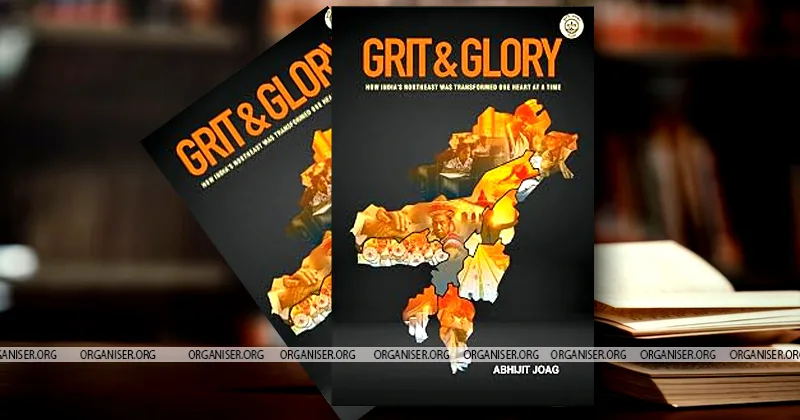
It is the story of such individuals that Abhijit Jog attempts to bring to the national imagination through Grit & Glory.
India’s vast geography contains extraordinary diversity—its many languages, cultures, traditions and ways of life shaped by its varied landscapes. The Northeast, surrounded by mountains, valleys, rivers and dense forests, represents one of the country’s most distinctive cultural worlds. Its many tribal communities and traditions have given the region a character unlike any other part of India.
But the decades following Independence also brought serious social, political and economic challenges. Distance and difficult terrain often made access itself a challenge. Linguistic and cultural differences created another layer of complexity, while insurgency and violence repeatedly raised questions about national integration.
Against this backdrop, Grit & Glory examines a claimed transformation in parts of Northeast India—from an environment marked by alienation and insurgency towards greater integration, development and engagement with the wider Indian mainstream.
The book asks an important set of questions: How did this transformation take place? Who were the people who chose this difficult path? Why did they go there? What did they encounter? And what did they do to build trust in communities where outsiders often struggled to find acceptance?
The answers, Jog argues, cannot be found only in statistics or government documents. They are also contained in the lives of individuals who left behind their homes and comforts and spent years living among unfamiliar communities. Some devoted their entire lives to this work; others ultimately made the supreme sacrifice.
Many of these stories, however, have remained outside India’s mainstream historical memory.
It is this forgotten human dimension that forms the core of Grit & Glory. The book documents the work of RSS pracharaks and workers associated with its affiliated organisations in Northeast India, including women who participated in this long social engagement. Through accounts of service, sacrifice and perseverance, Jog seeks to show how grassroots relationships and sustained community engagement became an important part of this journey.
The book is divided into six chapters. The first examines the historical and cultural significance of Northeast India, tracing its connections with the broader Indian civilisational narrative from the Ramayana and Mahabharata traditions to the present.
The second and third chapters examine the rise of separatism and insurgency and discuss the role that the author attributes to Christian missionary activity, demographic change and governmental policies in shaping the region’s political and social landscape. These chapters are likely to invite debate, particularly because the history of religion, identity and insurgency in Northeast India is complex and contested.
The fourth chapter turns to the entry and expansion of the RSS and its affiliated organisations into this challenging environment and describes their efforts amid separatism and insurgency.
But the heart of the book is undoubtedly the fifth chapter, “Idam Na Mam.”
This chapter captures the experiences of those described as the silent tapasvis of the movement—individuals who endured extraordinary hardships without seeking immediate recognition or personal gain. Their stories provide the book with its emotional force.
Here, “Grit” is not merely hard work. It represents resilience, patience, perseverance and the courage to remain committed despite repeated setbacks. “Glory,” meanwhile, is not simply success; it is the culmination of a long struggle undertaken for a larger purpose.
The accounts are particularly powerful because they are based not merely on second-hand narratives but on interviews with hundreds of workers from Northeast India and other parts of the country. In this respect, the book functions both as a collection of personal memories and as an attempt at documenting a lesser-known chapter of India’s contemporary social history.
The final chapter shifts from individual stories to data, examining the development trajectory of Northeast India and the areas in which the region has witnessed change.
Ultimately, Grit & Glory is more than an account of the work of the RSS. It is a collection of stories about young men and women who altered the course of their own lives to work in a difficult and unfamiliar region. It tells of people who faced violence and hostility, endured deprivation and continued their work in the belief that social transformation could be achieved through service, personal contact and perseverance.
Whether one agrees with every historical interpretation advanced by the author or not, the book raises an important question about India’s collective memory: why do the stories of those who sought to bridge India’s distances and strengthen social bonds receive so little attention compared with those who sought to deepen them?
That makes Grit & Glory worth reading—not merely as an organisational account, but as an attempt to preserve the memories of people whose lives were defined by hardship, service and sacrifice, and whose stories continue to wait for a larger place in India’s national narrative.