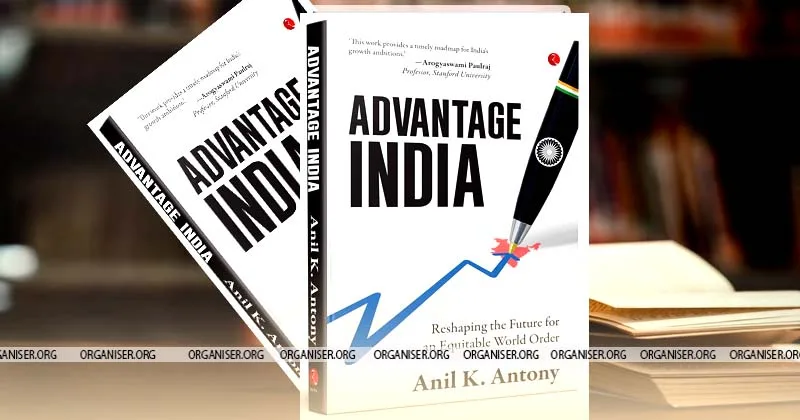
During an interview at the AI Impact Summit in 2026, Prime Minister Narendra Modi said, “The end goal of technology should be ‘Welfare for All, Happiness of All. Technology exists to serve humanity, not replace it.” Anil K. Antony’s book, Advantage India: Reshaping the Future for an Equitable World Order, is all about this. This book talks about technology as a means of welfare for all our citizens and how PM Modi was able to ensure this.
Today, technology is no longer limited to software companies or research laboratories. It shapes almost every part of our lives, from banking and education to farming, healthcare, governance, and national security. The countries that lead in technology will shape the future of the world. In this important book, Anil explains why India is not just participating in this technological revolution but is leading it. Drawing from his education at Stanford University and his experience in Silicon Valley, Anil presents readers with a clear and well-researched account of India’s remarkable transformation over the last decade. More importantly, he explains how the vision and policies of the Government of India under Prime Minister Narendra Modi have laid the foundation for this transformation.
One of the strongest messages of the book is that India has created its own model of development. While many advanced technologies in the West remain expensive and available only to a few, and China follows a highly centralised state-controlled model, India has chosen a completely different path. Our country has built digital public infrastructure that is open, affordable and accessible to every citizen. This approach reflects the spirit of democracy and inclusion. The first part of the book tells the story of India’s technological rise. Through initiatives such as Aadhaar, Unified Payments Interface (UPI), DigiLocker, CoWIN, and the Open Network for Digital Commerce (ONDC), India has created one of the world’s most inclusive digital ecosystems. These are not just Government schemes; they have become powerful tools that have changed the daily lives of ordinary people.
Today, a street vendor accepts digital payments through UPI. A farmer receives weather updates, market prices, and financial assistance on a mobile phone. A student in a remote village can learn through online platforms. A woman entrepreneur can start and expand her business without leaving her hometown. Millions who were once outside the formal economy are now connected to banking, insurance and government services. The book explains these changes with facts, examples and simple language, making the India story both inspiring and easy to understand.
Anil also highlights India’s growing strength in advanced technologies. He explains why the National Semiconductor Mission and the Production Linked Incentive (PLI) schemes are critical for India’s future. For decades, the world depended on only a few countries for semiconductor manufacturing. Today, India is building its own chip manufacturing, design and electronics ecosystem. This is not just an economic opportunity but also a matter of national security and technological sovereignty. The author further explores how India is becoming a leader in deep technologies such as artificial intelligence, quantum computing, biotechnology, space technology and clean energy. Under the leadership of Prime Minister Modi, India has moved steadily towards defence self-reliance through initiatives like Atmanirbhar Bharat. Indigenous defence manufacturing, modern military technologies and home-grown innovation are reducing our dependence on imports. The author explains in detail about India’s achievements in the space sector . From affordable satellite launches to successful lunar and planetary missions, India has demonstrated that world-class innovation can be achieved at a fraction of the global cost. At the same time, ambitious programmes in solar power, green hydrogen, battery storage and nuclear energy show India’s commitment to becoming a global leader in clean energy. This happened due to calibrated changes in these sectors under the Modi Government.
Anil explains how supportive initiatives such as Startup India, Digital India, Skill India and Make in India have created an environment where innovation can flourish. Young entrepreneurs are no longer merely adapting technologies developed elsewhere. They are building products and solutions that are solving problems not only for India but for the world. The second half of the book shifts from technology to foreign policy and geopolitics. Anil argues that India’s technological progress has strengthened its position in the emerging multipolar world. Today, India engages with all major powers while protecting its national interests. Whether through the “Neighbourhood First” policy, stronger ties with West Asia, or initiatives such as the India-Middle East-Europe Economic Corridor (IMEC), India is emerging as a confident and reliable global partner. The author also explains how India has become the voice of the Global South under Prime Minister Modi ji. Rather than simply following international institutions created by others, India is now helping shape the global agenda. Initiatives such as the International Solar Alliance (ISA) and the Coalition for Disaster Resilient Infrastructure (CDRI) reflect India’s willingness to provide practical solutions to global challenges. This is a confident India that contributes, leads and builds partnerships with the comity of nations across the country. It is not a non-aligned India, devoid of power, but an India that has become the Vishva Guru. One of the book’s greatest strengths is its optimism. Anil firmly believes that India’s biggest advantage is its young population. With the world’s largest youth workforce, affordable digital infrastructure, democratic institutions and stable governance, India possesses all the ingredients needed to become a leading global power. The author argues convincingly that India’s youth will not merely consume technology; they will create the technologies that shape the future. The writing throughout the book is simple, engaging, and supported by facts. Even readers without a technical background will find it easy to understand. The book successfully combines technology, economics, governance and geopolitics into one compelling narrative without becoming difficult or academic. Advantage India is much more than a book on technology. It is a story of New India, a nation that has moved from being a technology consumer to becoming a technology creator, from following global trends to setting them, and from depending on others to building self-reliance through vision, innovation and strong leadership under Prime Minister Modi. For anyone who wants to understand the transformation taking place in India under the leadership of Prime Minister Narendra Modi, this book is essential reading. It explains how visionary government policies, digital innovation and the energy of India’s youth are together laying the foundation of a Viksit Bharat. It is a powerful reminder that India’s rise is not an accident but the result of long-term planning, bold reforms and the confidence to think differently.
In a world marked by uncertainty and constant change, Advantage India offers hope. It leaves the reader with new knowledge, greater understanding of Government policies, renewed confidence, and one lasting thought: that India’s greatest days are now and today under Prime Minister Modi.
(The views expressed are personal)