Can Bharat become a developed nation while remaining dependent on others for the technologies that will power its development? This question will become increasingly important as the country advances towards Viksit Bharat 2047. Semiconductor fabs, artificial intelligence, data centres, advanced manufacturing, railways, electric mobility, defence production and green hydrogen will demand enormous quantities of reliable electricity. Solar and wind will remain indispensable pillars of Bharat’s energy transition, but an advanced industrial economy also requires dependable low-carbon power when the sun is not shining and the wind is not blowing.
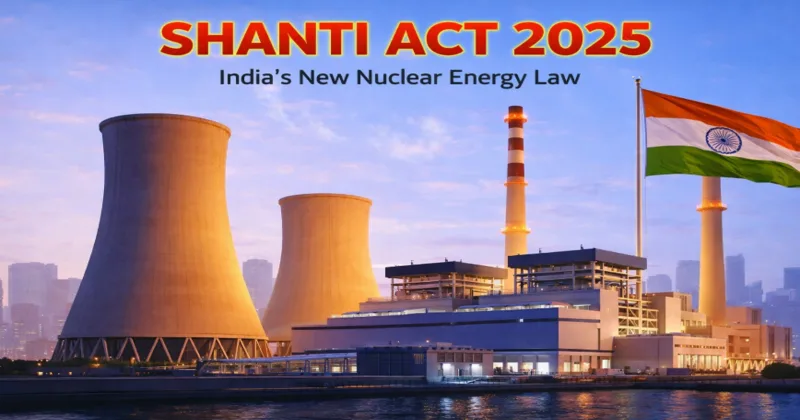
This is why the Sustainable Harnessing and Advancement of Nuclear Energy for Transforming India — SHANTI Act, 2025 needs to be understood as much more than a change in nuclear legislation. As noted in the Government’s April 2026 nuclear-energy factsheet, the Act modernises the legal framework and enables wider private participation under regulatory oversight. The Department of Atomic Energy (DAE) has further stated in Parliament that SHANTI is intended to enable wider participation of both public and private sectors in the national nuclear mission.
The legislation has opened the door. The larger question is: Who will build the nuclear Bharat that this law now makes possible?
The arithmetic of ambition
The numbers reveal the scale of the opportunity. According to a Press Information Bureau factsheet published in April 2026, Bharat’s installed nuclear-power capacity stands at 8.78 GW. Nuclear plants generated 56,681 million units of electricity in 2024–25, accounting for about 3.1 per cent of total electricity generation. The same Government assessment projects capacity rising to 22.38 GW by 2031–32, while the Nuclear Energy Mission has set the larger objective of 100 GW by 2047.
This is not incremental growth. It implies an expansion to more than eleven times the present capacity in roughly two decades. Even more significant for industry is the composition of that growth. In a written reply to Parliament on July 30, 2026, the DAE stated that NPCIL’s capacity is envisaged to reach about 54 GW by 2047, while the balance of 46 GW is expected to come from other Central and State public-sector enterprises, private-sector players and joint ventures through different business models.
That single number—46 GW—should change the way entrepreneurs and investors look at the sector. Nuclear energy can no longer be seen only as a specialised Government programme. Reaching 100 GW will require an industrial ecosystem extending from reactor engineering to materials, electronics, instrumentation, manufacturing, software, inspection, safety and specialised services.
The financial commitment has also begun. As announced under the Union Budget 2025–26 and subsequently reiterated by the DAE, the Nuclear Energy Mission provides ₹20,000 crore for research, design, development and deployment of Small Modular Reactors (SMRs), with at least five indigenously designed SMRs targeted for operationalisation by 2033. The DAE has reported that BARC is developing a 220 MWe Bharat Small Modular Reactor (BSMR-200), a 55 MWe SMR-55 and a High Temperature Gas Cooled Reactor of up to 5 MWth, which could be coupled to processes for hydrogen production.
The nuclear entrepreneur may never build a reactor
One of the biggest misconceptions among entrepreneurs is that entering nuclear energy means designing an entire reactor. It does not. A reactor sits at the centre of a vast high-technology supply chain. Opportunities can emerge in radiation detectors, nuclear-grade sensors, robotics, remote inspection, advanced materials and ceramics, specialised alloys, precision components, pumps, valves, heat exchangers, non-destructive testing, radiation-resistant electronics, control systems and specialised welding.
Digitalisation adds another layer. Nuclear facilities require increasingly sophisticated cybersecurity, digital twins, predictive-maintenance platforms, AI-assisted anomaly detection, machine vision, plant monitoring and condition-based maintenance. Beyond electricity generation, radiation technologies have applications in cancer diagnosis and treatment, food preservation, agriculture, water purification, industrial inspection and advanced materials processing.
These are not hypothetical possibilities. BARC’s own incubation portal currently lists technologies available for entrepreneurial incubation that include a handheld gamma spectrometer, sintered silicon-carbide composite ceramics, electron-beam technologies, hydrogen production and separation systems, radiation-related equipment and water-treatment technologies.
The nuclear entrepreneur of tomorrow may never own a reactor. That entrepreneur may instead own a critical sensor, material, software platform, inspection technology or manufacturing process without which a reactor cannot function safely and economically. For startups, this is perhaps the most important message emerging from SHANTI.
Bharat already has the laboratories—Can we create the companies?
Bharat is also not starting from zero. Decades of public investment have created deep scientific capabilities through institutions such as BARC, IGCAR, RRCAT and the Institute for Plasma Research, besides the larger DAE ecosystem of nuclear-power, fuel, electronics and engineering organisations.
What is more important for entrepreneurs is the technology pipeline already sitting inside these institutions. According to the Department of Atomic Energy’s technology-transfer programme, more than 250 technologies are currently listed for transfer, and over 800 licences have already been issued to around 600 industrial and rural transferees. DAE has also established four Atal Incubation Centres at BARC Mumbai, IGCAR Kalpakkam, RRCAT Indore and IPR Gandhinagar, specifically to translate its technology and know-how into market-driven products, with a special focus on startups.
The capabilities are diverse. As described by DAE, BARC works across nuclear science, chemical engineering, materials and metallurgy, electronic instrumentation, biology, medicine and supercomputing. IGCAR has generated spin-off capabilities in sensors, robotics, thermal imaging, materials and automation during the development of fast-reactor technologies.
The challenge, therefore, is no longer merely whether a Government laboratory can develop sophisticated technology. Bharat must now ask whether that intellectual capital can generate globally scalable enterprises.
The pathway should become:
Research Laboratory → Technology Transfer → Startup → Qualification → Procurement → Deployment → Export
This is particularly important because nuclear innovation cannot follow the conventional software-startup model. A digital application can be modified and relaunched in weeks. A component entering a nuclear facility may require extensive testing, qualification, documentation, reliability validation and regulatory acceptance. Nuclear deep-tech therefore requires patient capital, testing infrastructure and a first-customer pathway, not merely seed funding.
Here the larger national innovation architecture can become important. As published by the Department of Science and Technology, the Research, Development and Innovation (RDI) Scheme has a total outlay of ₹1 lakh crore to catalyse private-sector investment in high-impact research and strategic technologies. The scheme provides instruments including long-term low- or nil-interest financing, equity infusion particularly for startups, and contributions to deep-tech funds. DST also states that eligible transformative RDI projects at Technology Readiness Level 4 and above can generally receive financing covering up to 50 per cent of assessed project cost.
It is important to underline that this ₹1 lakh crore is not a nuclear-specific fund. But energy security, energy transition, robotics and other strategic technologies are explicitly among its priority areas. The ₹20,000-crore Nuclear Energy Mission and the broader ₹1-lakh-crore RDI architecture can therefore complement each other if credible nuclear deep-tech projects are connected to the appropriate financing mechanisms.
What other nuclear nations are doing
The global experience demonstrates that nuclear policy increasingly doubles as innovation and industrial policy. In the United States, the ADVANCE Act of 2024 introduced measures intended to improve the regulatory environment for new and advanced nuclear technologies. Equally significant is the US Department of Energy’s Gateway for Accelerated Innovation in Nuclear (GAIN) programme. As explained by the Department of Energy, GAIN provides industry with a single point of access to national-laboratory expertise, experimental facilities, modelling capabilities, data and specialists in nuclear engineering, materials, licensing and financing.
This model is particularly relevant for Bharat. A startup does not need to reproduce billion-dollar Government laboratories; it needs structured access to them.
The United Kingdom is following an equally explicit industrial strategy. The British Government announced more than £2.5 billion for its SMR programme and selected Rolls-Royce SMR for its first programme. More revealing than the headline investment is its localisation objective: Great British Energy–Nuclear has articulated an ambition for 70 per cent of supply-chain products to be British-built.
France has gone further in explicitly connecting nuclear revival to emerging companies. As published by the French Ministry of Economy under France 2030, the nuclear sector was allocated €1.2 billion in public funding to develop a sovereign and sustainable nuclear industry. Within this strategy, roughly €500 million was allocated through calls for innovative reactor projects, expressly intended to support emerging nuclear companies and create an ecosystem of nuclear startups.
The lesson is clear. America is connecting innovators with national laboratories; Britain is linking SMRs to domestic manufacturing; France is deliberately nurturing nuclear startups. Bharat should not merely replicate these models—it has the opportunity to create its own model around DAE’s scientific base, Indian manufacturing capability, a vast domestic electricity requirement and the financing architecture now being assembled.
From prakriti to paramanu
There is also a Bharatiya civilisational dimension to this transition, though it needs neither exaggeration nor scientifically unsupported claims about ancient reactors. The older Bharatiya understanding was that prosperity could not be separated from responsibility towards nature.
The Atharva Veda reminds us: “माता भूमिः पुत्रोऽहं पृथिव्याः” — Earth is my mother and I am her son. The Isha Upanishad similarly associates the enjoyment of material resources with restraint rather than limitless consumption. Modern environmental terminology may be new, but the idea of maintaining balance with प्रकृति is deeply rooted in Bharatiya thought.
Nuclear energy, governed by uncompromising safety and environmental standards, can complement solar, wind, hydro, storage and other low-carbon technologies. The objective should therefore not be an ideological competition among energy sources, but a national architecture built around security, sustainability, affordability and sovereignty.
The real test of SHANTI
By 2047, measuring nuclear capacity in gigawatts will be easy. The more important questions will be different. How many imported components did Bharat indigenise? How many technologies moved from BARC, IGCAR and RRCAT into commercial production? How many MSMEs became nuclear-qualified suppliers? How many startups crossed the difficult journey from laboratory prototype to industrial deployment? How much intellectual property was created in Bharat? And ultimately, how many Bharatiya nuclear technologies, components and services were exported to the world?
The next significant nuclear company may not emerge from a giant industrial conglomerate. It could begin as a small team developing a radiation-hard sensor, an inspection robot, an advanced ceramic, a monitoring system or an AI-driven predictive-maintenance platform.
The scientific laboratories already exist. DAE reports more than 250 technologies available for transfer and four dedicated incubation centres. The ₹20,000-crore Nuclear Energy Mission has begun, the national ₹1-lakh-crore RDI financing architecture is available for strategic innovation, wider private participation has been enabled, and the country has placed before itself the ambition of 100 GW by 2047.
What Bharat now requires is an entrepreneurial mobilisation around this national mission.
The journey from 8.78 GW to 100 GW should not merely increase the number of reactors. It should mark Bharat’s transition from technology user to technology creator, importer to innovator, laboratory excellence to industrial scale, and domestic capability to global supplier.
That is where SHANTI acquires its larger meaning—Shanti through sustainable energy, Shakti through science, Swavalamban through indigenous technology and Atmanirbharta through enterprise. When these forces converge, nuclear energy will cease to be merely another source of electricity. It will become an instrument of national power.