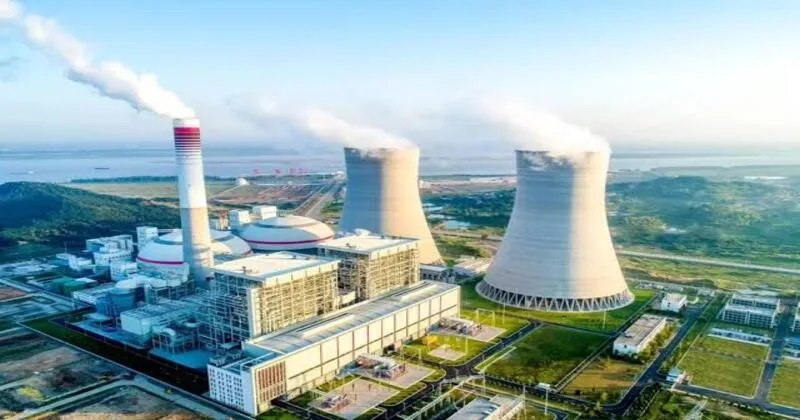
India’s nuclear programme is guided by a strategy of technological self-reliance, developed to overcome historical fuel embargoes while harnessing the country’s vast thorium reserves. At its core is the indigenously designed three-stage nuclear power programme, which enables a gradual transition from uranium- to thorium-based fuel cycles. By advancing indigenous innovation, expanding clean and reliable electricity generation, and ensuring long-term energy security, the programme is contributing to India’s vision of sustainable development and achieving 100 GW of nuclear power capacity by 2047.
Nuclear energy supporting India’s sustainable energy security
India is committed to building a secure, sustainable, and self-reliant energy future to support its journey towards Viksit Bharat. Recognising the growing demand for clean, reliable and stable baseload electricity, the Government of India has placed nuclear energy at the core of its long-term energy strategy. Nuclear power provides round-the-clock, low-carbon electricity, complementing renewable energy while ensuring grid stability.
It also reduces dependence on imported fossil fuels and supports India’s climate commitments. Guided by the vision of Aatmanirbhar Bharat, the Government of India is developing robust indigenous capabilities across the entire nuclear fuel cycle, including reactor design, fuel fabrication, waste management, and advanced technologies.
India currently operates 24 nuclear power reactors with a total installed capacity of 8.78 GW. Nine reactor units, with a combined capacity of 7.5 GW, are under construction. The Government has also approved 10 indigenous Pressurized Heavy Water Reactors (PHWRs) in fleet mode and pre-project activities for two 500 MW Fast Breeder Reactors (FBR).
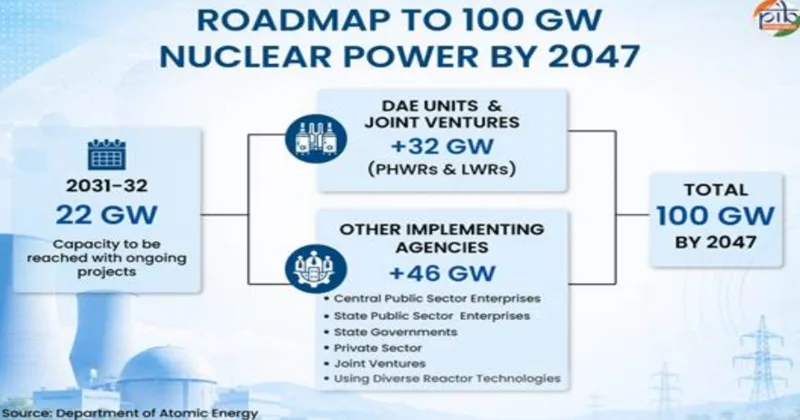
Recent policy initiatives, including the Nuclear Energy Mission (2025–26) and the SHANTI Act, 2025, are accelerating capacity expansion, strengthening domestic manufacturing, promoting innovation and enabling greater private sector participation. Together, these initiatives are creating a resilient nuclear ecosystem that supports sustainable development and advances India’s goal of achieving 100 GW of nuclear power capacity by 2047.
Understanding Nuclear Energy: An Overview
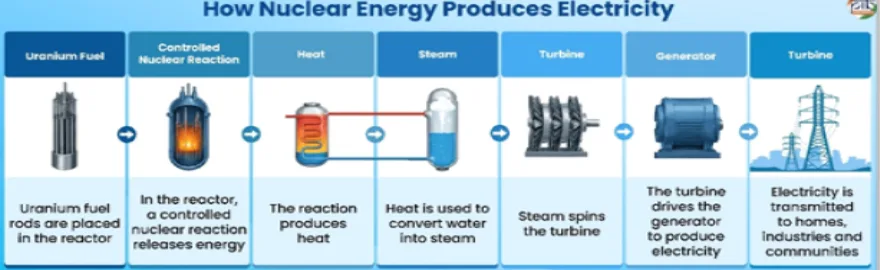
Nuclear power plants generate electricity by harnessing heat released through a carefully controlled process called nuclear fission. The heat converts water into steam, which drives a turbine connected to a generator. The generated electricity powers homes, industries, and essential services. The entire process operates within multiple engineered safety barriers and a robust regulatory framework.
Nuclear Fuel
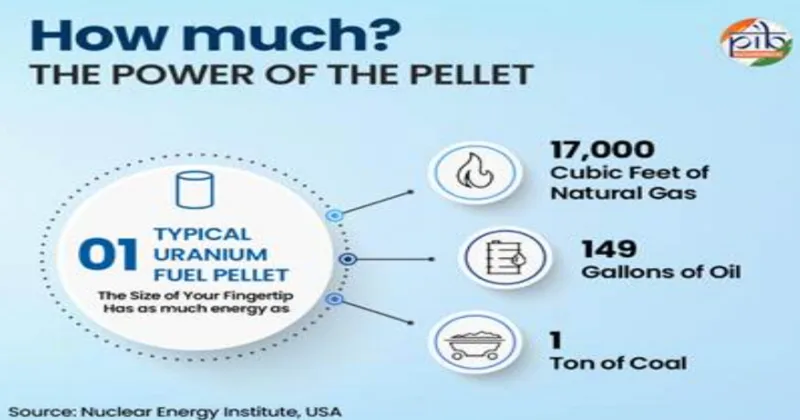
Nuclear fuel is the material placed inside a nuclear reactor to generate electricity. Its atoms split through nuclear fission and release large amounts of heat. The heat converts water into steam. The steam drives turbines to generate electricity.
Nuclear reactor fuels can be fissile, which directly sustain the chain reaction or fertile, which are first converted into fissile fuels inside the reactor. The most common nuclear fuels are Natural Uranium, Uranium-235 (U-235), Low-Enriched Uranium (LEU), Plutonium-239 (Pu-239), and Mixed Oxide (MOX) fuel.
Most countries, including the United States, France, China, Japan, South Korea, Canada, and Russia, use Low-Enriched Uranium (LEU) in Light Water Reactors. India mainly uses Natural Uranium in Pressurised Heavy Water Reactors (PHWRs), which do not require uranium enrichment. India also uses MOX fuel in its Prototype Fast Breeder Reactor (PFBR).
India’s uranium reserves are of low grade and therefore need to be supplemented through imports. India, however, has abundant reserves of thorium (Th-232). This is a fertile rather than fissile radioactive material, found mainly in the coastal sands of Kerala, Tamil Nadu, Andhra Pradesh, Odisha, West Bengal and Jharkhand. Inside a reactor, Th-232 absorbs a neutron and transforms into Uranium-233, which is fissile. India’s long-term nuclear strategy is centred on utilising its abundant thorium reserves, through its three-stage nuclear power programme.
India’s three-stage nuclear programme
Dr. Homi J. Bhabha proposed the three-stage nuclear power programme in 1954 to maximise the use of India’s indigenous resources and achieve long-term energy security. India achieved a major milestone in April 2026 when the Prototype Fast Breeder Reactor (PFBR) at Kalpakkam attained first criticality. A breeder reactor is one that produces more fissile material or fuel while generating electricity. This marked the beginning of the second stage of India’s three-stage nuclear power programme. The milestone brings India closer to harnessing its abundant thorium resources for long-term, clean, and self-reliant energy security.
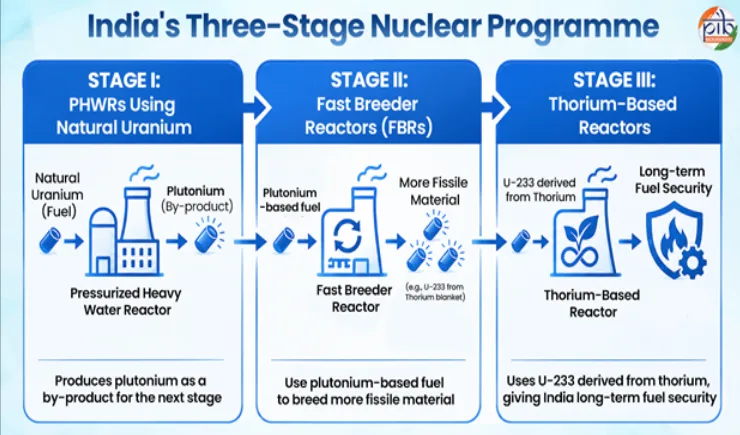
In the first stage, Pressurised Heavy Water Reactors (PHWRs) use natural uranium to generate electricity. The spent fuel is reprocessed to recover plutonium, which becomes the primary input for the second stage. In the second stage, Fast Breeder Reactors (FBRs) use this plutonium to generate electricity while breeding additional fissile material. They also produce uranium-233 from thorium, laying the groundwork for the third stage. In the third stage, thorium-based reactors use uranium-233 to harness India’s abundant thorium reserves. Each stage feeds into the next, unlocking long-term energy security.
The Indira Gandhi Centre for Atomic Research (IGCAR) led the design, development, testing, safety assessment, commissioning and indigenisation of India’s Prototype Fast Breeder Reactor (PFBR). Through close collaboration with Indian industry, IGCAR achieved nearly 90 per cent domestic manufacturing of the reactor’s equipment and systems, strengthening India’s self-reliance in advanced nuclear technology and supporting the country’s second stage of the Three Stage Nuclear Power Programme.
Nuclear Reaction
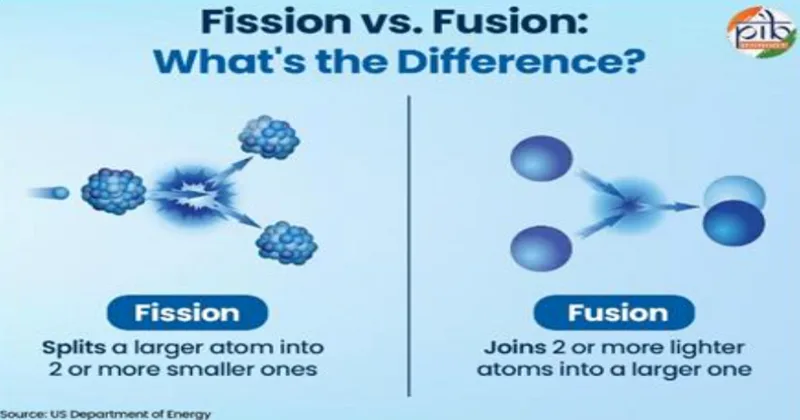
A nuclear reaction releases energy from the nucleus of an atom. The two main types are nuclear fission and nuclear fusion. Nuclear power plants use nuclear fission.
In a nuclear reactor, a neutron strikes the nucleus of a uranium or plutonium atom, causing it to split into two smaller atoms. This process, known as nuclear fission, releases a large amount of heat and additional neutrons. These neutrons trigger further fission reactions, creating a carefully controlled chain reaction. The heat generated is used to convert water into high-pressure steam. The steam drives a turbine, which is connected to a generator. As the turbine rotates, the generator produces electricity.
 Nuclear Reactors
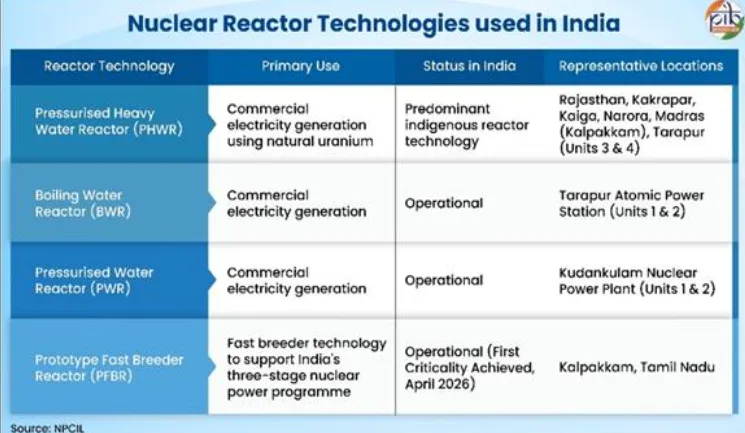
The nuclear reactor is the heart of a nuclear power plant, where the process of nuclear fission is safely controlled to generate heat. It contains nuclear fuel, such as uranium or plutonium, control rods to regulate the fission reaction, a coolant to transfer the heat produced, and multiple safety systems to ensure safe and reliable operation.
ndia primarily uses Pressurised Heavy Water Reactors (PHWRs), which operate on natural uranium. The country also operates Boiling Water Reactors (BWRs) and Pressurised Water Reactors (PWRs). India is advancing Fast Breeder Reactors (FBRs) to utilise plutonium and support the transition to thorium-based reactors. India is also developing Small Modular Reactors (SMRs) as the next generation of nuclear technology.
Small Modular Reactor
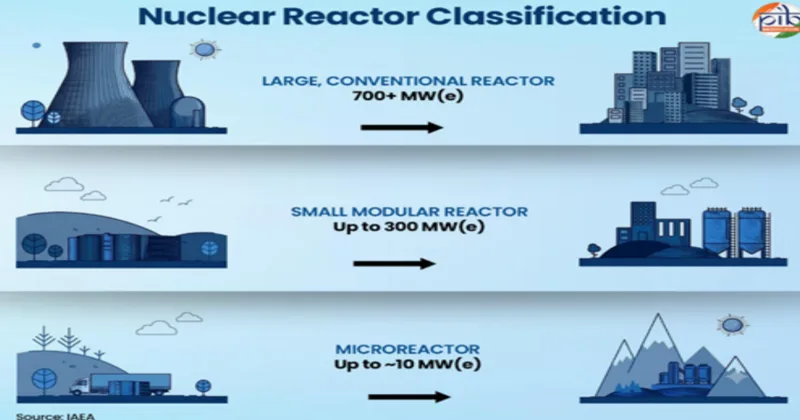
SMRs typically generate up to 300 MWe through nuclear fission. Their compact, modular design enables factory-based manufacturing, faster construction, improved quality, and phased deployment. Under the Nuclear Energy Mission, announced in the Union Budget 2025–26, the Government has allocated ₹20,000 crore for the research, design, development, and deployment of indigenous SMRs. India is developing the 220 MWe Bharat Small Modular Reactor (BSMR-200), jointly designed by BARC and NPCIL, the 55 MWe SMR-55, and a High-Temperature Gas-Cooled Reactor for hydrogen production. The Government aims to operationalise at least five indigenous SMRs by 2033.
Classification of Nuclear Reactors
Nuclear reactors are designed for different applications. Large conventional reactors (700–1,600 MW) supply continuous baseload power to national grids, cities, and industries. Small Modular Reactors (up to 300 MW) and Micro Reactors (up to 20 MW) serve remote areas, replace retiring coal plants, supply industrial process heat, and support hydrogen production.
Nuclear Waste
Nuclear waste is the radioactive material generated during the operation of a nuclear power plant. It includes used nuclear fuel and other materials, such as protective clothing, filters, tools, and equipment, that become radioactive after being used in the plant. Since it emits radiation, it is managed under strict safety standards to ensure the protection of people and the environment.
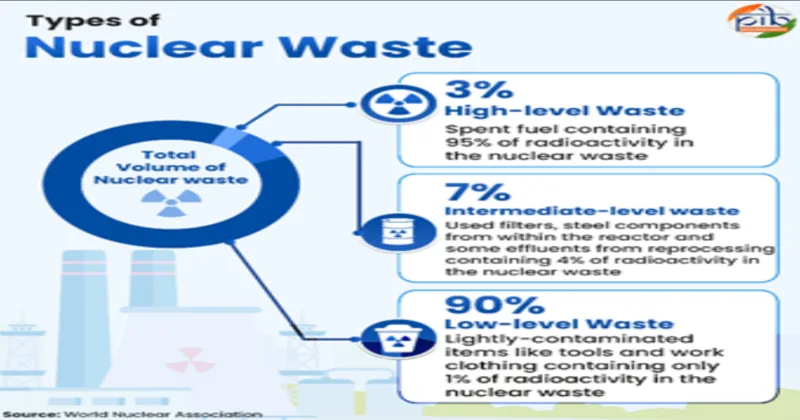
India follows a closed nuclear fuel cycle, where spent nuclear fuel is reprocessed to recover valuable materials for reuse in future reactors. The remaining high-level radioactive waste is immobilised and safely stored, reducing waste and supporting India’s three-stage nuclear power programme.
Vitrification Technology
India is among the few countries with vitrification technology for high-level radioactive waste. The process converts high-level radioactive waste into a stable glass form, making it safer for long-term storage, transport, and eventual disposal.
Powering India’s clean energy future
India’s nuclear energy programme reflects the country’s commitment to innovation, sustainability and self-reliance. By combining advanced technologies with rigorous safety standards and indigenous capabilities, nuclear energy is helping build a secure and resilient energy future. As the nation progresses towards Viksit Bharat, nuclear energy will continue to complement other clean energy sources, supporting economic growth, environmental sustainability and long-term energy security.