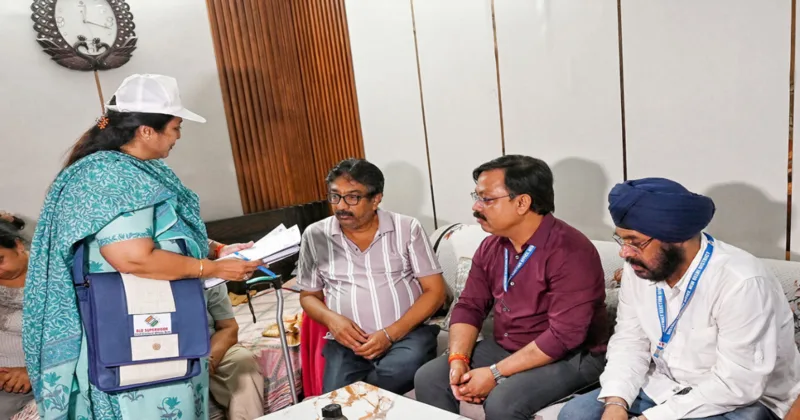
The Election Commission’s ongoing Special Intensive Revision (SIR) of electoral rolls in Delhi has brought several unusual family and age-related discrepancies under scrutiny.
Data cited by BJP general secretary (Org) B.L. Santhosh shows that notices issued during the exercise include cases where the electoral database records family relationships that raise questions about the accuracy of earlier voter records.
According to the figures shared by Santhosh, 6.4 per cent of the notices relate to cases where the age difference between siblings is less than nine months.
Another 2.5 per cent involve a difference of more than 50 years between a voter and a parent, while 2.3 per cent involve a voter whose recorded age is less than 40 years above that of a grandparent.
Some details of notices issued in Delhi during #SIR ….
1. Less than 9 months difference among siblings….. 6.4%
2. Difference between the age of voter & parents more than 50 years … 2.5%
3. Difference between age of voter & grand parents less than 40 years … 2.3%— B L Santhosh (@blsanthosh) September 25, 2026
The data also shows that 5 per cent of the notices involve cases where the recorded age gap between a voter and parent is less than 15 years. Another 4.2 per cent concern cases where six or more children are linked to the same parent in the electoral database.
What the SIR notices actually flag
These categories are part of the Election Commission’s framework for identifying “logical discrepancies” during the mapping of present electoral records with earlier rolls. The official SIR training material lists less-than-nine-month sibling gaps, parent-child age gaps below 15 years or above 50 years, grandparent age gaps below 40 years and six-or-more-child linkages among the discrepancies that can trigger scrutiny.
4. Difference between voter age & parent age less than 15 years … 5%
5. 6 or more children … 4.2%Are you wondering why so much of political storm over SIR … ? These are the reasons … Which forces want these names to remain in voter list ..?
— B L Santhosh (@blsanthosh) September 25, 2026
Importantly, a notice does not by itself establish that a voter is ineligible or that a record is fraudulent. It flags a discrepancy for verification and gives the elector an opportunity to establish the correct details.
Why the numbers have become political
Santhosh has questioned why there is strong political opposition to the SIR, arguing that the exercise is bringing questionable entries and inconsistencies in old electoral data under scrutiny.
He has also asked which political parties benefited from such voter lists in previous elections and why intensive revisions were not conducted more regularly.
Which parties benefitted from these voter lists all these years ..?
Which party & family created a system which kept such names in voter list for decades ..?
Why was #SIR not held regularly all these decades ..??
Nation wants answers for all these .— B L Santhosh (@blsanthosh) September 25, 2026
The opposition, meanwhile, has raised concerns about deletions, notices and the possibility of genuine voters being affected by the revision process. The Supreme Court has also taken up a challenge concerning Delhi’s SIR and has emphasised the need for voter assistance where notices are issued mechanically.
The debate therefore goes beyond the individual anomalies. It centres on how electoral rolls were maintained in the past, how discrepancies accumulated, and how the Election Commission can distinguish between genuine errors, outdated records and eligible voters during the present verification exercise.