‘“The resolve we took on the soil of Japan is today taking concrete shape on the soil of Lucknow,’” said Uttar Pradesh Chief Minister Yogi Adityanath, marking a defining moment in the state’s expanding partnership with Japan. What began as diplomatic conversations on Japanese soil has, over recent months, matured into what the Chief Minister described as a strong business partnership, now translating into fresh avenues of investment, industry and employment across Uttar Pradesh.
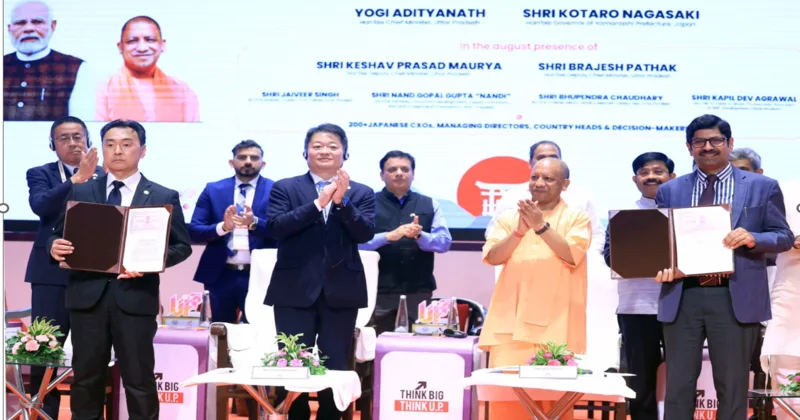
The remarks came against the backdrop of a rapidly deepening Uttar Pradesh-Japan relationship, anchored around Japan Yamanashi model. The Chief Minister held detailed discussions with Kotaro Nagasaki, Governor of Yamanashi, both during his own visit to Japan and subsequently when the Governor led a delegation to Lucknow. Its resulting in a Memorandum of Understanding covering industrial cooperation, tourism and vocational education, with a distinct thrust on green hydrogen and clean energy innovation.
Yamanashi Faith in Uttar Pradesh
Chief Minister Adityanath extended his gratitude to Governor Nagasaki and his team for what he called their ‘“wholehearted cooperation’” with the state government. Central to this partnership is Yamanashi’s decision to commit approximately Rs 600 crore towards facilitating investment by its MSME companies in Uttar Pradesh, a step the Chief Minister termed a ‘“significant proof of Japanese industry’s growing confidence’” in the state.
Governor Nagasaki engagement with the state has gone beyond a single agreement. He proposed leading a delegation of over 200 Japanese CEOs and business leaders to India, a plan that materialised when the Uttar Pradesh-Japan Investment Meet 2026 opened in New Delhi and Lucknow between August 18 and 23. Union Ministers Piyush Goyal, Ashwini Vaishnaw and Shivraj Singh Chouhan joined the Chief Minister in welcoming the delegation. As part of the meet, the Chief Minister performed a virtual bhoomi pujan for industrial projects by Escorts Kubota and Minda Corporation, together valued at over Rs 3,191 crore on 20th August,2026.
Discipline, Innovation and the Japanese Example
Reflecting on Japan’s economic trajectory, the Chief Minister observed that the country had shown the world that limited natural resources need not be an obstacle when discipline, willpower, high-quality standards, innovation and a spirit of ‘“Nation First’” guide national effort. Japan, he noted, stands today among the world’s foremost economic and industrial powers, an example he held up as instructive for Uttar Pradesh’s own ambitions.
The Uttar Pradesh-Yamanashi relationship, in his words, has opened ‘“a new era of partnership’” between India and Japan, one that rests as much on shared values as on commercial opportunity. He described Japan’s industrial excellence as a legacy built over decades, and Uttar Pradesh’s youth as an energetic generation ready to learn, create and lead provided the right ecosystem is built around them.
Infrastructure as the Foundation
Much of this ecosystem, the Chief Minister said, is already under construction. Under the guidance of Prime Minister Narendra Modi, Uttar Pradesh has been rapidly building expressways, airports, high-speed connectivity and modern transport infrastructure. But the goal, he clarified, is not connectivity alone. The state is working to build a complete infrastructure ecosystem that gives industry speed, citizens safety and investors reliability three outcomes he framed as inseparable from one another.
This infrastructure push has not gone unnoticed by Japanese industry. Delegates visiting Uttar Pradesh have spoken favourably of the state’s policy reforms and ease of doing business, particularly citing seamless approvals, simplified land allotment and reduced compliance burdens. Multimodal logistics hubs, integrated manufacturing and logistics clusters, and expanding industrial parks were also flagged by Japanese representatives as significant factors drawing investment towards the state.
A Dedicated Desk and a 90-Day Rhythm
To institutionalise this momentum, Invest UP will set up a dedicated Yamanashi Desk, intended to serve as a continuous coordination channel between the Yamanashi government, its industries and prospective investors on one side, and the state’s investment apparatus on the other. The two sides have also agreed to a review mechanism every 90 days, covering investment projects, industry requirements, pending approvals and challenges, so that no gap is left unaddressed at any stage. The Chief Minister said this rhythm of coordination would give fresh momentum to the entire journey from the signing of an MoU to the realisation of actual investment on the ground.
This institutional follow-through echoes a broader pattern in Uttar Pradesh’s Japan engagement. Yamanashi Prefecture had earlier signed an MoU with Uttar Pradesh in December 2024, aimed at business development and human resource exchange, and Governor Nagasaki has since spoken of inviting Indian engineers to work at Yamanashi Hydro Company and Indian students to study at Yamanashi University, alongside a medical insurance plan for Indian workers’ families in Japan. Uttar Pradesh, for its part, is developing IIT Kanpur as a Centre of Excellence in Green Hydrogen, a step aligned with Prime Minister Modi’s vision of energy self-reliance.
Beyond the Numbers: Jobs, Technology and Shared Prosperity
The Chief Minister was categorical that the success of the Uttar Pradesh-Japan partnership will not be measured only in the scale of investment it attracts. Its real test, he said, lies further ahead in the millions of jobs it generates, the new technologies it brings, the global products it enables, and the shared prosperity it delivers to future generations. The ambition, he added is for products manufactured in Uttar Pradesh to build a recognised presence not just in Japan but across markets worldwide.
This vision sits within the Chief Minister larger project of positioning Uttar Pradesh as a one-trillion-dollar economy, with Japan cast as a long-term partner in manufacturing and technology-driven growth. Union Minister Piyush Goyal, welcoming the Japanese delegation earlier this week, pointed to the deep economic ties between India and Japan and the widening opportunities the relationship now offers both sides.
Civilisational Ties Behind the Commerce
Beyond the balance sheets, the Chief Minister has repeatedly situated the Uttar Pradesh-Japan relationship within a much older frame. At the MoU signing in Lucknow, he noted that the roots of strategic, cultural and global cooperation between the two nations stretch back more than a millennium, long before either side spoke the language of investment summits or industrial corridors. He observed that at a time when several parts of the world remain gripped by conflict, Prime Minister Modi continues to bind nations together through the message of peace, harmony and unity associated with Lord Buddha a thread that runs through both Uttar Pradesh civilisational memory and Japan own spiritual heritage.
The Chief Minister also credited the personal equation between Prime Minister Modi and Japan’s late former Prime Minister Shinzo Abe with lifting India-Japan ties to new heights across the political, economic and business spheres. That foundation, he suggested, is what allows a state-level partnership such as the one with Yamanashi to move as quickly and substantively as it has. He recalled that Japan had earlier served as a partner country for the Global Investors Summit in Uttar Pradesh, an engagement that laid the early groundwork for the far deeper collaboration now unfolding.
Designing Viksit Bharat 2047 Together
The Chief Minister closed his remarks by framing the partnership in generational terms. ‘“The industries of 2047 are being designed today. We want Japan and Uttar Pradesh to design them together,’” he said, tying the state industrial ambitions to India’s centenary of independence.
Taken together, the Yamanashi engagement reflects a wider recalibration of how Uttar Pradesh approaches foreign investment moving from one-off agreements towards institutional mechanisms, dedicated desks and time-bound reviews meant to convert diplomatic goodwill into industrial outcomes. For a state chasing trillion-dollar ambitions, the Chief Minister message was what was resolved on Japanese soil is now being built, brick by brick, on the soil of Uttar Pradesh.