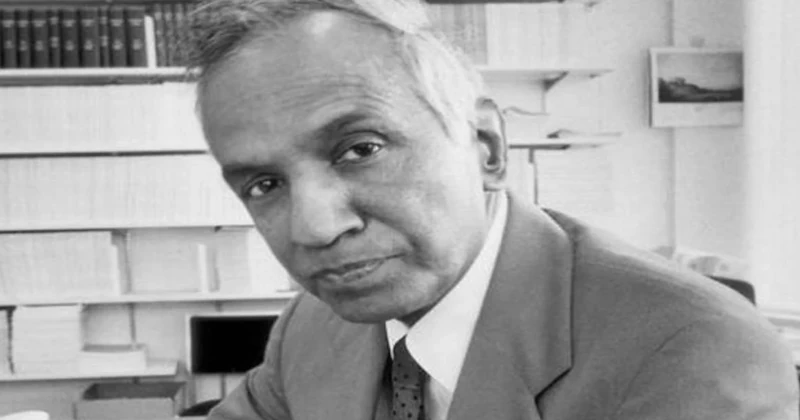
On the death anniversary of renowned Indian-American astrophysicist and Nobel laureate Dr. Subrahmanyam Chandrasekhar, tributes are being paid to a scientist whose groundbreaking work transformed the understanding of stars, stellar evolution and some of the most extreme objects in the universe.
Born on October 19, 1910, in Lahore, Chandrasekhar developed a deep fascination with the night sky from an early age. His childhood curiosity about the stars and their origins eventually evolved into a remarkable scientific career that placed him among the most influential astrophysicists of the 20th century.
डॉ. सुब्रह्मण्यम चंद्रशेखर को श्रद्धांजलि: सितारों में लिखी एक अमर विरासत
आज हम महान वैज्ञानिक और नोबेल पुरस्कार विजेता डॉ. सुब्रह्मण्यम चंद्रशेखर की पुण्यतिथि पर उन्हें विनम्र श्रद्धांजलि अर्पित करते हैं।
19 अक्टूबर 1910 को लाहौर में जन्मे चंद्रशेखर का जीवन यह दर्शाता है कि… pic.twitter.com/irMhwhUmEb
— Rashtra Sevika Samiti Delhi Prant (@sevikasamiti) August 20, 2026
Chandrasekhar is best known for the “Chandrasekhar Limit,” a fundamental concept in astrophysics that defines the maximum mass a stable white dwarf star can sustain before undergoing further gravitational collapse. His work provided crucial insights into the life cycle of stars and helped explain how massive stars can ultimately evolve into objects such as neutron stars and black holes.
His contributions extended well beyond the Chandrasekhar Limit. Through rigorous mathematical and theoretical research, he explored stellar structure, stellar dynamics, radiative transfer and the behaviour of matter under extreme conditions. His work helped establish a deeper connection between physics and astronomy.
Chandrasekhar’s research also contributed significantly to humanity’s understanding of the final stages of stellar evolution. His studies helped scientists understand how stars change throughout their lives and how different types of stellar remnants can emerge after a star exhausts its nuclear fuel.
Beyond his scientific achievements, Chandrasekhar was widely respected as an educator and mentor. He spent much of his academic career at the University of Chicago, where he taught and conducted research. His ability to explain complex scientific concepts with clarity made him an influential figure among generations of students and researchers.
In 1983, Chandrasekhar was awarded the Nobel Prize in Physics, jointly with William A. Fowler, for his theoretical studies of the physical processes important to the structure and evolution of stars. The award recognised decades of pioneering work in astrophysics.
His contributions were also recognised by the Government of India, which honoured him with the Padma Vibhushan, among the country’s highest civilian awards.
Chandrasekhar’s legacy extends far beyond the awards and scientific theories associated with his name. His life stands as an example of how curiosity, intellectual discipline and an unwavering pursuit of knowledge can reshape humanity’s understanding of the universe.