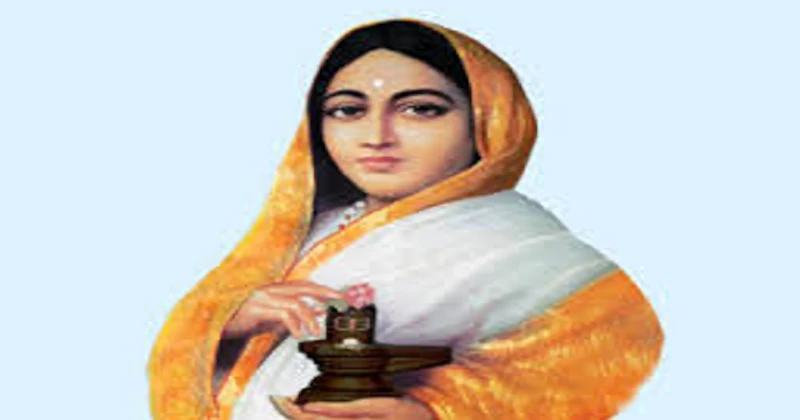
New Delhi: On August 13, India remembers Rajmata Ahilyabai Holkar, the remarkable 18th-century ruler of Malwa whose life stands as a powerful testament to courage, sacrifice, public service and unwavering devotion to dharma. Born on May 31, 1725, in Chondi village in present-day Maharashtra, Ahilyabai emerged from an ordinary farming family to become one of India’s most revered women rulers.
Her story was not one of inherited privilege alone. It was forged through repeated personal tragedies, political challenges and immense responsibility.
The daughter of Mankoji Rao Shinde, a devout Shiva devotee, Ahilya was deeply influenced by spiritual values from childhood. According to the traditional account of her life, Malhar Rao Holkar, the ruler of Indore, once encountered the young Ahilya participating in an aarti at a temple. Impressed by her devotion and character, he proposed that she marry his son Khanderao Holkar. She entered the Holkar household at just eight years of age.
13 अगस्त/ पुण्य तिथि
तपस्वी राजमाता अहिल्याबाई होल्करभारत में जिन महिलाओं का जीवन आदर्श, वीरता, त्याग तथा देशभक्ति के लिए सदा याद किया जाता है, उनमें रानी अहिल्याबाई होल्कर का नाम प्रमुख है। उनका जन्म 31 मई, 1725 को ग्राम छौंदी (अहमदनगर, महाराष्ट्र) में एक साधारण कृषक परिवार… pic.twitter.com/WHzbpCURc6
— Rashtra Sevika Samiti Delhi Prant (@sevikasamiti) August 12, 2026
But the royal palace did not shield her from suffering.
In 1754, her husband Khanderao was killed in battle. Twelve years later, in 1766, her father-in-law Malhar Rao also died. Ahilyabai was subsequently thrust into the centre of state affairs at a time when political instability and competing interests threatened the Holkar kingdom.
Yet the tragedies did not break her.
She assumed the responsibilities of governance with the discipline of an ascetic. Her personal life was subsequently devastated by further deaths within her family, including the loss of her son and daughters. Despite these crushing blows, Ahilyabai continued to discharge her responsibilities towards her subjects.
Her reign also tested her political courage.
At one point, an attempt was made to challenge her authority through political manoeuvring involving the Peshwa’s camp and Indore’s administration. Rather than surrender to intimidation, Ahilyabai responded with a firm diplomatic message.
Her argument was devastatingly simple: defeating a widow would bring little glory to a powerful ruler, while losing to her would bring lasting humiliation. She made it clear that she did not fear either death or war and had no personal hunger for the throne. But she would defend her kingdom and responsibility until her last breath.
The episode became emblematic of the kind of leadership associated with Ahilyabai measured, diplomatic and restrained, yet completely fearless when the interests of her people were at stake.
For Ahilyabai, kingship was not merely an instrument of power. It was a sacred responsibility. She is remembered for personally interacting with her subjects and travelling among them rather than remaining confined to the palace.
Her administration focused on public welfare and the economic and social development of the kingdom.
Traditions surrounding her reign also highlight her uncompromising commitment to justice. Even members of her own family were not considered above the law. Her willingness to punish wrongdoing within her household became a powerful symbol of her belief that the ruler must be subject to the same moral standards expected of the people.
Ahilyabai’s contribution extended far beyond the boundaries of the Holkar kingdom. A devout patron of Hindu religious and cultural institutions, she supported the construction and restoration of temples, wells, stepwells, dharamshalas and other public facilities at important pilgrimage centres across India.
Among her most enduring contributions was the reconstruction of the Kashi Vishwanath Temple in Varanasi in 1780, a landmark achievement that remains closely associated with her name.
Her patronage was not restricted to religious architecture. During her rule, Malwa became known for flourishing trade, agriculture, arts, culture and learning. Maheshwar, in particular, developed into an important centre of culture and craftsmanship.
What distinguishes Ahilyabai’s legacy is the contrast between the immense authority she wielded and the austere manner in which she is remembered for exercising it.
She did not treat sovereignty as an opportunity for personal luxury. Instead, the image that endured was that of an ascetic queen one who regarded power as a means of fulfilling duty.
Her life demonstrates how personal grief can either destroy an individual or be transformed into a deeper sense of responsibility. Ahilyabai chose the latter. She lost her husband. She lost her father-in-law. She endured the deaths of members of her immediate family. She faced political challenges. Yet she continued to govern.
Rajmata Ahilyabai Holkar passed away on August 13, 1795, at the age of 70.
More than two centuries later, her legacy continues to resonate because it was built not merely on military or political power, but on duty, justice, public welfare, spiritual conviction and personal sacrifice.
Her place in India’s historical memory is reflected in the Ekta Stotra, where she is remembered among the country’s illustrious women warriors and rulers, alongside figures such as Rani Lakshmibai of Jhansi, Kittur Chennamma and Rudramadevi.