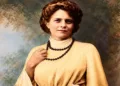
NEW DELHI: On her death anniversary, Mahadevi Verma is remembered not merely as one of Hindi literature’s most celebrated poets, but as a powerful voice who challenged the limitations imposed on women by society and established her own distinct identity in literature, education and public life.
Born in 1907 on the day of Holi, Mahadevi Verma grew up in an environment where tradition and modernity existed side by side. Her mother was deeply devoted to religious practices, while her father was influenced by Western ways and was not inclined towards rituals. The coexistence of these contrasting influences had a lasting impact on Mahadevi’s intellectual and emotional development.
At a time when literature was largely dominated by men, Mahadevi Verma emerged as a formidable literary personality. Her contributions extended beyond poetry to literary criticism, essays, memoirs and editing. She was also an accomplished line artist whose sketches reflected the same sensitivity and depth found in her writing.
Mahadevi displayed her poetic talent from a remarkably young age. At just seven, she wrote her first poem, reflecting the tenderness and imagination that would later become defining features of her literary work.
11 सितम्बर/पुण्य-तिथि
नारी चेतना का स्वर महादेवी वर्मा
महान कवियत्री महादेवी वर्मा का जन्म ऐसे समय में हुआ, जब साहित्य सष्जन के क्षेत्र में पुरुष वर्ग का वर्चस्व था; पर महादेवी ने केवल साहित्य ही नहीं, तो सामाजिक व राजनीतिक क्षेत्र में अपनी सषक्त उपस्थिति से समस्त नारी वर्ग का… pic.twitter.com/714x1F8hPU
— Rashtra Sevika Samiti Delhi Prant (@sevikasamiti) September 10, 2026
Her personal life was marked by several social constraints. Married at the age of nine, Mahadevi chose to pursue education and intellectual independence rather than conform to the conventional expectations surrounding marriage. She went on to complete her M.A. in Sanskrit from Allahabad University in 1932.
Her thirst for knowledge extended to India’s ancient intellectual traditions. She wanted to study the Vedas, Puranas and other classical texts in their original form. However, social barriers stood in her way. According to accounts of her life, scholars were reluctant to teach her because she was both a woman and from a non-Brahmin background. Her inability to gain access to formal study of these texts remained a source of pain for her.
Mahadevi Verma’s intellectual journey was also deeply influenced by Mahatma Gandhi. Gandhi’s emphasis on Hindi convinced her that the language could express the spirit of the Indian nation. Hindi subsequently became central to Mahadevi’s literary and educational mission.
Her commitment to women’s education was equally significant. Although she had aspirations for higher studies abroad, Gandhi’s influence encouraged her to devote herself to women’s education. She played a major role in establishing Mahila Vidyapeeth in Prayag, later serving as its Vice-Chancellor.
Her world extended far beyond human relationships. Mahadevi had a deep affection for animals and nature, and her memoirs vividly portray the cows, deer, cats, squirrels, rabbits and dogs that became part of her life. Her writings transformed these seemingly ordinary relationships into deeply moving reflections on compassion and companionship.
She was also closely associated with fellow writers, famously considering Suryakant Tripathi ‘Nirala’ her brother and tying a rakhi to him. In Prayag, she established the Sahityakar Sansad, an initiative aimed at supporting and assisting literary figures.
Her sensitivity was not confined to literature. During natural disasters such as floods, she extended help to affected people, demonstrating that her concern for society went beyond the written word.
Mahadevi Verma’s literary stature was ultimately recognised with the prestigious Jnanpith Award for ‘Yama’, one of the landmark works of modern Hindi poetry. Her writing, marked by emotional depth, spiritual reflection and an acute awareness of women’s experiences, gave a distinctive voice to feminine consciousness in Hindi literature.
Mahadevi Verma passed away on September 11, 1987. Decades after her death, her legacy remains alive not only in Hindi poetry and literature, but also in the fields of women’s education, social service and cultural thought.