In a written reply to the Lok Sabha this week, Minister of State for Education Shri Jayant Chaudhary placed on record something that rarely makes headlines but shapes the daily life of crores of Indian children, the precise nutritional and administrative architecture behind the PM POSHAN Scheme. Buried in parliamentary procedure was a reaffirmation of one of independent India’s most ambitious and least-noticed welfare commitments, that no child in a government school should sit through a school day on an empty stomach. Its implications are civilisational.
At a time when the discourse on India’s welfare state often oscillates between accusations of over-centralisation and complaints of Central apathy towards States, PM POSHAN offers a quieter and more instructive decision where Delhi sets the standard and the States to decide how best to meet it on their own terms. Understanding how this scheme actually works and why its nutrition science is deliberately not a copy-paste of Western models, is essential to understanding how Bharat feeds its future citizens.
Education, state power and the constitutional design
Few citizens realise that education sits on the Concurrent List of the Constitution, meaning both Parliament and State Legislatures can legislate on it, but administration of schools and school boards rests overwhelmingly with State Governments and Union Territory Administrations. This is not incidental. It is a deliberate constitutional choice reflecting India’s federal character recognising that a nation as vast and diverse as Bharat cannot be schooled by a single uniform template dictated from Delhi. PM POSHAN, implemented in partnership with States and UTs, operates squarely within this design. The Centre sets the nutritional floor and provides the funding framework; the States build the roof suited to their own climate, culture and produce. It is cooperative federalism translated into a mid-morning meal.
The partnership among the states and centre
Under PM POSHAN, the overall responsibility for delivering hot, nutritious meals to children from Bal Vatika to the pre-Class I stage now formally woven into the scheme following the National Education Policy’s emphasis on foundational years through Class VIII in government and government-aided schools rests with State Governments and UT Administrations. The Centre role is to prescribe nutrition and food norms rooted in the National Food Security Act, 2013 and to fund implementation. Within this framework, States and UTs enjoy real autonomy, they decide menus suited to local conditions and are actively encouraged to procure locally grown food items such as millets, seasonal vegetables and regional condiments. A child in Manipur and a child in Gujarat are guaranteed the same nutritional floor, but what lands on their plate reflects their own soil, season and tradition. This is Ekta in diversity, quite literally served on a plate.
The science on the plate
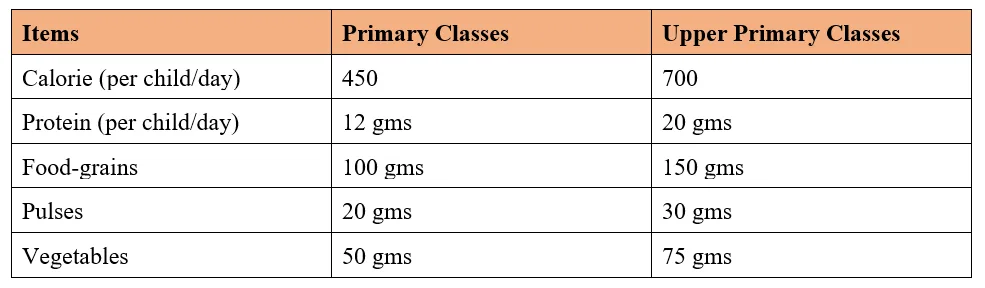
The scheme of food norms is not arbitrary, they are calibrated to the growth requirements of two distinct age groups. Salt and condiments are provided as per need. These are not suggestions, they are binding standards under the NFSA framework, verified and reported to Parliament the kind of granular accountability that distinguishes a functioning welfare state from a merely well-intentioned one.

Why nutrition science in Bharat cannot follow a borrowed template
Nutritional science, as practised in the industrialised West, was built largely around relatively homogenous populations, temperate climates and standardised food-supply chains. Bharat offers none of these comforts and that is precisely why its nutrition policy cannot be an imported template. Indian agro-climatic zones range from the wheat belts of Punjab to the rice bowls of the eastern seaboard to the millet-growing drylands of the Deccan plateau and children’s dietary patterns, seasonal food availability and even micronutrient deficiencies vary sharply across these regions.
According to the National Family Health Survey-5 (2019-21), child stunting stood at 35.5 per cent, wasting at 19.3 per cent and underweight prevalence at 32.1 per cent nationally figures that themselves mask wide inter-State variation, from relatively better indicators in the south to more acute challenges in parts of the Hindi heartland and the east. Anaemia, driven by iron deficiency, has also emerged as a stubborn concern among Indian children even as other malnutrition indicators have improved. A one-size-fits-all imported nutrition model, calibrated for a different genetic pool, climate and food culture, would simply fail here.
The United Nations own 2025 State of Food Security and Nutrition report noted that India recorded the world’s highest child wasting rate even as its broader hunger indicators improved with a paradox that underscores how undernutrition in Bharat is driven less by absolute food scarcity than by dietary quality, seasonal disease burden and micronutrient gaps that vary district to district. This is why PM POSHAN design, a national nutritional floor combined with State-level flexibility to localise the menu is not administrative convenience but nutritional necessity, grounded in the recognition that Bharat’s children are being fed by Bharat’s own science, not borrowed formulae.
From field to flexi approach
The scheme also builds in room for innovation and self-reliance. States and UTs are permitted to use 5 per cent of the total recurring budget as a flexi component, deployed for setting up School Nutrition Gardens and for supplementary nutrition interventions in identified districts. These gardens, cultivated often by students and school staff themselves, double as living classrooms in agriculture and self-sufficiency while supplying fresh vegetables to the kitchen. Many States further layer on additional supplementary nutrition drawing on local food habits and dietary practices a soybean-based supplement here, a groundnut chikki tailored to what a region already grows and already eats. This localisation dovetails naturally with the wider Shri Anna and millet-promotion push, embedding self-reliant, climate-resilient, locally-sourced nutrition directly into the school ecosystem rather than relying on long supply chains.
Measuring what matters: Outcomes on the ground
The rationale for this scale of investment is not merely humanitarian; it is developmental. Adequately nourished children attend school more regularly, concentrate better and retain what they learn. PM POSHAN, by anchoring a nutrition guarantee to school attendance, has long served as one of India’s most effective instruments for both reducing dropout rates and improving foundational learning outcomes for the objectives that sit at the very heart of the National Education Policy 2020’s vision for the early years. The extension of coverage to Bal Vatika reflects a growing policy consensus that nutritional intervention must begin before formal schooling, not after malnutrition has already left its mark on a child’s cognitive development.
There is also a quieter economic argument at work. A hot cooked meal on every working day functions as an income transfer to poor households, easing the food burden on families and making the opportunity cost of sending a child to school, rather than to work considerably lower. Combined with the supplementary nutrition interventions in identified high-burden districts, PM POSHAN increasingly functions less as a standalone mid-day meal scheme and more as a layered, targeted nutrition-security instrument, one that adapts its intensity to where the need is greatest, rather than applying a flat national response to a distinctly uneven problem.
PM POSHAN does not ask Manipur to eat what Madhya Pradesh eats, nor Kerala to eat what Rajasthan eats. It asks only that every child, regardless of geography, receive the calories and protein their growing body needs delivered through the food their own region already knows how to grow and cook. That is cooperative federalism at its most literal of the Centre setting the standard, the States serving the meal and the Constitution’s Concurrent List working exactly as its framers intended. In an era when governance debates often reduce federalism to friction between Delhi and the States, PM POSHAN quietly demonstrates what functional partnership looks like one hot meal, one school day, one child at a time.