New Delhi: India’s indigenous air-defence export ambitions are gaining momentum in Central Asia, with Turkmenistan and Tajikistan expressing interest in acquiring the Akash 1S Air Defence System, according to the report published by the Indian Defence Research Wing. Although neither country has signed a formal contract with India, the reported interest signals growing international acceptance of the Akash family as a potential alternative to traditional Russian and Chinese-origin medium-range air-defence systems.
The interest has emerged following Armenia’s procurement of the Indian-made Akash 1S, which made the country the first international customer for the system. Armenia signed a landmark agreement with India, with deliveries beginning in late 2024. The export was an important milestone for India’s defence industry, demonstrating foreign military confidence in an indigenous missile system and creating a potential pathway for further exports.
Akash 1S builds on proven Akash architecture
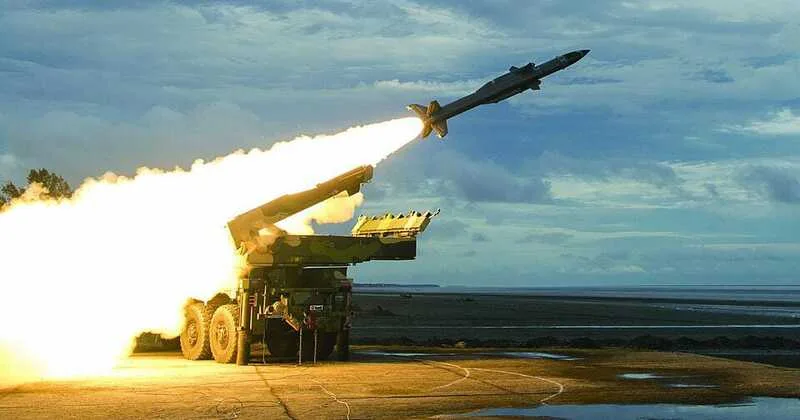
The Akash 1S is the seeker-equipped evolution of the original Akash missile system. Its most significant technological enhancement is an indigenous active Radio Frequency (RF) seeker that provides terminal guidance, while the missile continues to receive command guidance during the mid-course phase. This hybrid guidance architecture improves interception accuracy, particularly against highly manoeuvrable aerial targets, while strengthening resistance to electronic countermeasures. The Akash 1S was developed as an intermediate step between the original Akash and the more advanced Akash Prime, retaining the proven weapon architecture while introducing modern terminal-homing capability.
The system is designed to engage multiple targets simultaneously through its integrated Rajendra phased-array fire-control radar and networked command-and-control architecture. For Turkmenistan and Tajikistan, this offers an operationally relevant capability for protecting military installations, strategic infrastructure and forward-deployed forces from aircraft, helicopters, cruise missiles and increasingly unmanned aerial systems.
Both countries have extensive land borders and face evolving security requirements. The ability to deploy a mobile air-defence system capable of operating as part of a layered network could therefore make the Akash 1S an attractive option.
Central Asia looks beyond traditional suppliers
Central Asian air-defence inventories have traditionally been dominated by Soviet and Russian-origin systems, including the S-125, Kub, Buk and S-300 families. However, ageing equipment, changing aerial threats and shifting geopolitical realities have encouraged regional countries to explore diversification of defence procurement.
India’s expanding defence-industrial base could benefit from this trend. New Delhi’s willingness to provide technology cooperation, training and long-term maintenance support is increasingly positioning India as an alternative defence partner for countries seeking capable systems without becoming overly dependent on traditional suppliers.
The Akash 1S also benefits from being a mature production system. It is manufactured by Bharat Dynamics Limited (BDL), with major subsystems supplied by Bharat Electronics Limited (BEL) and other Indian defence firms. The system has a high level of indigenous content, while its active seeker enables the missile to independently refine its interception during the terminal phase. This reduces dependence on continuous ground-based tracking and can improve the probability of successfully engaging evasive targets.
For India, additional international orders would directly support the government’s objective of expanding defence exports while generating economies of scale for domestic production. Each export contract can strengthen India’s defence-manufacturing ecosystem and enhance the international reputation of missile technologies developed by the Defence Research and Development Organisation (DRDO).
The reported interest from Turkmenistan and Tajikistan could also open the door to a wider Indian air-defence export portfolio in Central Asia. Countries that adopt the Akash 1S could eventually explore higher-performance systems as their requirements evolve.
Akash-NG, the next-generation member of the Akash family, could be a natural future option. Armenia has already been linked with potential future interest in Akash-NG, suggesting that confidence gained through the induction of the Akash 1S could translate into demand for more advanced variants.
If the reported Central Asian interest develops into formal negotiations and eventual contracts, the Akash family could move beyond being an Indian success story to becoming a significant component of India’s emerging defence-export presence across a strategically important region.