India’s ride-hailing sector is witnessing the emergence of a different business model that seeks to combine digital technology with cooperative ownership.
Bharat Taxi, described as India’s first cooperative-led ride-hailing platform, is built around the principle of “Saarthi Hi Maalik”, or the driver is the owner. Under the model, drivers are not treated merely as service providers operating on a digital platform but as members and owners of the cooperative.
The platform was established on June 6, 2025, under the Multi-State Cooperative Societies Act, 2002, with the support of eight national-level cooperative institutions.
Unlike conventional app-based mobility platforms, where the relationship between the driver and the technology company is primarily transactional, Bharat Taxi seeks to combine driver ownership, democratic participation, fare transparency and shared economic benefits.
As of July 25, 2026, the platform had nearly 8 lakh registered Sarathis and around 41 lakh registered customers.
It is currently operational in Delhi-NCR, Gujarat, Lucknow, Chandigarh, Mumbai, Jaipur, Kanpur and Pune, with plans to expand to Ranchi, Patna, Guwahati, Bhopal, Kolkata, Indore and Nagpur in the coming months.
The long-term target is to establish a nationwide presence by 2029.
A cooperative alternative to conventional ride-hailing
Bharat Taxi was formally established by eight national-level cooperative institutions: the National Cooperative Development Corporation (NCDC), Indian Farmers Fertiliser Cooperative Limited (IFFCO), National Bank for Agriculture and Rural Development (NABARD), Krishak Bharati Cooperative Limited (KRIBHCO), Gujarat Cooperative Milk Marketing Federation Limited (Amul), National Agricultural Cooperative Marketing Federation of India Limited (NAFED), National Dairy Development Board (NDDB) and National Cooperative Export Limited (NCEL).
The platform was registered under the Multi-State Cooperative Societies Act, 2002, which provides the legal framework for cooperative societies operating across multiple states.
Its structure is based on principles such as voluntary participation, democratic functioning, institutional autonomy, self-help and mutual assistance.
Bharat Taxi applies these principles to digital mobility by making drivers members of the cooperative.
The idea is to align ownership with the people who actually provide the mobility service.
Instead of a conventional platform model in which the company owns the digital infrastructure and drivers operate independently on it, Bharat Taxi seeks to give its Sarathis a direct stake in the cooperative and its growth.
This approach is intended to create a mobility ecosystem where ownership, participation and earnings are linked.
“Saarthi Hi Maalik”: Drivers become member owners
The central feature of Bharat Taxi is its driver-centric ownership structure.
Drivers are called Sarathis and are positioned as member owners rather than simply drivers using an application to find passengers.
Sarathis can become member owners by subscribing to the cooperative’s share capital. Shares are valued at Rs 100 each, while a Sarathi seeking to become a partner can acquire ownership rights by purchasing shares worth Rs 500.
The cooperative structure also provides for representation of Sarathi members on the Board of Directors.
This gives drivers a formal mechanism to participate in the governance of the platform and contribute to decisions concerning its development and operations.
The model therefore seeks to bring together three elements that are often separated in conventional platform businesses: ownership, participation and earnings.
By making drivers stakeholders, Bharat Taxi aims to create a system in which the people whose labour sustains the platform also have a role in shaping its future.
Zero-commission model places driver earnings at the centre
Bharat Taxi operates on a zero-commission and surge-free pricing model.
The platform follows a subscription-based approach under which Sarathis can retain their full fare earnings.
Passengers pay the applicable trip fare based on distance, time and market conditions, without additional convenience fees, platform fees or surge pricing through the application.
Under the cooperative earnings structure, 20 per cent of the cooperative’s earnings is credited to Bharat Taxi as the Sarathis’ capital, while the remaining 80 per cent is distributed among Sarathis based on the kilometres travelled by their taxis.
A 7 per cent service charge is levied only at Bharat Taxi-operated airport prepaid booths to meet operational expenses.
The model is intended to provide greater clarity to passengers while ensuring that drivers have a direct economic interest in the platform.
For drivers, the zero-commission structure is designed to reduce the share of earnings typically retained by conventional ride-hailing platforms.
For passengers, the absence of surge pricing is intended to make fares more predictable.
More than a ride-hailing app
Bharat Taxi is not restricted to a single category of urban transport.
The application offers multiple vehicle categories, allowing passengers to select a service based on their travel requirements, passenger capacity, distance and comfort.
The categories include: 2-Wheeler or Bike Taxi, Auto, Economy Cab, Premium Sedan, XL Cab or SUV, Rentals, Out-Station travel, Scheduled Rides.
The range allows the platform to cater to short-distance urban journeys as well as daily commuting, intercity travel and pre-planned trips.
Passengers can book rides through the application, while drivers can register as Sarathis through the app or website by submitting the required documents and completing the onboarding process.
At selected airports, Bharat Taxi also operates prepaid booths, providing passengers with an alternative to app-based bookings.
This combination of app-based services and physical booking points is designed to make the platform accessible across different types of passengers and travel situations.
Rapid expansion across Indian cities
The platform has built a sizeable user base within its first phase of operations.
As of July 25, 2026, Bharat Taxi had nearly 8 lakh registered Sarathis and around 41 lakh registered customers.
It is operational in Delhi-NCR, Gujarat, Lucknow, Chandigarh, Mumbai, Jaipur, Kanpur and Pune.
Jaipur provides an example of the platform’s growing reach. As of July 25, more than 30,000 Sarathis and nearly 7 lakh customers had joined Bharat Taxi in the city.
The next phase of expansion is expected to cover Ranchi, Patna, Guwahati, Bhopal, Kolkata, Indore and Nagpur.
The expansion is planned in phases, with the platform targeting nationwide availability by 2029.
The scale-up will be important for testing whether a cooperative ride-hailing model can operate effectively across cities with different transport patterns, customer preferences and regulatory environments.
Transparent fares and predictable journeys
Fare transparency is another central element of the platform.
Passengers receive fare estimates in advance, while the platform operates without surge pricing.
The objective is to provide greater predictability and allow customers to make informed decisions before booking a ride.
For drivers, the zero-commission arrangement is designed to ensure that their ride earnings are not reduced by conventional platform commissions.
Together, the pricing and ownership models are intended to provide greater clarity on how money moves through the platform.
The cooperative structure also creates a direct connection between the platform’s growth and the economic interests of its driver members.
Opening more opportunities for women
Bharat Taxi has introduced initiatives aimed at increasing women’s participation in the mobility ecosystem.
The Sarathi Didi feature allows women passengers to select rides operated by women drivers through the application.
The platform has also launched Bike Didi, an initiative aimed at encouraging more women to work as drivers.
As of February 2026, more than 150 women drivers had joined Bharat Taxi through the initiative.
The programmes seek to address two aspects of mobility simultaneously: giving women passengers greater choice while creating additional livelihood opportunities for women in the transport sector.
Women-focused services could become particularly relevant as app-based mobility expands and demand grows for greater choice and perceived safety during travel.
Safety integrated into the platform
Safety is another component of Bharat Taxi’s operating model.
The platform incorporates police integration and control-room monitoring to provide coordinated oversight and facilitate responses during emergencies.
Drivers undergo Know Your Customer verification, periodic background checks and safety training before and during their association with the platform.
The application includes several safety features, including live ride tracking, SOS support, driver ratings and safety-rating reviews.
The system is intended to ensure that verified and trained drivers remain active on the platform.
By integrating these features into the application and operating system, Bharat Taxi seeks to make safety part of the platform architecture rather than treating it merely as an additional service.
Linking mobility with India’s digital public infrastructure
Bharat Taxi is also building its digital ecosystem through partnerships with government institutions and technology platforms.
Under a Memorandum of Understanding with the National e-Governance Division, or NeGD, the platform receives advisory and technical support within the Digital India framework.
The collaboration enables integration with national digital platforms including DigiLocker, UMANG and API Setu.
These integrations are intended to support digital verification, paperless processes and easier access to government services.
DigiLocker
DigiLocker, a Digital India initiative of the Ministry of Electronics and Information Technology, provides citizens with a secure digital platform for storing, verifying and sharing authenticated documents.
For Bharat Taxi, integration with DigiLocker can support paperless documentation and digital verification during the onboarding and service process.
UMANG
The Unified Mobile Application for New Age Governance, or UMANG, brings a wide range of government services from central, state and local authorities onto a single digital platform.
Its integration with Bharat Taxi contributes to easier digital access to government services for platform users.
API Setu
API Setu is the Government of India’s open API platform designed to enable secure and interoperable sharing of data and services across e-governance systems.
Together, these digital integrations are intended to support paperless Sarathi onboarding, secure verification, access to government services and more efficient digital operations.
Partnerships across transport, finance and insurance
Bharat Taxi has also developed partnerships with institutions involved in transport infrastructure, banking, insurance and digital payments.
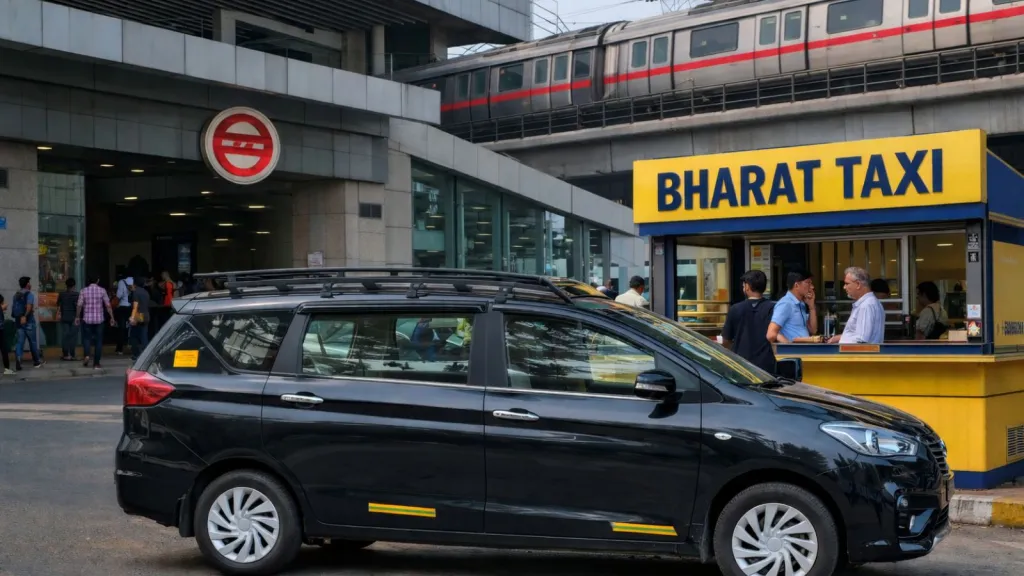
Its major institutional partners include Delhi Traffic Police, Delhi Metro Rail Corporation, Airport Authority, IFFCO Tokio Insurance, State Bank of India and Paytm.
These partnerships are intended to strengthen the platform’s wider service ecosystem.
The collaborations also connect Bharat Taxi with established transport infrastructure and financial and insurance services.
For a mobility platform seeking nationwide expansion, such institutional linkages can help build connections between app-based transport and existing urban transport systems.
Social security for platform workers
Bharat Taxi’s cooperative model extends beyond earnings and ownership to social security.
Sarathis associated with the platform are facilitated to register on the e-Shram portal, the national database of unorganised workers launched by the Ministry of Labour and Employment.
The registration is intended to help Sarathis access relevant social security and welfare schemes.
According to the initiative, Sarathis and their families become eligible for free medical treatment of up to Rs 5 lakh under Ayushman Bharat-Pradhan Mantri Jan Arogya Yojana after registration.
Additional measures include personal accident insurance of Rs 5 lakh through IFFCO Tokio at nominal rates, advisory support for long-term driver welfare and insurance solutions, and group health insurance coverage for drivers and their families supported through the Paytm partnership.
The emphasis on welfare adds another layer to Bharat Taxi’s cooperative model.
Drivers are positioned not only as people earning through the platform but as members whose broader economic and social security is also part of the cooperative framework.
Strengthening airport connectivity
Airport connectivity is another area where Bharat Taxi has expanded its operations.
The platform has entered into agreements with the Delhi Tourism and Transportation Development Corporation and Delhi Airport Parking Services.
These agreements allow Bharat Taxi’s white cab services to operate from multiple parking locations across the terminals of Indira Gandhi International Airport.
The arrangement complements its Kaali Peeli services and is intended to improve the availability of airport rides.
Passengers can also use Bharat Taxi’s prepaid booths for direct bookings.
These airport booths are the only part of the platform’s fare structure where the specified 7 per cent service charge is levied to meet operational expenses.
Why the cooperative model matters
Bharat Taxi is emerging at a time when app-based mobility has become an increasingly important component of urban transportation.
Indian cities now rely on a combination of public transport, private vehicles, walking, cycling and app-based services.
Ride-hailing platforms have helped fill gaps in urban mobility by providing convenient point-to-point transport and supporting last-mile connectivity.
Bharat Taxi seeks to change the relationship between the platform and the people providing the service.
Instead of treating drivers solely as service providers, it places them within a cooperative ownership structure.
Through shareholding, board representation and the distribution of cooperative earnings, Sarathis are intended to participate in the economic and institutional development of the platform.
The approach reflects the broader principle of “Sahkar se Samriddhi”, or prosperity through cooperation.
Bringing technology and democratic ownership together
The significance of Bharat Taxi lies in its attempt to combine two models that have traditionally operated separately.
The first is the technology-driven platform model, which relies on mobile applications, digital payments, GPS-based tracking, automated bookings and data-enabled services.
The second is the cooperative model, based on collective ownership, democratic participation and shared economic interests.
Bharat Taxi attempts to combine the two.
The driver becomes both a service provider and member owner, while passengers receive access to a technology-enabled mobility platform.
Its integration with DigiLocker, UMANG and API Setu further connects the platform to India’s digital public infrastructure.
This creates a model in which digital technology is used not only to match passengers and drivers but also to support documentation, verification and access to government services.
Mobility with an emphasis on inclusion
The platform’s women-focused initiatives, social security measures and cooperative ownership structure give Bharat Taxi a wider social dimension.
Sarathi Didi provides women passengers with the option of booking rides with women drivers, while Bike Didi seeks to bring more women into the driver network.
The e-Shram facilitation and insurance and healthcare-related measures extend the platform’s focus beyond the immediate ride transaction.
Under this model, mobility is presented as an ecosystem involving employment, ownership, social protection and participation.
For drivers, the cooperative framework is intended to create a stronger connection between their work and the growth of the platform.
For passengers, the platform seeks to provide multiple vehicle options, transparent fares and safety features.
Bharat Taxi’s current footprint and expansion plans represent an attempt to establish cooperative ride-hailing as a scalable model across India.
With nearly 8 lakh registered Sarathis and around 41 lakh registered customers as of July 25, 2026, the platform has already developed a substantial user base.
Its planned expansion into Ranchi, Patna, Guwahati, Bhopal, Kolkata, Indore and Nagpur will test the model across a wider range of urban markets.
The larger target of nationwide presence by 2029 will require the platform to scale its technology, driver network, customer base, safety systems, institutional partnerships and support infrastructure simultaneously.
Its ability to maintain the cooperative ownership structure while expanding at scale will be a key aspect of its future trajectory.
A different proposition for India’s urban mobility sector
Bharat Taxi represents an attempt to rethink the conventional relationship between technology platforms, drivers and passengers.
Its defining proposition is that the people who provide the service should also have a stake in owning and shaping the platform.
Through its zero-commission model, Sarathi ownership structure, board representation, transparent fares and cooperative earnings framework, Bharat Taxi seeks to place drivers at the centre of the mobility ecosystem.
At the same time, its multiple ride categories, digital booking system, safety features, women-focused initiatives, airport services and transparent pricing are aimed at serving passengers.
Its partnerships with government agencies, banks, insurance companies, payment platforms and transport institutions add further layers to the ecosystem.
The social security measures are designed to address the broader welfare of drivers and their families, while skill and employment initiatives seek to expand participation in the platform economy.
With its planned nationwide expansion by 2029, Bharat Taxi is positioning itself as more than another ride-hailing application.
It represents an experiment in cooperative digital mobility, bringing together technology, shared ownership, livelihood generation, social security and urban transport.
If the model succeeds at scale, it could offer an alternative framework for how platform-based businesses operate in India, one in which the people powering the service are also intended to have a stake in its ownership and future.
The initiative therefore places the cooperative movement at the heart of a rapidly changing digital economy, extending the principle of “Sahkar se Samriddhi” into India’s urban mobility sector.