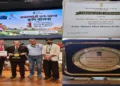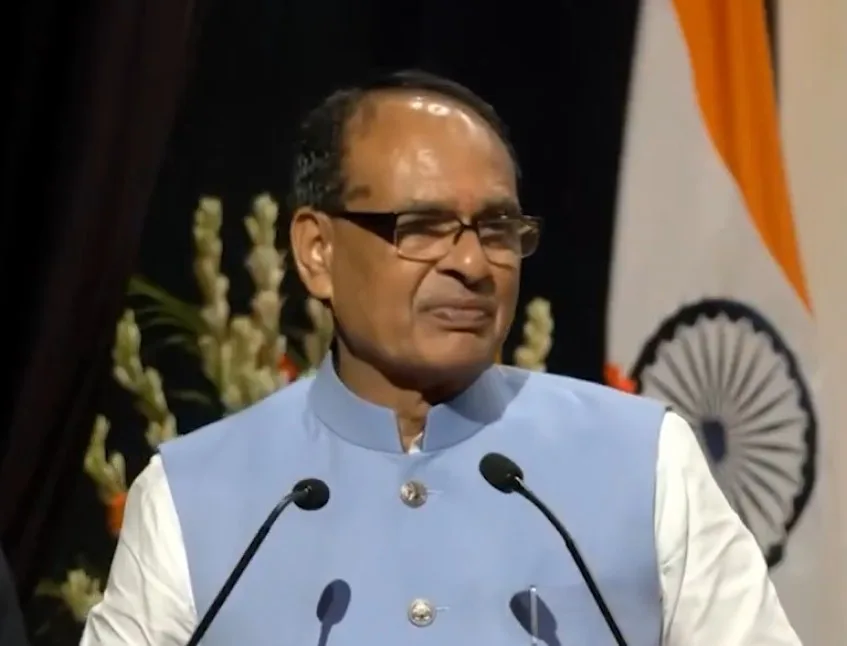
Union Agriculture and Farmers’ Welfare and Rural Development Minister Shivraj Singh Chouhan on Tuesday called for coordinated efforts by farmers, scientists, government officials, food processors, exporters, Farmer Producer Organisations (FPOs) and rural women to translate Prime Minister Narendra Modi’s ‘Shakti Ki Saptadhara’ vision into action.
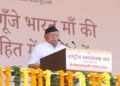
Addressing a commitment programme organised for departments under the Ministries of Agriculture & Farmers Welfare and Rural Development at the C. Subramaniam Auditorium in Pusa, Chouhan said agriculture and food processing would remain important pillars in India’s efforts to become a developed nation.
The Minister administered a collective pledge to officials, employees, scientists, farmers, Lakhpati Didis, food processors, exporters and FPO representatives to contribute towards building a developed, prosperous, self-reliant and empowered India.
Minister of State for Agriculture Bhagirath Choudhary and Dr Chandra Shekhar Pemmasani, along with the Secretaries of the four departments, were also present at the programme.
Focus shifts from farm production to global markets
Chouhan said increasing agricultural production alone would not be enough to significantly improve farmers’ incomes. He called for greater attention to quality, food safety, processing, packaging and compliance with international standards.
India produces a wide range of agricultural commodities, including spices, fruits, flowers and traditional food products. According to Chouhan, improving the quality of these products and connecting farmers with processing, branding and export networks could create greater value and substantially increase farm incomes.
He said “farm to global market” should become a central focus of agricultural development, with farmers, processors and exporters working as interconnected parts of a single value chain.
The Minister also highlighted the growing demand for natural, organic and chemical-free agricultural products. Farmers, he said, should have greater access to technical guidance, market intelligence and modern processing infrastructure to take advantage of changing consumer preferences.
State and district-specific agricultural roadmaps
Chouhan called for agricultural roadmaps to be prepared not only at the national level but also separately for every state and district.
He said agricultural planning must account for local differences in climate, soil, water availability and cropping patterns. Demand in domestic and international markets should also be assessed so that farmers can be guided towards crops and products with greater market potential.
The Department of Agricultural Research and Education (DARE), Indian Council of Agricultural Research (ICAR), Krishi Vigyan Kendras, state governments and other institutions should work together to ensure that new technologies and scientific innovations reach farmers, he said.
Chouhan also stressed greater adoption of mechanisation, artificial intelligence, improved seeds and modern farming practices to increase agricultural productivity.
Higher production, lower costs and better returns
The Minister outlined three broad priorities for strengthening agriculture — increasing production, reducing cultivation costs and improving quality while ensuring remunerative returns for farmers.
He said farmers should receive timely information on weather, markets and production practices. Greater attention should also be given to natural and organic farming, irrigation, water conservation, crop diversification and other agriculture-based income opportunities.
Chouhan advocated integrated farming systems and locally suitable agricultural models that can help farmers diversify their sources of income and reduce dependence on a single crop or activity.
He said the progress achieved in agriculture should be treated as a milestone rather than the final destination, with new targets to be pursued as part of the broader vision of a developed India by 2047.
Three crore Lakhpati Didis target achieved
Highlighting the role of rural women in strengthening the rural economy, Chouhan said the government had achieved its target of creating three crore Lakhpati Didis and was now working towards creating six crore Lakhpati Didis.
He said members of Self-Help Groups would be supported through skill development, financial assistance, entrepreneurship opportunities and improved market access.
Initiatives such as ‘She-Marts’ and stronger branding, he said, could help take products made by rural women, including handicrafts, food products, Ayurvedic products and traditional goods to markets across India and abroad.
Chouhan said women’s empowerment should not be viewed merely through the lens of an increase in individual income. Economically empowered women, he said, strengthen families, villages and the wider rural economy.
Development must be visible at village level
Chouhan said the goal of building a developed India could not be achieved without the development of rural areas.
He called for greater focus on pucca houses, roads, water conservation, employment, livelihoods, women’s empowerment and agriculture-based economic activities. The impact of government schemes, he said, should be visible at the village and beneficiary levels.
The Minister urged officials and employees to regularly visit the field instead of relying exclusively on office-based assessments. He also called for better coordination between government data and ground-level realities.
He stressed faster implementation of programmes related to water security, river rejuvenation, land-resource conservation and rural livelihoods.
Chouhan gives four principles for officials
Urging government officials and employees to remain committed to their responsibilities, Chouhan outlined four principles: “Paanv mein chakkar, munh mein shakkar, seene mein aag aur maathe par barf.”
Explaining the phrase, he said “paanv mein chakkar” means regularly visiting the field and reviewing implementation on the ground. “Munh mein shakkar” refers to maintaining a cordial and respectful approach towards colleagues and citizens.
“Seene mein aag”, he said, represents determination, commitment and passion towards work, while “maathe par barf” signifies patience, composure and balance while dealing with difficult situations.
He urged officials not to be discouraged by setbacks and to continue working with persistence and patience to achieve development targets.
Farmers, scientists and industry to work together
Chouhan said closer coordination among farmers, scientists, government officials, processors, exporters, FPOs and Self-Help Groups would be essential for strengthening India’s agricultural value chain.
Agricultural research institutions and Krishi Vigyan Kendras, he said, should focus on developing solutions based on the actual requirements of farmers. Stronger connections between farms and markets could simultaneously improve farmer incomes and provide consumers with better-quality products.
During the programme, farmers, Lakhpati Didis, exporters and FPO representatives shared their experiences and suggestions.
Lalita spoke about women’s empowerment and the Lakhpati Didi initiative, while Vinod Kumar Saini discussed agricultural production, technology and market-related issues. Mukesh Jain shared suggestions on food processing and marketing, while Praful Goswami spoke about connecting FPOs and farmers more effectively with markets.
Four departments present their roadmaps
Secretaries of the four departments outlined their respective priorities during the programme.
Dr Mangilal Jat, Secretary, Department of Agricultural Research and Education and Director General of ICAR, presented priorities related to agricultural research, technology and scientific innovation.
Atish Chandra, Secretary, Department of Agriculture & Farmers Welfare, discussed agricultural production, farmers’ incomes and improvement in the quality of agricultural output.
Rohit Kansal, Secretary, Department of Rural Development, highlighted the Lakhpati Didi initiative, rural livelihoods and efforts to develop prosperous villages.
Narendra Bhushan, Secretary, Department of Land Resources, outlined priorities related to land conservation, water management and improved utilisation of natural resources.
At the conclusion of the programme, Chouhan administered a collective pledge calling upon participants to work towards the objectives of ‘Shakti Ki Saptadhara’, including strengthening agriculture, expanding food processing, improving farmers’ incomes, taking Indian agricultural products to global markets and empowering rural women.
He said fulfilling the vision of a developed India would require collective resolve, institutional coordination and sustained efforts from everyone associated with agriculture and rural development.